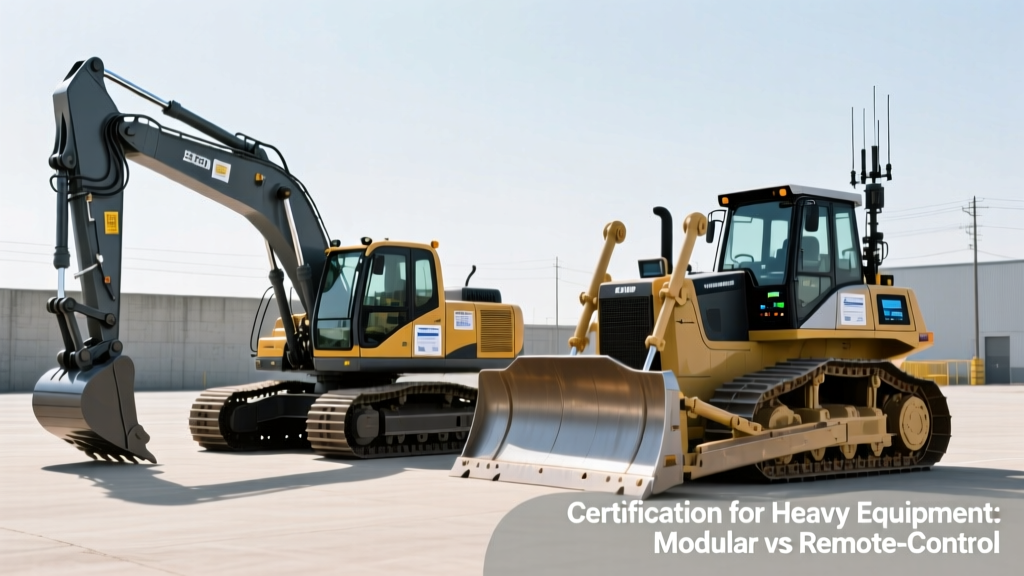
Certification for Heavy Equipment: Modular vs Remote-Control
Compare certification for heavy equipment operators focusing on modular attachments vs remote-controlled machinery. Costs, requirements, and ROI inside.
Core Analysis: As construction and mining fleets integrate advanced machinery, standard operator credentials are no longer sufficient. This guide compares the certification for heavy equipment operators specializing in modular attachment systems versus remote-controlled teleoperation, detailing exact costs, regulatory baselines, and technical competency requirements.
The Regulatory Baseline for Advanced Machinery
Standard heavy equipment operator licenses generally cover baseline hydraulic excavation and material handling. However, when machinery deviates from the traditional cab-and-boom configuration, regulatory bodies require specialized validation. Under OSHA 1926.1427, operators must be certified or qualified for the specific type and configuration of equipment they run. This mandate creates two distinct certification tracks for modern fleets: modular attachment integration (e.g., tiltrotators, hydraulic quick couplers) and remote-controlled teleoperation (e.g., demolition robots, autonomous-assist dozers).
Choosing between these tracks—or cross-training a workforce across both—requires a clear understanding of the cognitive and mechanical competencies each certification demands.
Modular Equipment Certification: Managing Dynamic Load Centers
Modular heavy equipment relies on quick-coupling systems and advanced wrist attachments, such as the Engcon EC209 or Steelwrist SQ60-5 tiltrotators, paired with compact excavators like the Mecalac 12MXT. Certification for these systems focuses heavily on dynamic load management and hydraulic circuit integration.
Key Competency Modules
- Dynamic Load Chart Interpretation: Unlike a fixed bucket, a tiltrotator adds 400 to 800 lbs of weight at the end of the boom, shifting the machine's center of gravity. Certified operators must calculate real-time lift capacities when the wrist is tilted at 45-degree angles.
- Hydraulic Flow Calibration: Operators must demonstrate proficiency in matching auxiliary hydraulic flow (measured in GPM or L/min) to specific modular attachments, such as switching from a 15 GPM grapple to a 40 GPM hydraulic breaker without blowing hose seals.
- Coupler Safety Protocols: Training includes strict verification of semi-automatic vs. fully automatic pin-grabbing couplers, focusing on the mechanical indicators and secondary locking pins required to prevent attachment drop-offs.
Remote-Controlled Certification: Mastering Teleoperation and Latency
Remote-controlled heavy equipment removes the operator from the cab, relying on radio frequency (RF) or 5G cellular networks to transmit joystick inputs to machinery like the Brokk 70 demolition robot or Caterpillar D11 dozers equipped with Cat MineStar Command. NCCCO and specialized OEM programs evaluate an operator's ability to manage sensory deprivation and network latency.
Key Competency Modules
- Latency Compensation: Operators are trained to anticipate machine response delays. For precision grading via remote control, network latency must remain under 100 milliseconds. Certification requires operating effectively in environments where latency spikes to 150-200ms.
- Depth Perception and Spatial Awareness: Without a physical cab, operators lose vestibular feedback and stereoscopic depth perception. Training utilizes multi-camera arrays and LiDAR overlays on the remote control unit (RCU) to navigate blind spots.
- BVLOS and Line-of-Sight Regulations: For beyond-visual-line-of-sight (BVLOS) operations, such as remote mining dozers, certification includes advanced telemetry reading and emergency stop (E-stop) protocol execution when video feeds drop.
'The hardest part of certifying a remote dozer operator isn't teaching them how to push dirt; it is rewiring their brain to trust the LiDAR proximity sensors when their camera feed drops due to dust interference.' — Senior Field Trainer, Autonomous Mining Systems
Cost, Time, and ROI Comparison Matrix
Fleet managers must weigh the upfront investment against the operational flexibility each certification provides. The table below outlines the current market averages for third-party and OEM credentials.
| Feature | Modular Attachment Certification | Remote-Controlled Teleoperation |
|---|---|---|
| Average Training Time | 16 to 24 hours (2-3 days) | 40 to 80 hours (1-2 weeks) |
| Estimated Cost per Operator | $800 - $1,400 | $3,500 - $6,200 |
| Primary Certifying Bodies | NCCCO, AEM, OEM Dealerships | OEM Direct (Cat, Komatsu, Brokk) |
| Recertification Interval | Every 5 years | Every 3 years (or post-incident) |
| Insurance Premium Impact | Reduces liability by 5-8% | Reduces liability by 15-22% |
Decision Framework: Which Certification Tracks to Prioritize?
Use the following operational criteria to determine which certification pathway yields the highest return on investment for your specific fleet deployment.
Prioritize Modular Certification If:
- Your fleet operates primarily in urban environments with strict footprint constraints, requiring a single compact excavator to perform digging, grading, and demolition via quick-coupler swaps.
- You utilize tiltrotators on more than 40% of your excavator fleet to reduce manual labor in trenching and pipe-laying applications.
- Your primary safety concern is attachment detachment and hydraulic hose failures at the boom tip.
Prioritize Remote-Controlled Certification If:
- Your operators work in hazardous environments, such as active demolition zones, unstable slopes, or underground mining shafts, where human presence in the cab violates site safety plans.
- You are deploying semi-autonomous fleet systems (e.g., Cat Command) that require operators to manage multiple machines simultaneously from a centralized control room.
- Your insurance provider mandates specialized teleoperation credentials to underwrite policies for heavy machinery operating near high-voltage infrastructure or blast zones.
Alternative Pathways: Simulator-Based and OEM Credentials
For companies hesitant to commit to full-scale field certifications, alternative pathways offer a bridge to compliance and competency.
Simulator-Based Credentials: Organizations like CM Labs offer Vortex simulator training that replicates the exact physics of modular load shifts and remote-control latency. While a simulator certificate does not replace an OSHA-mandated practical exam, it reduces the required field-training hours by up to 30%, significantly cutting equipment wear and fuel costs during the learning phase.
OEM-Specific vs. Third-Party: While third-party certifications (like NCCCO) are widely recognized across state lines and multiple job sites, OEM-specific certifications are often mandatory for warranty compliance. For instance, operating a Husqvarna DXR 310 remote demolition robot without completing the manufacturer's proprietary 40-hour teleoperation course can void the machine's hydraulic pump warranty if a failure occurs due to improper E-stop sequencing.
Fleet Manager Tip: When drafting your annual training budget, allocate funds for OEM recertification specifically for remote-controlled assets. The software governing teleoperation latency and camera telemetry receives over-the-air (OTA) updates annually, and operators must be re-qualified on the latest user interface layouts to maintain compliance.