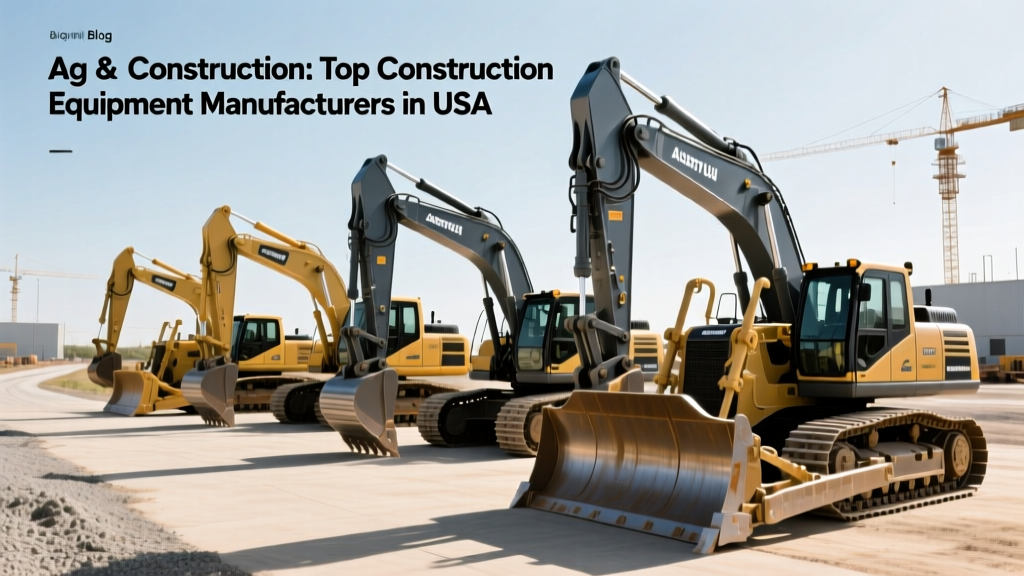
Ag vs Construction: Top Construction Equipment Manufacturers in USA
Compare agricultural vs construction heavy equipment. Discover top construction equipment manufacturers in USA, pricing, specs, and buying frameworks.
The Core Divide: Soil Preservation vs. Earthmoving Force
Land developers, large-scale farming operations, and rural municipalities frequently face a critical procurement crossroads: should you deploy agricultural heavy equipment or dedicated construction machinery for land clearing, site preparation, and earthmoving? While a high-horsepower tractor and a crawler dozer may share similar engine displacement, their engineering philosophies are fundamentally opposed. Understanding these mechanical differences is essential before evaluating the leading construction equipment manufacturers in USA markets for your next fleet acquisition.
Agricultural machinery is engineered around the principle of soil preservation and high-flow implement support. The primary goal is to maximize traction while minimizing ground compaction, which destroys soil structure and reduces crop yields. Conversely, construction equipment is designed for brute force, high ground pressure, and extreme hydraulic breakout forces. Using an agricultural tractor for heavy dozing or rock breaking not only results in catastrophic inefficiency but routinely voids manufacturer warranties and accelerates structural fatigue.
Mechanical Specifications Matrix: Ag vs. Construction
| Specification | Agricultural Tractor (e.g., John Deere 8R 410) | Construction Dozer (e.g., Caterpillar D6) |
|---|---|---|
| Ground Pressure (PSI) | 10 - 16 PSI (via IF/VF Radial Tires) | 14 - 22 PSI (via Steel Tracks / Wide Pads) |
| Hydraulic System Focus | High Flow (up to 110 GPM) at ~2,500 PSI | High Pressure (up to 5,000+ PSI) at ~150 GPM |
| Transmission Type | IVT / CVT (Continuous speed for PTO implements) | Powershift / Hydrostatic (Torque multiplication) |
| Chassis & Frame | Articulated or Flexible Axle (for uneven terrain) | Rigid Box-Section Frame (for heavy blade loads) |
| Primary Power Take-Off | Rear PTO (1000 RPM) for seeders/mowers | Front PTO / Hydraulic Quick Couplers for attachments |
Evaluating Construction Equipment Manufacturers in USA for Dual-Purpose Needs
When sourcing machinery for operations that blur the line between farming and site development, buyers must scrutinize the domestic manufacturing footprints of major OEMs. Relying on top construction equipment manufacturers in USA-based facilities ensures faster parts availability, localized telemetry support, and adherence to domestic emissions standards (EPA Tier 4 Final / Stage V).
Domestic Production Hubs & Supply Chain Realities
- Caterpillar (Peoria & Decatur, IL): Cat's domestic crawler tractor and motor grader lines benefit from localized supply chains. In 2026, sourcing a Cat D6 or D8 from Illinois-based dealers typically guarantees undercarriage replacement parts within 48 hours, a critical metric for minimizing downtime during short construction seasons.
- John Deere (Waterloo, IA): The Waterloo facility produces the massive 7R, 8R, and 9R series tractors. While these are agricultural icons, their 400+ horsepower engines and heavy-duty drawbars make them popular for light land-clearing and snow pushing. However, Deere's telematics (JDLink) are optimized for agronomic data, not cut-and-fill grading metrics.
- Case Construction Equipment (Racine, WI & Wichita, KS): Case bridges the gap effectively. Their Racine facility produces heavy compactors and dozers, while their agricultural lineage (CNH Industrial) allows for shared powertrain components across divisions, simplifying maintenance for mixed-fleet operators.
According to industry data tracked by the Construction Equipment Association, up to 18% of premature powertrain failures in high-horsepower agricultural tractors occur when owners use them for unapproved construction tasks like heavy rock dozing or pulling scrapers beyond rated limits. OEMs monitor hydraulic pressure spikes and PTO abuse via onboard ECMs. If your telematics show sustained high-load, low-speed dozing on an 8R series tractor, your warranty claim will likely be denied.
Head-to-Head Matrix: John Deere 8R 410 vs. Caterpillar D6
To illustrate the practical differences in equipment selection, let us compare two flagship models from top-tier manufacturers, analyzing their 2026 market positioning, pricing, and operational limits.
John Deere 8R 410 (Agricultural Heavyweight)
- Base Price Range (2026): $480,000 - $560,000 (depending on AutoTrac and precision ag packages).
- Engine: 9.0L PowerTech, 410 rated engine HP.
- Best Use Case: Pulling large air seeders, operating 24-row planters, high-speed tillage, and light snow removal on municipal roads.
- Limitation: Lacks the rigid blade-mounting architecture required for precision grading. The rear axle is designed for pulling, not pushing massive lateral loads.
Caterpillar D6 (Construction Crawler Dozer)
- Base Price Range (2026): $360,000 - $430,000.
- Engine: 9.3L Cat C9.3B, 215 net HP (optimized for torque at low RPMs).
- Best Use Case: Fine grading, heavy clay dozing, forestry mulching, and trench backfilling.
- Limitation: Steel tracks will severely compact topsoil, making it unsuitable for agricultural field preparation unless equipped with specialized (and expensive) low-ground-pressure swamp pads.
For deeper insights into fleet utilization and safety standards across these machine classes, the Association of Equipment Manufacturers (AEM) provides extensive guidelines on operator certification and attachment compatibility matrices.
Total Cost of Ownership (TCO) and Resale Realities
The financial calculus of buying agricultural versus construction equipment extends far beyond the initial invoice. Depreciation curves and maintenance schedules diverge sharply after the 3,000-hour mark.
The Depreciation Curve
Agricultural tractors generally experience a steep initial depreciation (15-20% in year one) but stabilize remarkably well between years three and seven, provided the PTO and hydraulic pumps remain in spec. A well-maintained John Deere 8R with 4,000 hours can still command 55% of its original MSRP at auction.
Construction dozers, however, are entirely dependent on undercarriage condition. The undercarriage represents roughly 50% of a crawler's maintenance budget. If a Cat D6 is operated in highly abrasive rock environments without frequent track tension adjustments and roller frame cleaning, its resale value can plummet by 30% regardless of engine health. Buyers in the secondary market will immediately deduct $25,000 to $40,000 for a required undercarriage overhaul.
Emissions and DPF Servicing
Both machine classes utilize Diesel Particulate Filters (DPF) and Diesel Exhaust Fluid (DEF). However, construction equipment frequently operates at high load factors (80%+), which naturally generates the exhaust heat required for passive DPF regeneration. Agricultural tractors often experience variable loads (e.g., idling at headlands, then spiking during PTO engagement), leading to active regeneration cycles that consume excess fuel and, if interrupted, can cause severe DPF clogging requiring $4,500+ off-machine baking services.
2026 Decision Framework: Which Fleet Fits Your Operation?
Do not rely on generic dealer pitches. Use this actionable framework to determine which equipment category your capital should target this year.
Choose Agricultural Heavy Equipment If:
- Your primary revenue is crop yield or livestock management. Soil compaction from construction tracks will cost you 5-10% in localized yield losses over a five-year period.
- You require high-flow, low-pressure hydraulics. If you are running pneumatic seeders, liquid fertilizer applicators, or large rotary mowers, the 110+ GPM flow rates of Ag tractors are non-negotiable.
- You need high-speed road transit. Modern Ag tractors with CVT transmissions can legally and safely travel at 25-31 MPH on public roads to reach distant parcels, whereas construction dozers require low-boy trailers and CDL transport.
Choose Construction Equipment If:
- Your work involves pushing, lifting, or breaking. If you are moving more than 1,500 cubic yards of dirt weekly, clearing heavy timber, or using hydraulic hammers, the rigid chassis and high-pressure hydraulics of construction gear are mandatory.
- Precision grading is required. If you are integrating 3D GPS machine control (e.g., Trimble Earthworks or Topcon) for site leveling, construction dozers and motor graders offer the blade responsiveness and IMU integration that Ag tractors lack.
- You operate in abrasive or rocky terrain. Steel tracks and sealed, oil-bathed final drives will survive rock quarries and demolition sites that would destroy agricultural rubber tires and exposed axle housings in a matter of weeks.
Ultimately, the most successful multi-disciplinary contractors in 2026 maintain a bifurcated fleet. They leverage domestic agricultural manufacturers for high-speed, low-impact material handling and planting, while relying on specialized construction OEMs for the heavy, high-stress earthmoving that forms the foundation of site development. Align your procurement strategy with the physics of your daily operations, not just the horsepower on the spec sheet.