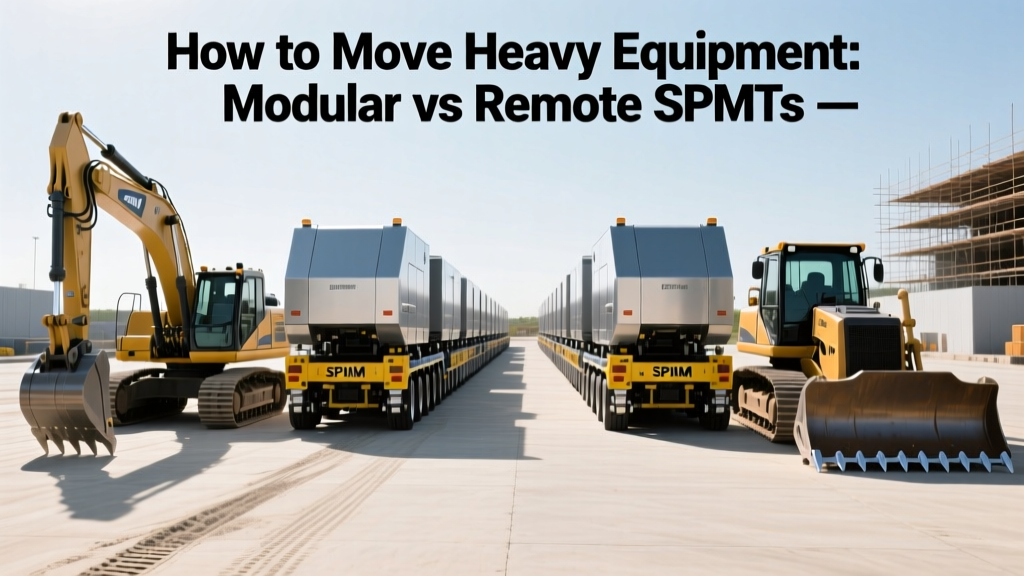
How to Move Heavy Equipment: Modular vs Remote SPMTs
Learn how to move heavy equipment by comparing modular hydraulic trailers and remote-controlled SPMTs. Discover payload specs, costs, and use cases.
Moving loads exceeding 200 metric tons requires abandoning standard flatbeds in favor of multi-axle modular systems. When project managers evaluate how to move heavy equipment across short fabrication yards versus long-haul highway routes, the decision narrows to two distinct technologies: Towed Modular Hydraulic Trailers (MHT) and Remote-Controlled Self-Propelled Modular Transporters (SPMT). Selecting the wrong system results in catastrophic routing failures, massive permit delays, or unnecessary capital expenditure.
This analysis breaks down the mechanical capabilities, procurement costs, and operational limits of both systems to help heavy-haul logistics teams specify the exact equipment required for their next mega-load transport.
The Engineering Divide: Towed vs. Self-Propelled
The fundamental difference between these systems lies in their power delivery and steering mechanics. Modular hydraulic trailers rely on a prime mover (a heavy haul tractor) for both propulsion and steering initiation. The tractor’s fifth wheel or drawbar turns a hydraulic pump that mechanically links to the trailer’s steering axles. This limits the steering angle and requires a massive turning radius.
Conversely, remote-controlled SPMTs are entirely self-propelled. A separate Power Pack Unit (PPU) pushes hydraulic fluid to hydrostatic drives mounted directly inside each axle. Steering is controlled via a wireless remote pendant, allowing independent rotation of every single axle. This engineering distinction dictates where each system can physically operate.
Technical Specification Matrix
| Feature | Modular Hydraulic Trailer (MHT) | Remote-Controlled SPMT |
|---|---|---|
| Prime Mover | Heavy Haul Tractor (e.g., Kenworth C500) | Power Pack Unit (PPU) |
| Payload per Axle Line | 12 to 20 metric tons | 40 to 48 metric tons |
| Steering Angle | ±40° to ±60° (Hydraulic linkage) | ±130° (Hydrostatic independent) |
| Max Speed (Loaded) | 40 - 80 km/h (Highway capable) | 5 - 10 km/h (Yard/terminal only) |
| Suspension | Pendulum or hydraulic cylinder | Hydraulic cylinder (3-point support) |
| Primary Use Case | Long-distance over-the-road transport | Short-distance precision placement |
Remote-Controlled SPMTs: Precision and Extreme Payloads
Self-Propelled Modular Transporters dominate the heavy-lift sector for moving offshore oil modules, shipyard blocks, and aerospace components. The industry standard is set by manufacturers like the TII Group (Scheuerle) and Cometto. Modern 2026 SPMT configurations utilize 6-cylinder, Tier 5 Final diesel PPUs delivering up to 500 horsepower to the hydraulic network.
Hydrostatic Drive and Carousel Steering
Because each axle on an SPMT is individually driven and steered, operators can execute a 'carousel' maneuver. By turning all axles 90 degrees to the trailer's longitudinal axis, the SPMT drives sideways. By angling the axles toward a central geometric point, the entire load can rotate 360 degrees around its own center of gravity. This is non-negotiable for navigating tight fabrication yards where traditional turning radii are impossible.
Warning: PPU Synchronization LimitsWhile SPMTs can be coupled together to carry 5,000+ ton loads, synchronizing more than four PPUs via CAN-bus networks introduces latency risks. For ultra-heavy tandem configurations, ensure your lead operator is certified in multi-PPU electronic synchronization to prevent hydraulic line ruptures caused by opposing drive vectors.
Modular Hydraulic Trailers: Highway Efficiency
If the cargo must travel 400 miles over public highways, SPMTs are useless; their top speed of 10 km/h would cause gridlock and violate Department of Transportation (DOT) regulations. For over-the-road transit, fleets deploy Modular Hydraulic Trailers like the Faymonville MultiMAX or Goldhofer THP series.
Pendulum Axles and Ground Pressure
Highway modular trailers utilize pendulum axles or hydraulic cylinder suspensions that offer up to 600mm of vertical stroke. This allows the trailer to absorb road camber and maintain a perfectly level load deck. Furthermore, because MHTs use standardized highway tires (typically 235/75 R 17.5 or 245/70 R 17.5) spread across 8 to 22 axle lines, they distribute weight to meet strict state bridge formula laws, allowing legal transit over public infrastructure without requiring expensive temporary bridge reinforcement.
Decision Framework: How to Move Heavy Equipment Based on Route
Use this logic tree to specify the correct equipment for your transport contract:
- IF the transport distance is under 5 miles AND requires placement within a confined facility → Specify Remote SPMTs.
- IF the load exceeds 1,500 tons AND the route is strictly on private, paved industrial yards → Specify Remote SPMTs (MHTs would require an unmanageable number of axle lines and tractors).
- IF the transport involves public highways, bridges, or distances over 10 miles → Specify Modular Hydraulic Trailers.
- IF the load is a long, flexible structure (like a wind turbine blade or bridge girder) requiring variable spacing → Specify Schnabel-type Modular MHTs to allow the load to act as the trailer's structural spine.
Capital Expenditure and Operational Cost Breakdown
Procurement strategies for these systems differ vastly. Heavy haul fleets must account for the base hardware, the power source, and the ongoing maintenance of high-pressure hydraulics.
| Cost Category | Modular Hydraulic Trailer (MHT) | Remote-Controlled SPMT |
|---|---|---|
| Hardware Cost (Per Axle Line) | $18,000 - $25,000 | $45,000 - $60,000 |
| Power Source Cost | $250,000 - $350,000 (Heavy Tractor) | $450,000 - $550,000 (500HP PPU) |
| Operator Requirement | 1 Tractor Driver + 1 Trailer Steersman | 1 Remote Pendant Operator + 1 Spotter |
| Maintenance Focus | Kingu pins, tie-rods, tractor drivetrain | Hose integrity, hydrostatic wheel motors |
Hidden Operational Costs
When calculating the total cost of ownership, factor in hydraulic hose replacement. An SPMT utilizes high-pressure hoses routed through the center of the chassis to connect axle lines. In harsh marine or fabrication yard environments, these hoses degrade rapidly. Budget approximately $12,000 annually per 10-axle SPMT module purely for preventative hydraulic hose and fitting replacements. MHTs, operating at lower hydraulic pressures and protected by highway mudguards, incur roughly 40% less hydraulic maintenance.
Final Procurement Strategy
There is no universal solution for moving mega-loads. Remote-controlled SPMTs are unmatched for extreme point-loads and millimeter-precise maneuvering in industrial yards, justifying their high per-axle cost and low travel speeds. Modular hydraulic trailers remain the undisputed standard for integrating massive payloads into public highway networks, leveraging heavy tractors for speed and pendulum axles for road compliance. Match the equipment to the route geometry, not just the cargo weight.