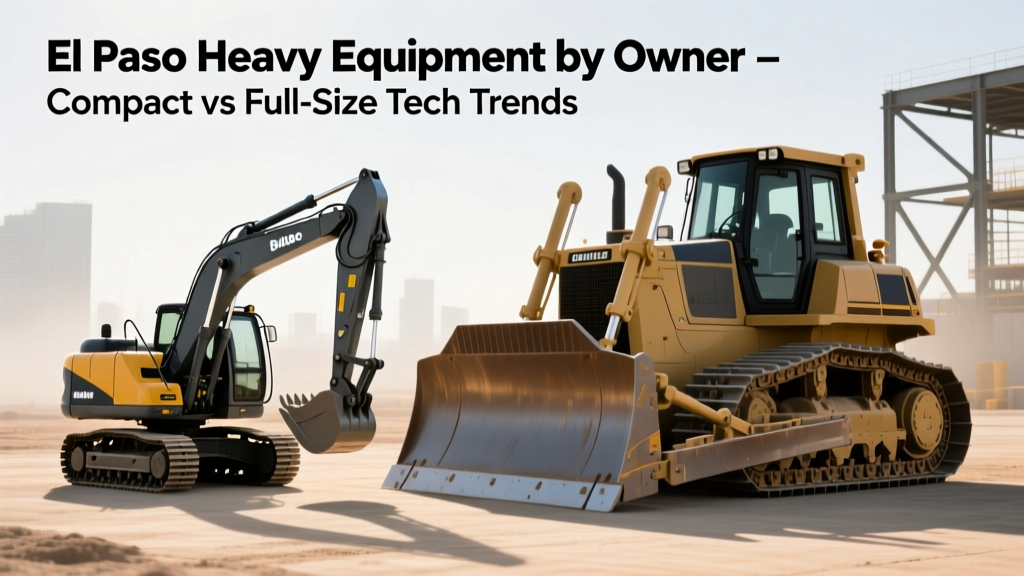
El Paso Heavy Equipment by Owner: Compact vs Full-Size Tech Trends
Evaluate El Paso heavy equipment by owner listings. Compare 2026 compact vs full-size tech trends, telematics, and electrification for Southwest projects.
Navigating the Direct-Sale Market in the Southwest
Acquiring el paso heavy equipment by owner presents a unique arbitrage opportunity for regional contractors. Bypassing dealer lots eliminates the typical 12% to 18% retail markup, but it shifts the burden of technological verification entirely onto the buyer. In the El Paso market, where expansive caliche soils and summer ambient temperatures routinely exceeding 105°F dictate machine survival, the choice between compact and full-size equipment is no longer just about physical dimensions. It is fundamentally a decision about thermal management architecture, telematics integration, and auxiliary hydraulic flow rates.
According to recent market analyses by Equipment World, the secondary market for direct-owner sales has seen a surge in tech-enabled compact machines, fundamentally altering the traditional ROI calculations for Southwest earthmoving and utility contractors.
Market Insight: When purchasing direct from an owner in the Borderland region, always verify the machine's geofence history. Equipment previously operated in high-dust environments (like the limestone quarries near Hueco Mountains) requires significantly more aggressive HVAC and radiator fin maintenance than machines used in residential El Paso zoning.Telematics: The Ultimate "By Owner" Verification Tool
Historically, buying heavy machinery from a private owner meant trusting a handwritten maintenance log. In 2026, the standard for verification is OEM telematics. Modern compact machines, such as the Cat 301.7 CR or the Bobcat E19z, and full-size counterparts like the Cat 330 or John Deere 380G LC, are equipped with advanced Telematics Control Modules (TCM).
When evaluating an owner-sold listing, demand temporary access to the OEM portal (e.g., Cat Connect or Bobcat Machine IQ). You are looking for three specific data points that separate a well-maintained machine from an abused one:
- Idle Time vs. Active Work Ratio: Excessive idling (over 40% of total engine hours) in full-size diesel machines indicates poor site management by the previous owner and accelerated DPF (Diesel Particulate Filter) clogging, a common failure point in stop-and-go urban utility work.
- Hydraulic Pressure Spikes: Frequent relief valve actuations logged in the TCM suggest the previous owner routinely used undersized breakers or pushed the machine beyond its auxiliary flow limits, leading to micro-fractures in the boom cylinders.
- Thermal Derating Events: Crucial for El Paso summers. If the engine control module (ECM) logs frequent thermal derating, the machine's cooling package is compromised or undersized for the local climate.
Compact vs. Full-Size: 2026 Technology Decision Matrix
The Association of Equipment Manufacturers (AEM) notes that the technological gap between compact and full-size equipment has narrowed significantly, particularly in cab ergonomics and digital grade control. However, physical limitations still dictate specific use cases in hardpan and caliche conditions.
| Technological Feature | Modern Compact (e.g., Cat 301.7 CR / Bobcat E19z) | Full-Size (e.g., Cat 330 / JD 380G LC) |
|---|---|---|
| Auxiliary Hydraulic Flow | 15 - 25 GPM (Standard/High-Flow) | 140 - 185 GPM (Multi-Combined Circuits) |
| Telematics Depth | Fault codes, location, basic fuel/DEF tracking | Payload weighing, 3D grade control integration, predictive maintenance AI |
| Thermal Management | Standard liquid cooling; prone to derating at 110°F+ under heavy load | Demand-driven variable-speed fans; optimized for sustained 115°F+ desert operations |
| Electrification Status | Widespread (Battery-electric models readily available in secondary market) | Limited (Mostly diesel-hybrid; full electric still rare in 30-ton class) |
| Typical Owner-Sale Price (2026) | $85,000 – $125,000 | $275,000 – $360,000 |
Electrification and Thermal Realities in the Chihuahuan Desert
The most significant technology trend impacting the El Paso heavy equipment by owner market is the influx of battery-electric compact excavators and loaders. Contractors are increasingly selling 3-to-5-year-old electric compacts as they upgrade to newer solid-state battery models. These machines offer zero emissions and near-silent operation, making them highly desirable for indoor commercial retrofits and noise-restricted municipal projects in El Paso.
However, buyers must scrutinize the battery thermal management system (TMS). Early-generation electric compacts relied on passive air cooling for their lithium-ion packs. In the Southwest, ambient heat combined with the internal heat generated during continuous digging cycles can cause the Battery Management System (BMS) to throttle power output to prevent thermal runaway. When inspecting an owner-sold electric compact, verify that the machine utilizes an active liquid-cooled TMS. According to Caterpillar engineering specifications, liquid-cooled systems maintain optimal cell temperatures between 77°F and 95°F, regardless of external desert conditions, preserving the long-term State of Health (SoH) of the battery cells.
Caliche Soil Penetration: The Physics of Downforce
El Paso's caliche layer acts like poorly cured concrete. While modern compact machines feature advanced hydraulic thumb attachments and tilt-rotators, they simply lack the physical mass and hydraulic breakout force required to fracture deep caliche without pre-ripping. A full-size machine like the John Deere 380G LC generates over 44,000 lbf of bucket breakout force, compared to the roughly 9,000 lbf of a compact 1.7-ton class machine. If your primary workflow involves trenching through undisturbed desert hardpan, full-size equipment remains a non-negotiable requirement, regardless of the compact machine's advanced digital features.
Step-by-Step Tech Inspection for Direct Purchases
When meeting an owner to finalize a purchase, execute this technology-focused inspection protocol to ensure the machine's digital and mechanical systems align:
- Initiate the OEM Portal Transfer: Do not accept a machine where the telematics subscription is lapsed. Require the owner to initiate the digital ownership transfer in the OEM's cloud portal while you are present, ensuring you inherit the historical machine data.
- Inspect the TCM Physical Seal: Locate the Telematics Control Module (usually behind the cab seat or in the battery compartment). Verify the OEM tamper-evident seal is intact. A broken seal indicates the previous owner may have attempted to install third-party bypass chips to mask emissions faults or alter hour meters.
- Test the 3D Grade Control Sensors (If Equipped): For full-size machines equipped with GNSS masts and cab tablets, power up the system and check for satellite lock times. In El Paso's open sky, lock time should be under 45 seconds. Delays suggest degraded antenna cables or failing base station receivers.
- Verify Auxiliary Circuit Pressures: Hook up a physical flow meter to the auxiliary hammer circuit. Compare the physical GPM reading at 2,500 RPM against the digital readout on the cab monitor. Discrepancies greater than 8% indicate failing internal hydraulic pump swash plates or a miscalibrated digital sensor.
Total Cost of Ownership: Factoring in Local Tech Support
The purchase price of owner-sold equipment is only the entry fee. The true cost lies in maintaining the technology stack. Full-size machines with complex predictive AI and integrated payload scales require specialized software licenses and certified technicians for recalibration. In the El Paso region, dealer service routes can be stretched thin, meaning downtime for a software-related fault on a full-size machine can easily span 48 to 72 hours.
Conversely, modern compact machines utilize more modular, plug-and-play electronic control units (ECUs). If a sensor fails on a compact electric loader, a competent site mechanic can often swap the component and clear the code via a ruggedized tablet in under an hour. For small-to-mid-sized El Paso contractors managing tight municipal deadlines, the technological simplicity and lower barrier to entry of compact equipment often yield a faster, more predictable return on investment than the high-capability, high-complexity full-size alternatives.
Final Procurement Directive: Limit your search to owner-sold machines manufactured after 2021. Pre-2021 models often lack the advanced liquid-cooled battery architectures and standardized API telematics outputs required to compete in the 2026 contracting landscape. Always tie the final payment to a successful OEM digital ownership transfer.