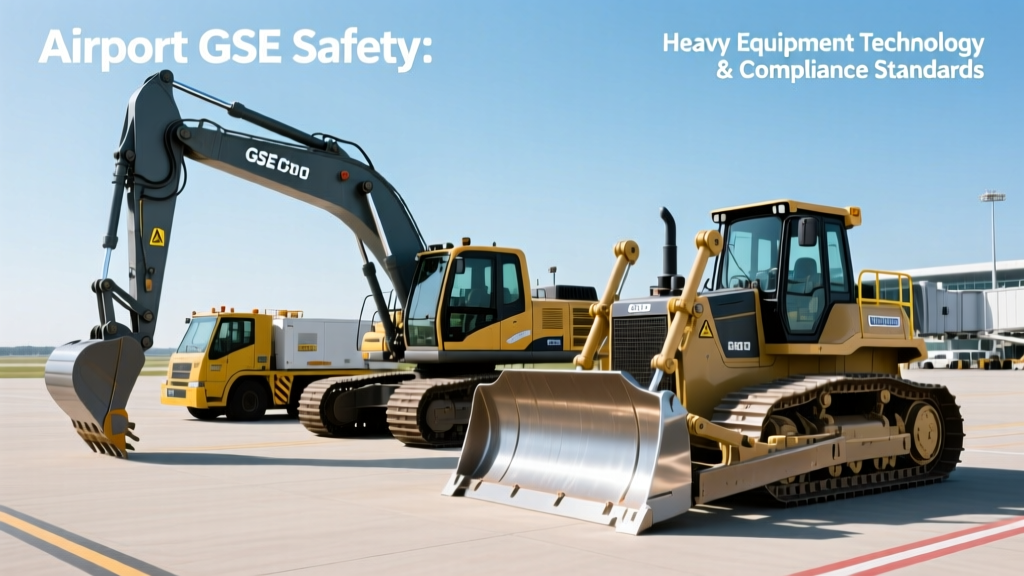
Airport GSE Safety: Heavy Equipment Technology & Compliance Standards
Explore how heavy equipment technology ensures airport GSE safety compliance, covering LiDAR anti-collision, IATA standards, and retrofit costs.
The High-Stakes Apron: Why GSE Compliance Demands Advanced Tech
The airport apron is one of the most unforgiving operational environments in industrial logistics. Ground Support Equipment (GSE)—ranging from 40-ton aircraft pushback tractors to high-reach cargo loaders—operates within inches of multi-million-dollar aircraft fuselages. A single collision can result in hundreds of thousands of dollars in damages, severe flight delays, and critical safety hazards. As of 2026, relying solely on operator training and painted guide lines is no longer sufficient. Integrating advanced heavy equipment technology into GSE fleets is now a strict compliance mandate driven by global aviation authorities and insurance underwriters.
This guide details the specific safety standards governing airport heavy machinery, the exact technological integrations required for compliance, and the financial realities of upgrading legacy GSE fleets.
⚠️ Compliance Warning: The Cost of Apron IncursionsAccording to the International Air Transport Association (IATA), ground damage incidents cost the global aviation industry over $10 billion annually. Modern insurance policies for ground handlers increasingly require documented telematics and active collision avoidance systems to qualify for standard premium rates. Operating legacy GSE without active sensor arrays is now classified as a high-risk liability.
The Regulatory Framework for Apron Heavy Machinery
Safety compliance for airport GSE is not governed by a single body, but rather a matrix of international and local standards. Fleet managers must align their heavy equipment technology deployments with the following core frameworks:
- IATA Airport Handling Manual (AHM 903): Dictates the Safety Management System (SMS) requirements for ground operations, specifically mandating risk mitigation technologies for vehicle-to-aircraft interactions.
- SAE ARP1801 (Aircraft Ground Equipment): Published by SAE International, this Aerospace Recommended Practice outlines the physical and operational safety requirements for GSE design, including visibility zones, braking systems, and emergency stop mechanisms.
- ANSI/ITSDF B56.1: While primarily for industrial forklifts, this standard applies directly to belt loaders and cargo elevators operating on the apron, governing load stability and operator guard requirements.
- NFPA 855: The critical standard for the installation of stationary energy storage systems, which now strictly governs the charging infrastructure for the new generation of lithium-ion electric GSE.
Core Heavy Equipment Technology Integrations for GSE
To meet the 2026 compliance landscape, ground handlers are deploying three primary categories of safety technology across their heavy machinery fleets.
1. LiDAR and Radar Anti-Collision Systems
Standard ultrasonic sensors are inadequate for the vast detection zones required around wide-body aircraft like the Boeing 777 or Airbus A350. Modern compliance requires solid-state LiDAR or 77 GHz radar arrays. Systems utilizing the SICK microScan3 LiDAR provide a 270-degree field of view with a 40-meter detection range. These systems are programmed with virtual 'geofences'—creating a 3-meter warning zone (triggering an audible cab alarm and reducing engine RPM) and a 1-meter critical zone (triggering automatic hydraulic braking).
2. Operator Fatigue and Behavior Monitoring
Apron operations run 24/7, making operator fatigue a leading cause of GSE incidents. In-cabin heavy equipment technology now leverages PERCLOS (Percentage of Eyelid Closure over the Pupil Center) algorithms. Systems like the Seeing Machines Guardian S use infrared cameras to track microsleeps and gaze distraction. If an operator's eyes divert from the primary travel path for more than 2.5 seconds while the vehicle is in motion, the system triggers a haptic seat vibration and logs the event in the fleet telematics dashboard for safety officer review.
3. Electrification and Thermal Runaway Prevention
The shift from diesel to battery-electric GSE (e-GSE) introduces new compliance hazards, specifically lithium-ion thermal runaway. Modern electric pushback tractors, such as the Goldhofer ASTOMAX e, utilize advanced Battery Management Systems (BMS) that monitor individual cell temperatures at 10-millisecond intervals. If a cell exceeds 60°C, the BMS automatically isolates the faulty module and deploys an internal fire-suppression aerosol, a requirement for indoor terminal staging areas.
Equipment-Specific Compliance & Technology Matrix
Different GSE categories face unique hazard profiles, requiring tailored technological solutions to maintain compliance.
| GSE Category | Primary Apron Hazard | Mandatory Tech Integration (2026 Standard) | Governing Standard |
|---|---|---|---|
| Aircraft Pushback Tractors (e.g., TLD TPX-200) | Towbar shear / Fuselage crush | Automated Towbar Angle Sensors & Load Cell Telematics | IATA AHM 964 |
| High-Load Cargo Elevators (e.g., JBT Commander) | Wing/Engine strike during elevation | 3D LiDAR Overhead Proximity Scanners & Auto-Stop | SAE ARP1801 |
| Belt Loaders | Reverse blind-spot collisions | 77 GHz Rear Radar with Active Braking Override | ANSI/ITSDF B56.1 |
| De-Icing Rigs | Fluid overspray / Boom collision | Computer Vision Boom Tracking & Gyro-Stabilization | SAE ARP6257 |
Real-World Implementation: Upgrading Legacy GSE Fleets
Replacing an entire fleet of diesel GSE with new smart-electric models is capital-prohibitive for most ground handlers, with a single electric pushback tractor costing upwards of $350,000. The industry standard approach for 2026 compliance is the targeted retrofitting of legacy equipment with modular heavy equipment technology.
💡 Financial Insight: Retrofit ROIRetrofitting a standard diesel belt loader with a 360-degree LiDAR anti-collision suite and telematics gateway costs between $18,500 and $24,000 per unit. However, ground handlers report a 12% to 18% reduction in annual insurance premiums post-retrofit, alongside a 40% drop in minor apron scrape incidents. The typical ROI timeline for a GSE safety retrofit is 14 to 18 months.
Step-by-Step Retrofit Protocol for Collision Avoidance
- Hydraulic Interface Mapping: Before installing auto-braking, technicians must map the GSE's hydraulic brake pressure curves. Air-over-hydraulic systems require different solenoid valve response times compared to pure hydraulic systems to prevent abrupt, load-shifting stops.
- Sensor Calibration (ISO 13849-1): LiDAR sensors must be calibrated to Performance Level D (PLd). This involves setting the 'masking' parameters so the sensor ignores the aircraft's landing gear struts while detecting the fuselage and ground crew.
- Telematics Gateway Integration: Connect the sensor array to the vehicle's J1939 CAN bus network. This allows the safety system to read engine RPM and ground speed, ensuring that braking interventions are scaled proportionally to the vehicle's momentum.
- Apron Validation Testing: Conduct controlled incursion tests using standardized foam barricades at 5 mph, 10 mph, and 15 mph to verify stopping distances against the manufacturer's declared safety envelopes.
Future-Proofing: Autonomous GSE and SAE Level 4
The frontier of heavy equipment technology on the apron is autonomous GSE. Companies like Webber and AeroBotics are currently deploying Level 4 autonomous tow tractors that operate without a cab operator. Compliance for these units requires a completely different safety architecture, relying on RTK-GPS (Real-Time Kinematic) for centimeter-level positioning and V2X (Vehicle-to-Everything) communication to coordinate with airport surface surveillance radar. As these units become more prevalent, ground handlers must update their SMS to include 'mixed-fleet' protocols, ensuring human-driven GSE can safely share apron lanes with autonomous units.
Frequently Asked Questions (FAQ)
How does heavy equipment technology handle apron snow and ice interference with LiDAR?
Standard LiDAR struggles in heavy snow or freezing rain due to beam scattering. For airports in harsh climates (e.g., Anchorage, Oslo), compliance requires a sensor-fusion approach. Heavy equipment technology packages in these regions combine 77 GHz radar—which penetrates precipitation effectively—with heated LiDAR lenses and ultrasonic backups to maintain redundant detection zones during winter storms.
Are anti-collision systems required on manual pushback tractors?
Yes. While the tractor is moving at low speeds (typically under 3 mph), the mass of the tractor combined with the aircraft requires strict collision avoidance. IATA AHM guidelines mandate that any motorized vehicle approaching an aircraft must have an active, sensor-based warning or stopping mechanism, regardless of the vehicle's top speed.
What is the maintenance interval for GSE safety sensors?
LiDAR and radar arrays on the apron are subjected to jet blast, de-icing fluid (which is highly corrosive to optical lenses), and rubber debris. Manufacturers require optical cleaning and alignment verification every 250 operating hours or every 30 days, whichever comes first. Failure to log this maintenance can void the safety system's compliance certification in the event of an incident investigation.