Safety Compliance in the 2026 Food Processing Machinery Market
Explore how 3-A, EHEDG, and FDA safety standards shape the 2026 food processing machinery market. Learn compliance frameworks and vendor audit tactics.
The Compliance Premium: Why Safety Standards Dictate Market Value
The global food processing machinery market is undergoing a structural shift in 2026. Capital expenditure decisions are no longer driven exclusively by throughput metrics or energy efficiency; hygienic design and regulatory compliance have become the primary determinants of asset valuation. According to industry analyses, non-compliant equipment can increase the risk of product recalls by up to 40%, directly impacting brand equity and operational continuity.
For procurement engineers and plant managers, navigating this market requires a granular understanding of sanitary design principles. A machine that fails to meet basic hygienic criteria—such as maintaining a surface roughness (Ra) of ≤ 0.8 µm on all product-contact surfaces—becomes a liability. In the modern food processing machinery market, the "compliance premium" (the additional 8% to 15% CAPEX for certified hygienic equipment) is rapidly offset by reductions in Clean-In-Place (CIP) water usage, chemical costs, and downtime.
⚠️ WARNING: The Hidden Cost of Harborage PointsPurchasing uncertified slicers or mixers often introduces microscopic harborage points. Listeria monocytogenes can colonize in crevices as small as 0.1 mm. If a vendor cannot provide orbital weld logs and electropolishing certificates for all 316L stainless steel contact zones, the equipment does not belong in a high-care facility.
Core Certifications Shaping the Food Processing Machinery Market
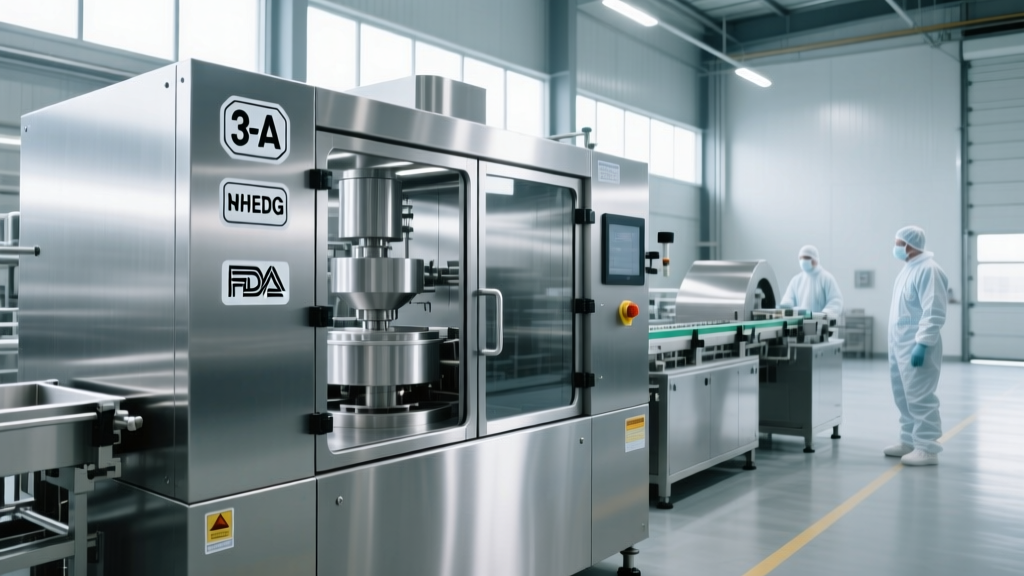
Buyers evaluating the food processing machinery market must filter vendors through the lens of three dominant regulatory and voluntary frameworks. Each serves a distinct operational and geographic purpose.
3-A Sanitary Standards (3-A SSI)
Dominant in North America, particularly within the dairy, beverage, and liquid food sectors, 3-A SSI standards dictate strict criteria for cleanability. For instance, 3-A Sanitary Standard 03-01 specifically governs CIP systems, mandating that internal piping must sustain a turbulent flow velocity of at least 1.5 meters per second (approx. 5 ft/sec) to ensure mechanical scouring of soil.
EHEDG (European Hygienic Engineering & Design Group)
Crucial for manufacturers exporting to or operating within the European Union, EHEDG certification focuses heavily on both wet and dry cleanability. The EHEDG guidelines provide rigorous testing protocols, such as the microbiological swab test and the ribbon test for assessing surface drainage. Equipment bearing the EHEDG logo has passed empirical validation proving it can be cleaned to a microbiologically safe standard.
FDA FSMA & Preventive Controls
While the FDA does not "approve" individual food processing machines, the Food Safety Modernization Act (FSMA) mandates that facilities implement risk-based preventive controls. Procuring machinery that inherently supports these controls (e.g., automated allergen flush valves, enclosed drive motors to prevent grease contamination) is a legal necessity for US-based operators.
Certification Matrix: Navigating the Compliance Landscape
| Standard / Body | Primary Region | Equipment Focus | Key Metric / Requirement | CAPEX Impact |
|---|---|---|---|---|
| 3-A SSI | North America | Dairy, Liquid Foods, CIP | CIP flow ≥ 1.5 m/s; Ra ≤ 0.8 µm | + 8% to 12% |
| EHEDG | Europe / Global | Meat, Bakery, Dry/Wet | Self-draining angles ≥ 3°; No dead legs | + 10% to 15% |
| ISO 22000 | Global | Management Systems | Hazard analysis integration | Indirect (Process) |
| UL / CE (Safety) | NA / EU | Operator Guarding, LOTO | ISO 14120 Guarding compliance | + 5% to 8% |
The 4-Step Vendor Compliance Audit Framework
Marketing brochures frequently misuse terms like "sanitary" or "food-grade." To protect your facility, implement this rigorous 4-step audit framework before issuing a Purchase Order in the food processing machinery market.
- Demand Material Traceability (EN 10204 3.1): Require the vendor to provide certified mill test reports for all 316L or 304 stainless steel components. Verify that the molybdenum content in 316L meets the 2.0-3.0% threshold required for pitting resistance against chloride-based CIP sanitizers.
- Audit the Weld Logs: Manual TIG welding introduces inconsistency. Mandate that all internal product-contact welds are performed via automated orbital welding. Request the borescope inspection logs and the purging gas flow rates used during welding to ensure zero internal oxidation (sugaring).
- Verify Dead-Leg Elimination: Inspect the P&ID (Piping and Instrumentation Diagram). Any branch pipe or sensor housing must adhere to the 2:1 or 3:1 dead-leg rule (the length of the branch must not exceed 2 to 3 times its internal diameter) to prevent stagnant fluid pools.
- Test Gasket Compatibility: Ensure all elastomeric seals (e.g., EPDM, Viton, Silicone) are FDA 21 CFR 177.2600 compliant and USP Class VI certified. Request the vendor's accelerated aging data showing gasket compression set after 500 CIP cycles at 85°C.
"In 2026, the most sophisticated food processors are not just buying machines; they are buying data. Equipment that natively integrates CIP validation sensors directly into the PLC—proving that the 1.5 m/s flow velocity and 82°C temperature thresholds were met for the exact required duration—is capturing the premium tier of the market."
— Dr. Aris Thorne, Lead Hygienic Design Engineer, Global Food Safety Consortium
Emerging 2026 Safety Tech: Automated CIP & IoT Validation
The cutting edge of the food processing machinery market is defined by the transition from passive compliance to active, verifiable safety. Modern hygienic pumps and valves now feature embedded IoT conductivity and turbidity sensors.
Instead of relying on manual swabbing to verify cleanliness, these systems measure the turbidity of the final CIP rinse water in real-time. If the turbidity exceeds 5 NTU (Nephelometric Turbidity Units), the PLC automatically triggers an additional rinse cycle, locking out the production sequence until compliance is achieved. This eliminates the human error variable in sanitation protocols and provides auditors with immutable, time-stamped digital logs.
Strategic Sourcing: Balancing CAPEX with Compliance ROI
Procurement teams often experience sticker shock when comparing standard industrial machinery against certified hygienic alternatives. A standard industrial conveyor might cost $45,000, while an EHEDG-certified hygienic conveyor with quick-release belts and IP69K washdown motors will command $68,000 to $75,000.
However, the ROI calculation must factor in operational expenditures (OPEX). The hygienic conveyor reduces daily washdown time by 45 minutes. Over a 300-day operating year, this saves 225 hours of labor and reduces water and caustic chemical consumption by approximately 30%. At current industrial utility and labor rates, the compliance premium is typically recovered within 14 to 18 months, after which the certified equipment generates pure margin protection by mitigating recall risks.
Frequently Asked Questions (FAQ)
Can I use 304 stainless steel instead of 316L to save costs?
Only in dry environments or non-corrosive applications. If your CIP regimen utilizes chlorine-based sanitizers or if the product contains high chlorides (e.g., tomato processing, brines), 304 will suffer from stress corrosion cracking. 316L is mandatory for wet, high-chloride environments.
Does CE marking guarantee hygienic compliance?
No. The CE mark indicates conformity with health, safety, and environmental protection standards for products sold within the European Economic Area (EEA), primarily focusing on operator safety (e.g., electrical, mechanical guarding). It does not certify microbiological hygienic design; that requires EHEDG or equivalent validation.