Pet Food Manufacturing Equipment: Twin-Screw Extruder Troubleshooting
Diagnose and resolve twin-screw extruder failures in pet food manufacturing equipment. Expert fixes for surging, screw wear, and die pressure drops.
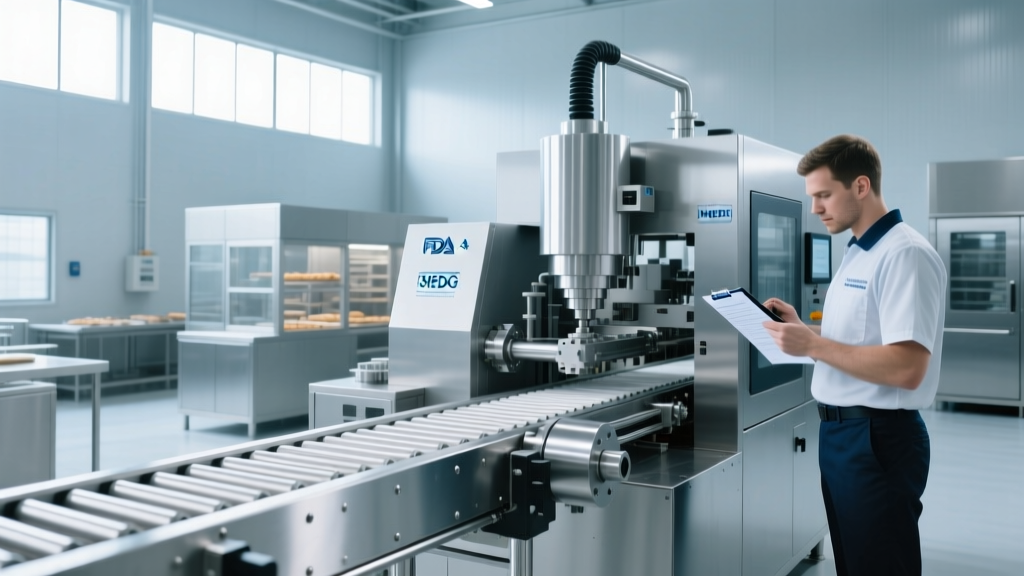
Twin-screw extrusion is the thermal and mechanical core of modern kibble production. As 2026 formulations push fresh meat inclusions past 40% to meet premiumization demands, the rheological stress on pet food manufacturing equipment has increased exponentially. High-moisture, high-protein doughs exhibit non-Newtonian shear-thickening behaviors that accelerate component wear and destabilize die pressure.
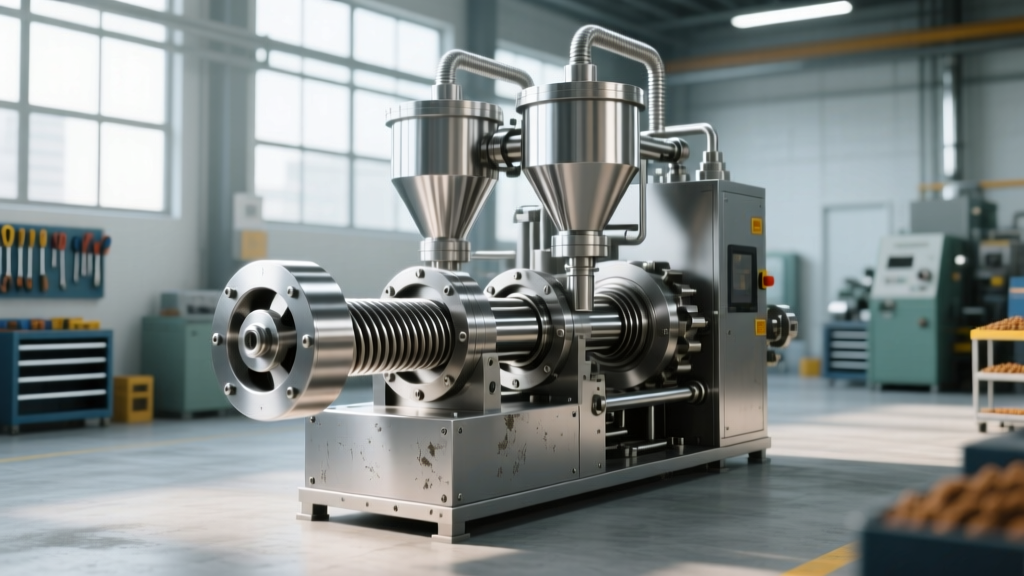
This diagnostic guide bypasses generic maintenance checklists, targeting specific mechanical and thermodynamic failure modes in industrial twin-screw extruders (such as the Wenger TT3630 or Clextral Evoluc TX73 series) used in high-capacity pet food lines.
⚠️ Downtime Cost Warning: Unplanned halts on a 10-ton-per-hour kibble line cost approximately $2,800 to $3,500 per hour in lost throughput, energy waste, and out-of-spec product disposal. Accurate first-time diagnostics are critical.Preconditioner Steam Surging & Moisture Instability
The preconditioner hydrates the raw meal and initiates starch gelatinization before the material enters the extruder barrel. When processing high-fresh-meat slurries, steam condensation rates fluctuate, leading to moisture variances of 3-5% at the extrusion chamber inlet. This causes cyclic surging at the die face.
Diagnostic Steps for Surging
- Verify Pneumatic Actuator Hysteresis: Inspect the steam injection control valve (e.g., Fisher V500 or equivalent). If the actuator hysteresis exceeds 4%, the valve cannot micro-adjust to rapid thermal load changes. Replace the positioner.
- Inspect Sparger Tube Scaling: Hard water minerals and protein coagulation can occlude the 3mm sparger orifices. Remove the sparger and perform a CIP (Clean-In-Place) flush using a 2% nitric acid solution at 75°C for 45 minutes to dissolve calcium carbonate and protein cross-links.
- Thermal Loss in Transfer Hood: Measure the temperature delta between the preconditioner discharge and the extruder feed throat. A drop greater than 12°C indicates inadequate steam jacketing or insulation failure in the transfer hood, causing premature dough cooling and subsequent extruder stall.
Screw Flight and Barrel Wear Tolerances
Abrasive bone meal, titanium dioxide (used in premium whitening applications), and high-fiber botanical inclusions act as lapping compounds against bimetallic barrel liners and stainless steel screw flights. Operating beyond critical clearance thresholds destroys the specific mechanical energy (SME) input, resulting in under-cooked kibble with poor shelf stability.
| Component Pairing | Nominal Clearance | Maximum Wear Limit | Failure Symptom | Estimated Replacement Cost (USD) |
|---|---|---|---|---|
| Screw Flight OD / Barrel ID (90mm section) | 0.15mm - 0.25mm | 1.20mm | Pressure drop at die; reduced SME; surging | $14,500 - $18,000 (Full shaft set) |
| Intermeshing Screw Flights (Twin-Screw overlap) | 0.10mm - 0.20mm | 0.80mm | Material bypass; inconsistent kibble density | N/A (Requires full shaft replacement) |
| Cutlass Bearing / Screw Shaft Spline | 0.05mm | 0.35mm | Axial shaft thrust; gearbox seal failure | $2,200 - $3,500 (Bearing kit) |
Measurement Protocol: Do not rely on visual inspection. Use a digital bore gauge for the barrel ID and an outside micrometer for the screw flight OD. Measure at three equidistant points along the 900mm processing section. If the maximum clearance limit is breached in the final two mixing zones, the entire screw shaft must be replaced to maintain volumetric pumping efficiency.
Die Plate Clogging and Kibble Deformation
As extrudate exits the die plate, it undergoes rapid flash evaporation. High-fat formulations (exceeding 22% crude fat) often cause lipid separation at the die face, leading to localized clogging and asymmetrical kibble expansion. Furthermore, FDA CGMP regulations for animal food mandate strict sanitation protocols to prevent Salmonella or Listeria harborage in die crevices.
💡 Pro-Tip: Die Plate Purging SequenceNever use metal picks to clear clogged die orifices; this alters the land length and ruins the expansion ratio. Instead, execute a thermal purge:
- Stop the dry meal feed and transition to a 100% corn-starch purge compound.
- Increase barrel zone 4 and 5 temperatures to 165°C to melt trapped lipids.
- Run the purge compound for 8 minutes at 50% screw RPM.
- Extract the die plate and soak in an ultrasonic bath with an alkaline enzymatic detergent (pH 11.5) at 60°C for 30 minutes.
Gearbox Thermal Overloads in High-Torque Applications
Modern premium diets require higher specific mechanical energy (SME) to properly gelatinize starches in the presence of high meat slurries. This translates to massive torque demands on the main drive gearbox. Thermal overloads are frequently misdiagnosed as cooling system failures when the root cause is lubricant shear degradation.
Lubricant Shear Analysis
Most heavy-duty extruder gearboxes specify an ISO VG 320 synthetic gear oil. Under continuous high-torque loads (exceeding 85% of motor nameplate amperage), the oil's viscosity index improvers can mechanically shear, dropping the operational viscosity below the critical 280 cSt threshold at 80°C.
- Symptom: Gearbox oil sump temperature alarms trigger at 88°C despite functioning heat exchangers.
- Root Cause: Sheared lubricant failing to maintain the elastohydrodynamic lubrication (EHL) film between helical gear teeth.
- Resolution: Implement quarterly ferrography and viscosity testing. If the ISO VG 320 oil drops below 295 cSt at 40°C, drain and replace with a high-VI synthetic alternative (e.g., Mobil SHC 632 or equivalent). Do not mix polyalphaolefin (PAO) and polyglycol (PAG) base stocks.
Regulatory Compliance and Sanitation Design
Repair and replacement protocols must align with modern sanitary design principles. The Pet Food Institute emphasizes that equipment modifications cannot introduce harborage points for pathogens. When replacing worn barrel sections or die assemblies, ensure all O-rings are FDA-compliant fluorocarbon (FKM/Viton) rather than standard NBR, as FKM withstands the 120°C+ CIP sanitization cycles without degrading or leaching plasticizers into the kibble matrix.
'Sanitary design in pet food manufacturing equipment is not merely about surface finishes; it requires the elimination of dead zones in extruder barrels and die holders where moisture and organic material can stagnate and foster biofilm formation.' — Industry Sanitary Design Guidelines, 2025 Update.
Diagnostic Decision Matrix: Kibble Density Variations
When finished kibble bulk density falls outside the target 320-420 g/L range, use this matrix to isolate the mechanical fault before adjusting the recipe.
| Observed Symptom | Primary Mechanical Suspect | Verification Method | Corrective Action |
|---|---|---|---|
| Density too LOW (Kibble too expanded) | Die plate land length worn | Measure die orifice depth with pin gauge | Replace die plate if land length < 4.5mm |
| Density too HIGH (Kibble dense/hard) | Preconditioner steam valve failing open | Check moisture at extruder inlet (Target: 26%) | Rebuild or replace pneumatic steam valve |
| Inconsistent density batch-to-batch | Worn cutlass bearing allowing axial shaft play | Dial indicator on shaft end during load changes | Replace cutlass bearing and thrust collars |
Precision troubleshooting of pet food extrusion systems requires moving beyond superficial adjustments. By targeting the exact mechanical tolerances, thermodynamic states, and tribological limits of the equipment, maintenance teams can eliminate chronic surging, ensure strict FSMA compliance, and protect the multi-million-dollar margins of premium kibble production lines.