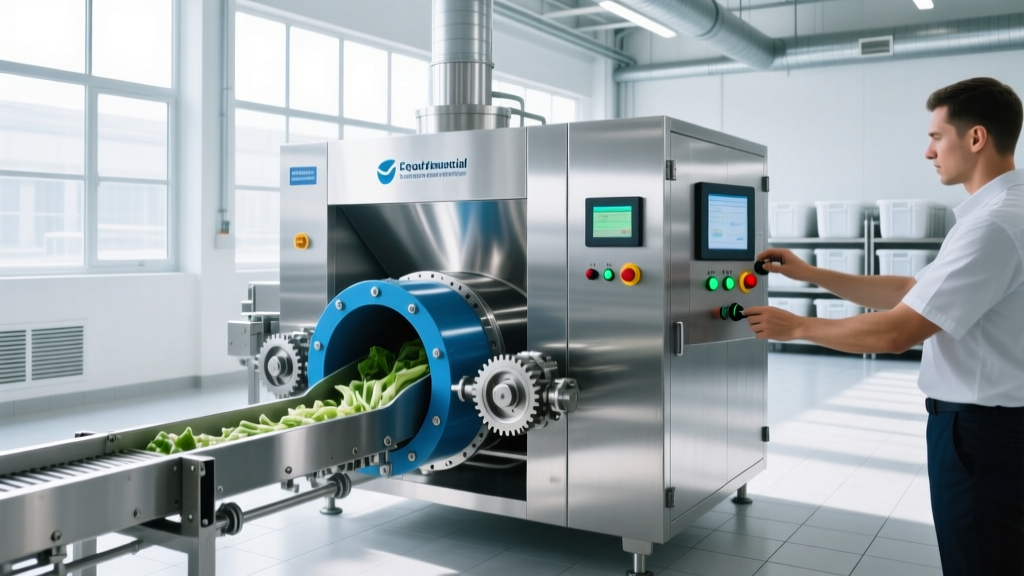
EHEDG & 3-A Compliance: Machinery for Food Processing Industry
Master sanitary design standards for machinery for food processing industry. Compare 3-A, EHEDG, and NSF requirements, Ra values, and CIP validation.
When specifying machinery for food processing industry applications, engineers and plant managers must navigate a complex web of sanitary design regulations. A single microscopic crevice in a homogenizer valve or an improperly pitched drain line in a pasteurizer can harbor biofilms, leading to catastrophic pathogen outbreaks. Compliance is no longer just about passing an annual audit; it is the foundational baseline for operational continuity under strict regulatory frameworks like the FDA's Food Safety Modernization Act (FSMA).
⚠️ Compliance Warning: Under FSMA's Preventive Controls for Human Food rule, equipment design flaws that harbor Listeria monocytogenes or Salmonella can trigger mandatory facility shutdowns and criminal liability. Retrofitting non-compliant welds or replacing shadowed CIP zones post-installation costs 300% to 400% more than specifying certified sanitary design upfront.Decoding the Global Sanitary Frameworks
Procurement teams often conflate different sanitary standards, assuming a 'food-grade' label is universally applicable. In reality, the machinery for food processing industry must be aligned with specific regional and application-based frameworks. The three dominant authorities are 3-A Sanitary Standards (primarily US dairy and liquid foods), EHEDG (European Hygienic Engineering & Design Group), and NSF/ANSI.
| Standard Body | Primary Geography | Core Focus & Application | Key Documentation |
|---|---|---|---|
| 3-A SSI | North America | Dairy, liquid eggs, beverage processing. Highly prescriptive on exact dimensions and surface finishes. | 3-A Sanitary Standards repository |
| EHEDG | Europe / Global | Broad food & beverage. Focuses on performance-based testing (e.g., cleanability tests) rather than rigid dimensional mandates. | EHEDG guideline documentation |
| NSF/ANSI 353 | North America | Process equipment for meat, poultry, and high-risk ready-to-eat (RTE) environments. | NSF Joint Committee on Food Equipment |
Critical Design Mandates: Surfaces, Welds, and Drainability
Sanitary design dictates that all product contact surfaces must be self-draining, non-porous, and free of crevices. The execution of these principles requires exact engineering tolerances.
Surface Finish and Ra Values
The standard metric for surface roughness is Ra (arithmetical mean deviation). For general food processing machinery, an Ra of ≤ 0.8 µm (32 µin) is the baseline requirement. However, for high-acid products (pH < 4.5) or dairy applications prone to rapid bacterial adhesion, mechanical polishing is insufficient. Engineers must specify electropolishing (EP), which removes the amorphous Beilby layer left by mechanical abrasives, yielding a chromium-rich, passive oxide layer with an effective Ra often below 0.4 µm.
Orbital Welding and Argon Purging
Manual TIG welding introduces unacceptable variability in sanitary piping and machinery housings. Automated orbital welding with continuous argon purging on the ID (inside diameter) is mandatory to prevent 'sugaring' (oxidation and crystallization). Post-weld, the interior must be passivated using a nitric or citric acid solution to restore the chromium-oxide layer, ensuring the weld seam matches the corrosion resistance of the base 316L material.
The Dead-Leg Ratio (L/D)
A 'dead leg' is any branch or stagnant zone in a pipe or valve manifold where fluid does not circulate during Clean-In-Place (CIP) operations. 3-A Sanitary Standards mandate an L/D (Length to Diameter) ratio of ≤ 2:1 for dead legs. EHEDG guidelines are stricter, recommending an L/D of ≤ 1:1, and ideally zero dead legs through the use of zero-static (mix-proof) valve arrays. Any instrument port (e.g., thermowells, pressure transmitters) must utilize flush-mounted diaphragm seals to eliminate internal cavities.
Material Selection: Beyond Basic 304 Stainless
While 304 stainless steel is acceptable for dry environments or low-corrosion applications, the machinery for food processing industry handling wet, high-chloride, or high-acid products requires 316L stainless steel. The 'L' denotes low carbon (≤ 0.03%), which prevents carbide precipitation during welding, while the addition of 2-3% molybdenum provides critical pitting resistance against chlorinated alkaline CIP detergents.
💡 Engineering Insight: Elastomer SelectionGaskets and O-rings are frequent failure points for bacterial ingress. Standard NBR (Nitrile) degrades rapidly under high-temperature CIP (85°C+). Specify EPDM (Ethylene Propylene Diene Monomer) for steam and alkaline resistance, or FKM (Viton) for environments requiring aggressive acid sanitizers. All elastomers must carry FDA 21 CFR 177.2600 compliance and feature a surface finish that matches the metal housing to prevent gasket extrusion into the product stream.
Step-by-Step CIP Validation Protocol for New Equipment
Installing compliant machinery is only half the battle; validating its cleanability before commercial production is a regulatory requirement. Follow this ATP bioluminescence validation protocol:
- Pre-Rinse & Visual Inspection: Execute a standard water flush. Use a high-lumen inspection light (minimum 1000 lumens) and boroscopes for enclosed vessels to check for gross soil accumulation.
- Simulated Soil Application: Apply a standardized test soil (e.g., a mixture of wheat flour, milk powder, and egg yolk) to high-risk zones: valve seats, agitator shafts, and baffle welds.
- Execute Automated CIP: Run the programmed CIP cycle. Ensure turbulent flow is achieved; Reynolds number must exceed 30,000, which typically requires a fluid velocity of 1.5 to 2.0 m/s in the piping network.
- ATP Swabbing: Swab the designated high-risk zones immediately post-CIP. Measure Relative Light Units (RLU) using a calibrated luminometer.
- < 10 RLU: Pass (Optimal sanitary condition).
- 11 - 29 RLU: Caution (Investigate potential CIP shadowing or gasket degradation).
- > 30 RLU: Fail (Equipment requires redesign or manual intervention before release).
Real-World Edge Cases and Failure Modes
Case Study: CIP Spray Ball Shadowing
A mid-sized beverage manufacturer experienced recurring Alicyclobacillus spoilage in their aseptic mixing tanks. The root cause was not the CIP chemistry, but the mechanical design of the tank interior. The static spray balls were positioned below the top baffles, creating a 'shadow zone' where the caustic wash never impacted the upper headspace.
The Fix: The static spray balls were replaced with rotating impingement jet heads (e.g., Alfa Tanko or equivalent) operating at 3 to 5 bar pressure. The high-impact droplets eliminated the shadow zones, and the spoilage rate dropped to zero within 48 hours.
Frequently Asked Questions (FAQ)
Can we use 304 stainless steel for meat processing machinery?
It is highly discouraged. Meat processing environments rely heavily on chlorinated foam cleaners and quaternary ammonium compounds (QACs) for sanitation. 304 stainless steel is highly susceptible to chloride-induced pitting and stress corrosion cracking in these conditions. 316L is the minimum acceptable baseline for wet meat processing environments to prevent rust pits that harbor pathogens.
What is the acceptable slope for self-draining machinery surfaces?
Both 3-A and EHEDG mandate that horizontal surfaces must be sloped to ensure complete drainage. The minimum acceptable pitch is 1/8 inch per foot (approximately 1%), though a slope of 3% is preferred for highly viscous products like doughs, pastes, or heavy syrups to prevent pooling during CIP cycles.
How do we handle electrical enclosures in high-pressure washdown zones?
Electrical panels and HMI screens mounted on processing machinery must carry an IP69K rating, not just IP65 or IP67. IP69K specifically certifies that the enclosure can withstand high-pressure (up to 100 bar), high-temperature (80°C) steam and water jets used in aggressive sanitary washdowns without moisture ingress that could cause short circuits or mold growth inside the panel.