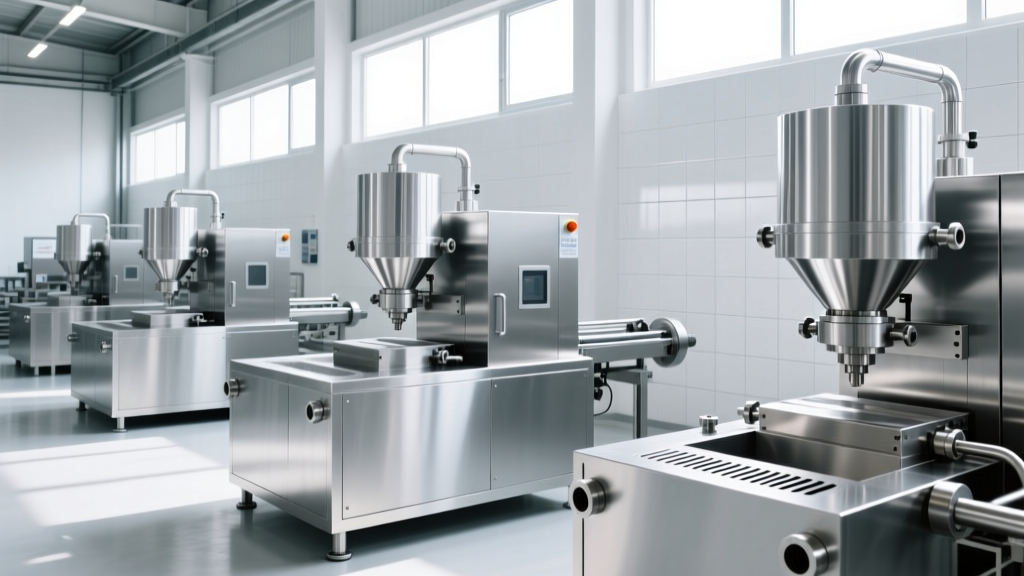
Food Manufacturing Equipment Compliance: 3-A, NSF & EHEDG
Navigate 3-A, NSF, and EHEDG safety standards for food manufacturing equipment. Ensure compliance, avoid recalls, and select sanitary-grade machinery.
The True Cost of Sanitary Design Failures
A single sanitary design failure in food manufacturing equipment can trigger a Class I recall, costing an average of $10 million in direct expenses, excluding long-term brand degradation. Under the FDA’s Food Safety Modernization Act (FSMA), the regulatory burden has shifted from reactive contamination response to proactive preventive controls. This means the equipment you install on your processing line must be inherently designed to prevent pathogen harboring, not just cleaned after the fact.
Compliance is not a monolithic standard. Depending on your product category (dairy, meat, beverage, or dry powder) and export markets, your machinery must align with specific global frameworks. Procuring equipment without verifying these certifications exposes your facility to FDA Form 483 observations and catastrophic microbial ingress.
Decoding the Global Triad: 3-A, NSF, and EHEDG
When evaluating food manufacturing equipment, three primary organizations dictate sanitary design and material safety. Understanding the distinction between them is critical for capital expenditure planning and international market access.
| Standard Body | Primary Focus | Geographic Dominance | Verification Mechanism |
|---|---|---|---|
| 3-A SSI | Hygienic design for dairy, liquid foods, and pharmaceuticals. | North America | Third-Party Certification (TPC) and voluntary symbol authorization. |
| NSF International | Material safety, non-toxicity, and broad food equipment sanitation. | Global (Strong US/Canada) | Rigorous facility audits, material testing, and NSF mark listing. |
| EHEDG | Hygienic engineering, cleanability validation, and CIP optimization. | Europe / Global | Certification based on standardized test methods (e.g., ELRDT). |
While 3-A Sanitary Standards Incorporated focuses heavily on the geometric and metallurgical requirements of liquid and dairy processing, the European Hygienic Engineering & Design Group (EHEDG) provides rigorous empirical testing for Clean-in-Place (CIP) efficacy. If your facility exports to the EU or utilizes complex CIP manifolds, EHEDG-certified valves and pumps are virtually mandatory to ensure turbulent flow and complete soil removal.
Material Science & Sanitary Design Specifications
General statements like "food-grade stainless steel" are insufficient for modern compliance auditing. Engineering teams must specify exact metallurgical grades and surface topographies to prevent biofilm formation.
Metallurgy: 304 vs. 316L Stainless Steel
While 304 stainless steel is acceptable for dry or low-moisture environments, 316L is the non-negotiable standard for wet processing, particularly where chlorides are present. The addition of 2-3% molybdenum in 316L provides critical resistance to pitting corrosion from salt brines, acidic sauces, and chlorine-based sanitizers (like sodium hypochlorite). Pitting creates microscopic crevices where Listeria monocytogenes and Salmonella establish impenetrable biofilms.
Surface Finish Topography
Sanitary standards dictate that all product-contact surfaces must achieve a specific surface roughness. The universal benchmark is an Ra (Arithmetic Average Roughness) of ≤ 0.8 µm (32 µin). However, achieving this number is only half the battle; the method of finishing matters.
- Mechanical Polishing: Leaves directional grit lines. If grit lines run perpendicular to product flow, they can trap particulate matter.
- Electropolishing: Removes the amorphous, disturbed surface layer left by mechanical abrasion, exposing a chromium-rich, passive oxide layer that is vastly superior for corrosion resistance and cleanability.
⚠️ The "Dead Leg" Trap
A dead leg is any branch pipe or stagnant zone in a fluid system. Both 3-A and EHEDG strictly mandate that the Length-to-Diameter (L/D) ratio of any dead leg must not exceed 2:1 (and ideally should be < 1.5:1 for dairy). Exceeding this ratio prevents CIP fluids from achieving the minimum 1.5 m/s (5 ft/s) velocity required for turbulent flow, guaranteeing soil accumulation and bacterial proliferation in the stagnant branch.
Washdown Electronics: NEMA 4X vs. IP69K
Modern food manufacturing equipment relies heavily on Variable Frequency Drives (VFDs), HMI touchscreens, and load cells. The enclosures housing these electronics are frequent points of compliance failure during high-pressure sanitation shifts.
Many OEMs default to NEMA 4X enclosures. While NEMA 4X provides excellent protection against hose-directed water and corrosion, it is not explicitly tested for high-pressure, high-temperature washdowns. In environments requiring aggressive sanitation (e.g., raw meat processing or ready-to-eat facilities), you must specify IP69K (per DIN 40050-9 / ISO 20653).
IP69K certifies that the enclosure can withstand close-range, high-pressure (up to 100 bar / 1450 psi) and high-temperature (up to 80°C / 176°F) spray downs. Specifying IP69K for all zone-1 electronics prevents water ingress, short circuits, and the subsequent harboring of moisture-borne pathogens inside electrical panels.
Elastomers and Gasket Compliance
Gaskets are the most frequently replaced wear parts in food processing machinery, making them a high-risk vector for contamination. All elastomers (O-rings, butterfly valve seats, pump diaphragms) must comply with FDA 21 CFR 177.2600 for rubber articles intended for repeated use.
When selecting gasket materials, match the elastomer to the chemical and thermal profile of your process:
- EPDM: Excellent for steam and CIP caustics (up to 150°C). Poor resistance to fats and oils.
- FKM (Viton): Superior for high-fat products, essential oils, and aggressive acidic cleaners. Not suitable for steam.
- PTFE (Teflon) Envelope: Chemically inert and handles extreme temperatures, but lacks the elasticity of solid elastomers, requiring precise torque settings on tri-clamp fittings to prevent leaks.
Furthermore, ensure all gaskets feature a self-draining design with a raised lip that prevents the gasket edge from intruding into the product flow path, which would otherwise create a harboring point for debris.
The OEM Procurement Compliance Checklist
Do not rely on verbal assurances from machinery vendors. Before signing a Purchase Order for any food manufacturing equipment, mandate the submission of the following technical documentation:
- Material Certifications (Mill Certs): Require 3.1 or 3.2 EN 10204 certificates for all product-contact stainless steel, verifying the 316L alloy composition.
- Surface Roughness Reports: Demand profilometer readings (Ra values) for internal vessel and pipe surfaces, confirming the ≤ 0.8 µm specification.
- FDA/USP Declarations: Require written declarations of compliance for all polymers and elastomers against FDA 21 CFR and USP Class VI standards.
- CIP Validation Data: For complex machinery (e.g., homogenizers, fillers), request EHEDG test certificates or computational fluid dynamics (CFD) models proving CIP coverage and drainage slopes (minimum 1:100).
- IP69K Test Reports: Require third-party lab results for all electrical enclosures located within the high-care washdown zones.
Enforcing this checklist at the procurement phase shifts the compliance burden back to the OEM, ensuring your facility is audit-ready from the moment the equipment is commissioned.