Commercial Food Processing Equipment Manufacturers: Sanitary Specs
Explore the exact technical specifications, metallurgy, and CIP fluid dynamics top commercial food processing equipment manufacturers use for sanitary design.
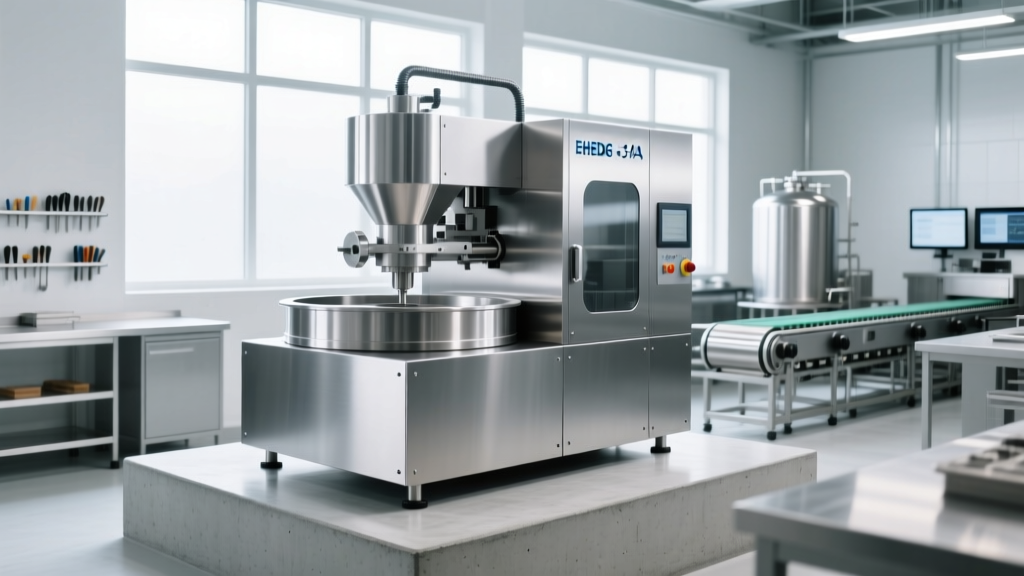
Microscopic harborage points are the primary catalyst for biofilm formation and pathogen proliferation in food manufacturing. When evaluating machinery, plant engineers and food safety directors cannot rely on visual inspections alone. The engineering tolerances, metallurgical compositions, and fluid dynamics designed into the equipment dictate its long-term sanitary viability. Leading commercial food processing equipment manufacturers adhere to rigorous frameworks established by the 3-A Sanitary Standards, Inc. and the European Hygienic Engineering & Design Group (EHEDG) to eliminate these vectors.
CRITICAL COMPLIANCE NOTE: Under the FDA’s FSMA Preventive Controls Rule, equipment design that inherently traps moisture or organic soil is classified as a preventive control failure. Non-compliant machinery directly correlates with increased environmental swab positives for Listeria monocytogenes.Metallurgy and Elastomer Selection Protocols
The baseline material for product contact surfaces in wet-processing environments is austenitic stainless steel. However, the specific alloy grade must be matched to the chemical profile of the food product and the sanitizing agents used.
Stainless Steel Alloy Matrix
| Alloy Grade | UNS Designation | Key Composition | Application & Limitations |
|---|---|---|---|
| 304 / 304L | S30400 / S30403 | 18% Cr, 8% Ni | Dry goods, low-acid foods. Susceptible to pitting from chloride-based sanitizers. |
| 316L | S31603 | 16% Cr, 10% Ni, 2-3% Mo | Dairy, meat, acidic beverages. Molybdenum prevents chloride pitting and crevice corrosion. |
| Duplex 2205 | S31803 | 22% Cr, 5% Ni, 3% Mo | High-chloride brines, aggressive CIP chemicals. Superior stress-corrosion cracking resistance. |
Elastomer Degradation and Swelling
O-rings and gaskets are frequent failure points in sanitary valves and pump seals. Selecting the wrong elastomer leads to volumetric swelling, which extrudes the material into the product stream and creates dead-legs where bacteria thrive.
- EPDM (Ethylene Propylene Diene Monomer): The standard for steam and alkaline CIP cleaners. Maximum continuous temperature of 150°C (302°F). Fails rapidly in high-fat or petroleum-based environments.
- FKM (Fluoroelastomer / Viton): Required for high-fat dairy, edible oils, and acidic products. Excellent chemical resistance but poor performance in steam-in-place (SIP) applications due to hydrolysis.
- PTFE (Polytetrafluoroethylene): Used for extreme chemical resistance and high-purity pharmaceutical-grade food processing. Requires encapsulation (e.g., FEP-encapsulated silicone core) to provide adequate compression set memory.
Surface Topography and Finish Specifications
A polished surface visually appears clean, but microscopic valleys can harbor soil. Commercial food processing equipment manufacturers specify surface roughness using the Ra (Roughness Average) parameter, measured in micrometers (µm) or microinches (µin).
"For product contact surfaces, the standard mechanical finish must achieve an Ra of ≤ 0.8 µm (32 µin). However, for highly viscous products or those prone to rapid bacterial adhesion, an electropolished finish achieving Ra ≤ 0.4 µm (16 µin) is required to remove the disturbed Beilby layer and expose a passive, chromium-rich surface."
Electropolishing vs. Mechanical Polishing: Mechanical polishing (using abrasive belts) smears metal across the surface, trapping inclusions. Electropolishing is an electrochemical process that removes the amorphous surface layer, leveling micro-peaks and increasing the chromium-to-iron ratio on the surface. This enhances the passive oxide layer, directly improving corrosion resistance against acidic foods like tomato paste or citrus juices.
CIP Fluid Dynamics and Piping Geometry
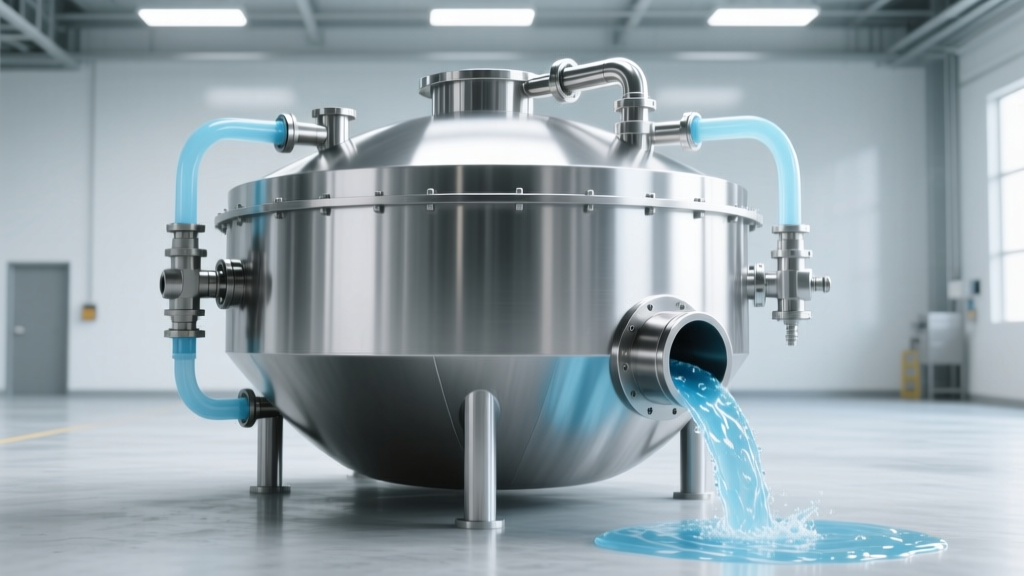
Clean-in-Place (CIP) systems rely on turbulent flow to generate the mechanical shear force necessary to strip biofilms from pipe walls. Laminar flow will leave the center of the pipe clean while the boundary layer remains contaminated.
Engineering Rule of Thumb: To guarantee turbulent flow (Reynolds number > 20,000) in standard sanitary tubing, CIP fluid velocity must maintain a minimum of 1.5 meters per second (5 ft/s) at the furthest, most restrictive point in the circuit.Self-Draining Slopes and Dead-Legs
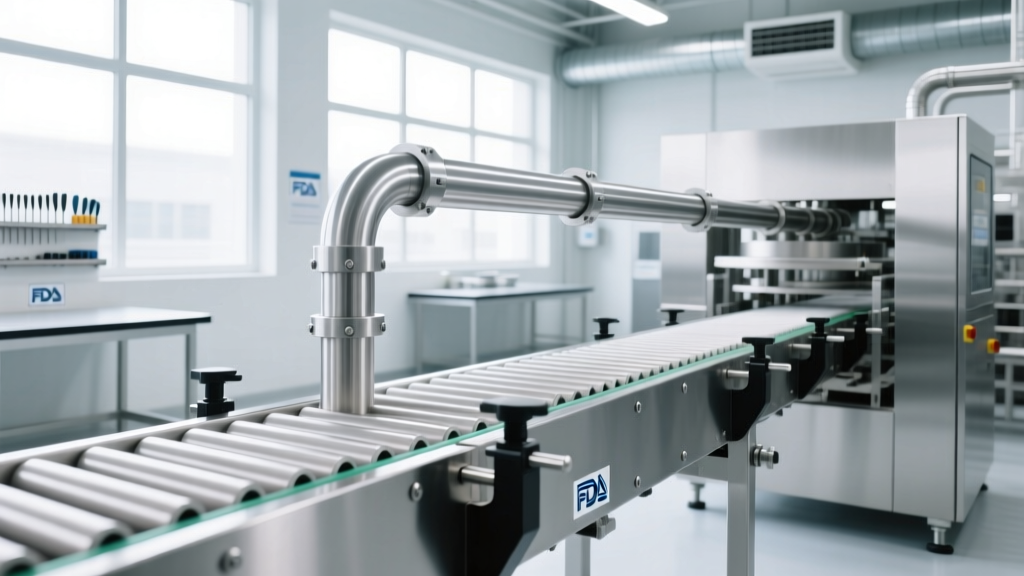
Gravity drainage is non-negotiable in hygienic piping design. Standing water in horizontal lines breeds Pseudomonas and Listeria.
- Minimum Slope: All horizontal product and CIP lines must be sloped at a minimum of 1/4 inch per foot (approximately 1.19 degrees). However, EHEDG guidelines strongly recommend a 3-degree slope to overcome surface tension and ensure complete evacuation of viscous fluids.
- Dead-Leg Elimination: Branch connections (tees) must adhere to the 2:1 rule (or preferably 1:1). The length of the dead-leg (L) must not exceed twice the internal diameter (D) of the branch pipe. Modern manufacturers utilize zero dead-leg (ZDL) block valves or diaphragm valves to reduce this ratio to virtually zero.
Electrical Enclosure and Motor Ingress Protection
Sanitary design extends beyond product contact zones to the external machine architecture. Washdown environments utilize high-pressure, high-temperature caustic sprays that easily penetrate standard electrical enclosures, causing catastrophic VFD (Variable Frequency Drive) failures and arc flashes.
| IP Rating | Protection Level | Food Processing Application |
|---|---|---|
| IP65 | Dust tight, low-pressure water jets | Dry processing zones, packaging areas above the product line. |
| IP67 | Dust tight, temporary immersion | Low-pressure foam cleaning environments, beverage bottling. |
| IP69K | Dust tight, high-pressure/high-temp steam jets (100 bar, 80°C) | Raw meat processing, ready-to-eat (RTE) zones requiring aggressive sanitization. |
For IP69K compliance, motors and enclosures must feature stainless steel housings with polished, angled tops (minimum 30-degree pitch) to prevent water pooling. Cable glands must be sealed with FDA-approved silicone, and breather vents must utilize hydrophobic PTFE membranes to equalize pressure during thermal shock without admitting moisture.
Real-World Edge Case: Crevice Corrosion in Heat Exchangers
A common failure mode in dairy pasteurization occurs at the tube-to-tubesheet joints of shell-and-tube heat exchangers. If manufacturers use standard interference fits or incomplete weld penetration, a microscopic crevice is formed. The localized depletion of oxygen inside this crevice destroys the passive chromium oxide layer, leading to aggressive crevice corrosion even in 316L stainless steel. Procurement specifications must explicitly mandate full-penetration, orbital TIG welding with internal argon purging (to prevent sugaring) and subsequent automated boroscopy inspection for all heat exchanger joints.