Machining CNC Lathe Parts: 2026 Cost & Budget Analysis
Discover the true cost of machining CNC lathe parts in 2026. Break down CapEx, OpEx, tooling, and hidden expenses to build an accurate shop budget.
Executive Financial Snapshot
Allocating capital for a CNC turning center requires moving beyond the base sticker price of the machine tool. In 2026, the financial viability of machining CNC lathe components hinges on a granular understanding of fully burdened hourly rates, tooling amortization, and predictive maintenance reserves. A mid-sized 2-axis turning center requires an average CapEx of $145,000, but fully equipped operational readiness pushes the initial cash outlay to $185,000 or more.
Capital Expenditure (CapEx): Beyond the Machine Sticker Price
When budgeting for a new turning center, shop managers frequently underestimate the cost of necessary peripherals. The base price of a machine rarely reflects its production-ready state. Below is a breakdown of current 2026 market pricing for popular mid-range turning centers, alongside the mandatory options required for untended or high-volume production.
Base Machine Pricing (2026 Estimates)
- Haas ST-20Y (Y-Axis, Live Tooling): $125,000 - $135,000
- Okuma GENOS L3000-e (OSP-P500L Control): $140,000 - $155,000
- DMG MORI CLX 350 (Siemens CELOS): $165,000 - $180,000
The 'Hidden' CapEx Adders
To achieve the cycle times quoted by OEMs, you must equip the machine correctly. Budget for these specific line items:
- High-Pressure Coolant (HPC) Systems: Upgrading from standard 300 PSI to 1,000+ PSI through-the-tool coolant is essential for breaking chips in gummy materials like 316L stainless steel or Inconel. Cost: $8,500 - $11,000.
- Automated Bar Feeders: Hydrodynamic or hydrostatic bar feeders (e.g., Edge Technologies or IEMCA) are mandatory for lights-out machining. Cost: $16,000 - $24,000.
- High-Capacity Chip Conveyors: Standard hinge-belt conveyors jam on stringy aluminum chips. Upgrading to a scraper-belt or pressurized coolant flush system is critical. Cost: $4,500 - $6,200.
- Tool Setting and Probing: Renishaw or Blum non-contact tool setting arms prevent crashes and automate offset updates. Cost: $5,500 - $8,000.
Operational Expenditure (OpEx): Calculating the True Hourly Rate
According to data from the Department of Energy's Industrial Assessment Centers, industrial energy consumption is a major variable cost often miscalculated by job shops. Calculating the exact energy draw of your spindle and axes is the first step in establishing an accurate shop rate.
| Cost Category | Specification / Metric | Estimated Hourly Cost |
|---|---|---|
| Spindle Power (30HP / 22kW) | 60% average load draw (13.4 kW @ $0.14/kWh) | $1.87 |
| Axis Servos & Control | X, Z, and Y axis rapid movement + CNC brain | $0.95 |
| Coolant Pump & Skimmer | 2.5 kW continuous run + tramp oil separator | $0.42 |
| Compressed Air | Chuck actuation, blow-offs, air blasts (15 CFM) | $0.65 |
| Facility Allocation | HVAC, lighting, floor space (per sq ft lease rate) | $2.10 |
| Total Base Energy/Space | Excludes direct labor and tooling | $5.99 / hr |
This $5.99 baseline must be added to your direct labor rate, machine depreciation, and cutting tool costs to find your true break-even hourly rate. For most North American job shops in 2026, the fully burdened machine rate for a mid-sized CNC lathe falls between $65.00 and $95.00 per hour.
Tooling and Consumables: The Silent Budget Killers
The economics of machining CNC lathe parts are heavily dictated by insert wear and tooling lifecycle management. Relying on cheap, uncoated carbide inserts for production turning is a false economy that destroys spindle bearings through excessive cutting pressure and increases cycle times.
Insert Grade Selection and Cost-Per-Edge
Consider the machining of 4140 pre-hardened steel (28-32 HRC). Using a standard CVD-coated insert versus a specialized PVD-coated grade yields drastically different financial outcomes:
- Standard Grade (e.g., Sandvik GC4225 equivalent): $12.50 per insert (3 edges = $4.16 per edge). Runs at 650 SFM. Tool life: 45 minutes.
- Premium Grade (e.g., Sandvik GC4325 with Inveio coating): $18.00 per insert (3 edges = $6.00 per edge). Runs at 850 SFM. Tool life: 75 minutes.
While the premium insert costs 44% more per edge, the 30% increase in surface speed reduces the cycle time per part, yielding a net positive margin on high-volume runs. Furthermore, predictable wear patterns prevent catastrophic insert failure, which can gouge the workpiece and scrap a $500 raw forging.
Warning: Live Tooling Crash Costs
When utilizing Y-axis and live tooling for milling operations on a turning center, the financial risk of a crash multiplies. A standard static VDI40 tool holder costs $250. A driven VDI40 live tooling holder costs $850 to $1,400. A programming error that drives a live drill into the chuck or main spindle nose will destroy the live holder, the ER collet chuck ($350), and potentially misalign the main spindle, resulting in a $15,000+ service call.
Edge Case Analysis: Swiss-Type vs. Standard 2-Axis Turning
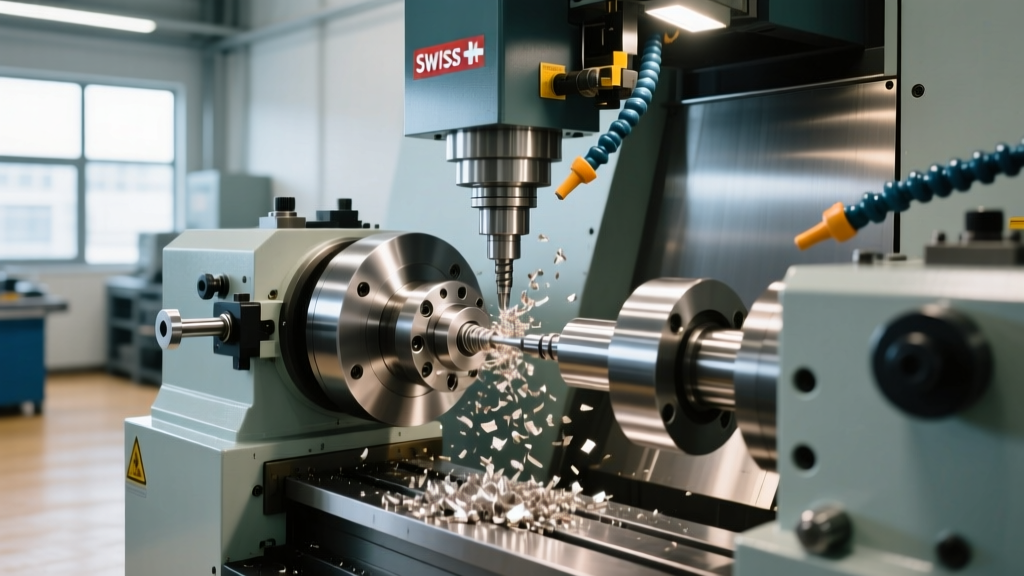
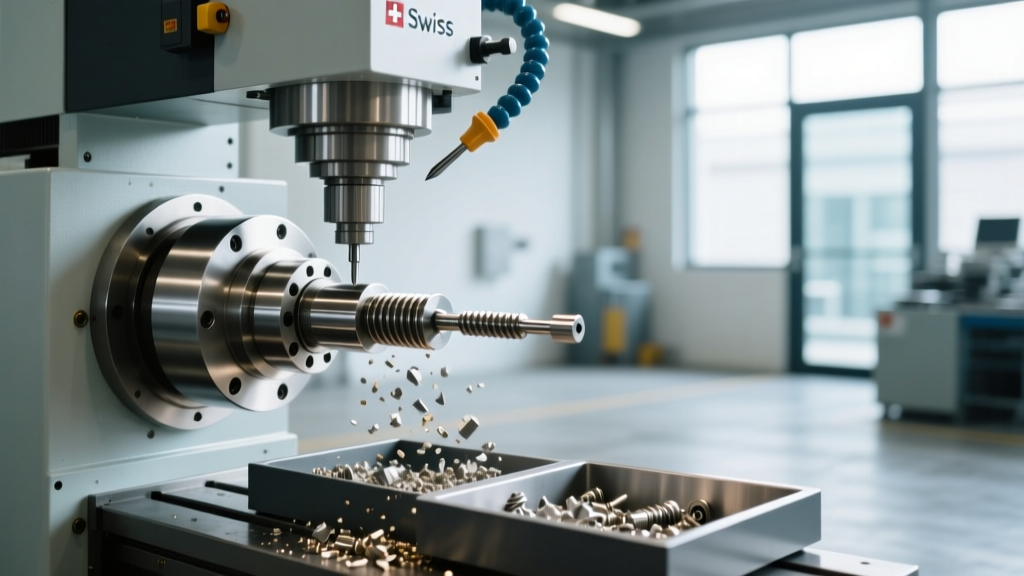
When planning a budget for high-precision, small-diameter parts (under 1.25 inches), shops must decide between a standard 2-axis lathe with a sub-spindle and a dedicated Swiss-type automatic lathe. The cost divergence is substantial.
'Swiss-type machining offers unparalleled concentricity and surface finish for long, slender components, but the hidden costs of guide bushings and ultra-precise bar stock frequently blind first-time buyers.' — Insights derived from The Association For Manufacturing Technology (AMT) market reports on turning center utilization.
Material Cost Divergence
A standard CNC lathe can run standard commercial-grade bar stock with a diameter tolerance of +/- 0.005 inches. A Swiss-type machine relies on a guide bushing to support the material millimeters away from the cutting tool. This requires ground, h6 or h7 tolerance bar stock. In 2026, purchasing h6 tolerance 304 stainless steel bar stock carries a 15% to 22% material premium over standard cold-drawn stock. This material cost must be factored into the per-part quote.
Hidden Costs and Maintenance Reserves
Machine tool OEMs design for mean-time-between-failures (MTBF), but job shop environments introduce variables that accelerate wear. A robust budget must include a sinking fund for the following inevitable expenses:
- Way Cover Replacement ($3,000 - $5,500): Telescopic steel way covers on the X and Z axes are subjected to hot, abrasive chips. In heavy cast-iron or superalloy machining, way covers typically require replacement every 4 to 6 years. If chips bypass the covers and enter the ball screws, the repair cost jumps to $25,000+.
- Coolant Rancidity and Disposal ($1,200 - $2,500 annually): Synthetic and semi-synthetic coolants break down due to tramp oil infiltration and bacterial growth. Disposing of a 300-gallon sump of hazardous waste coolant costs upwards of $1,500. Budgeting for a high-quality centrifugal tramp oil separator ($3,500 CapEx) pays for itself in 14 months by extending coolant life by 300%.
- Spindle Bearing Rebuild ($18,000 - $28,000): If an operator crashes the machine, or if high-pressure coolant seals fail, the main spindle bearings will degrade. Rebuilding a 4,000 RPM high-torque spindle requires specialized clean-room assembly and dynamic balancing. Allocate 3% of the machine's CapEx annually to a spindle replacement reserve.
The 5-Step Budgeting Framework for Turning Centers
To standardize your financial planning, utilize the NIST Manufacturing Extension Partnership lean accounting principles adapted for CNC turning:
- Establish the Burdened Hourly Rate: Combine direct energy costs, floor space lease, and machine depreciation (typically calculated over a 7-year MACRS schedule) to find your baseline machine cost per hour.
- Amortize the Tooling Package: Do not expense initial tooling purchases (VDI blocks, live holders, boring bars) as general shop overhead. Amortize the $15,000 initial tooling package over the first 2,000 spindle hours to accurately reflect startup costs.
- Calculate the Scrap Allowance: For complex multi-axis turning, budget a 3% to 5% material scrap rate for setup proving and first-article inspection. Aerospace and medical turning contracts often require destructive testing of the first part, which must be billed to the customer.
- Fund the Automation Upgrade Path: If you are not buying a bar feeder or cobot (e.g., Universal Machines UR10e or FANUC CRX-25iA) on day one, reserve $25,000 in year-two CapEx to automate part loading. Labor shortages in 2026 make manual tending financially unviable for runs exceeding 500 parts.
- Track Cost-Per-Edge, Not Cost-Per-Insert: Mandate that your CAM programmers and setup operators track tool life in cutting minutes, not just part counts. This data allows you to switch insert geometries and optimize the true cost per machined feature.
Accurate budget planning for CNC turning is an exercise in predictive risk management. By mapping out the exact energy draw, tooling lifecycle, and inevitable mechanical wear of your specific machine configuration, you transform vague estimates into a rigid financial model capable of sustaining profitability in a highly competitive 2026 manufacturing landscape.