Lathe CNC Machine vs. Mill-Turn: 2026 Alternatives Guide
Compare a standard lathe CNC machine with mill-turn centers for 2026 production. Analyze costs, cycle times, and exact model alternatives for your shop.
The Core Dilemma: 2-Axis Turning vs. Multitasking
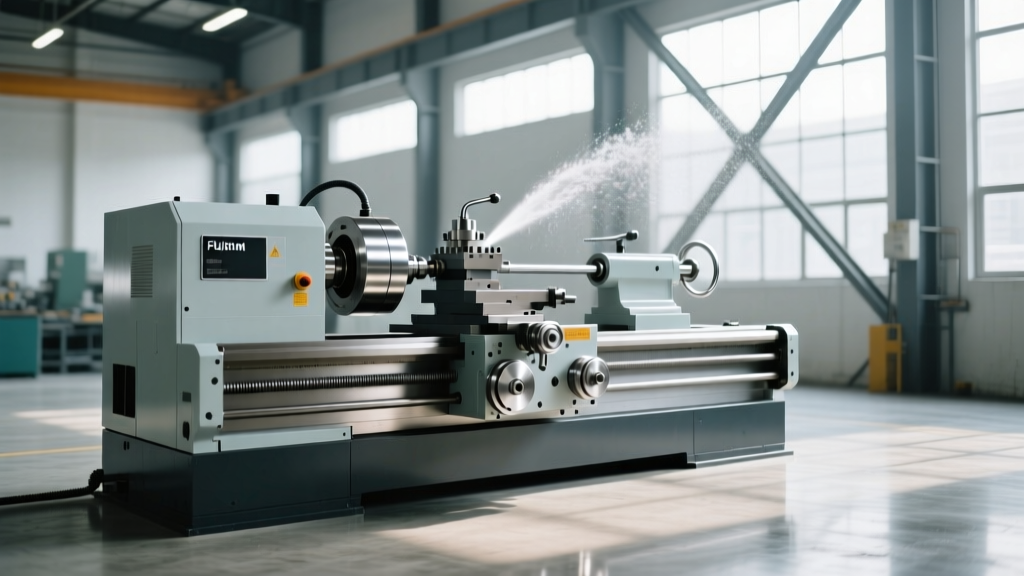
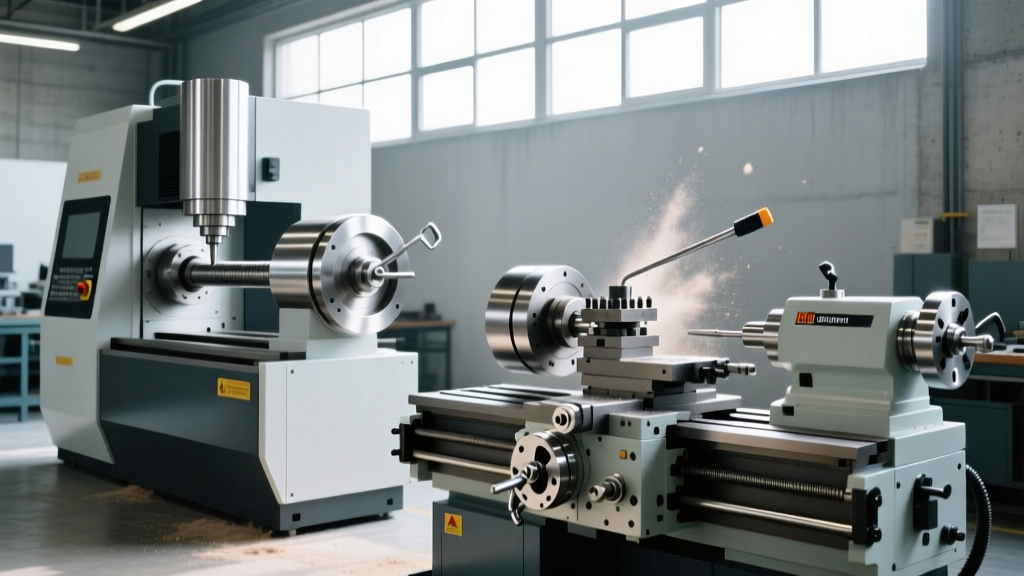
When evaluating a standard lathe CNC machine against a full mill-turn center, shop owners often default to the 'done-in-one' marketing narrative. However, the reality of 2026 production economics dictates that more axes do not automatically equal higher profitability. A traditional 2-axis lathe CNC machine remains the undisputed champion for high-volume, rotationally symmetric parts, while mill-turn centers excel at complex, low-to-medium volume aerospace and medical components. The decision hinges on a precise calculation of setup time reduction versus the hidden costs of CAM programming, tooling interfaces, and maintenance.
Warning: The Hidden Mill-Turn TaxMany shops upgrade from a standard lathe CNC machine to a Y-axis mill-turn center without budgeting for the programming overhead. Mill-turn CAM verification requires advanced kinematic simulation software (like Mastercam Mill-Turn or ESPRIT) to prevent catastrophic B-axis and spindle collisions. Expect a 20-30% increase in initial CAM programming time for the first run of a new part compared to standard 2-axis turning.
2026 Cost & Capability Matrix
To understand the financial leap between machine categories, we must look at exact market pricing and capability thresholds for current-generation equipment. The following matrix compares a baseline lathe CNC machine against entry-level and high-end multitasking alternatives.
| Machine Category | Representative Model | Approx. 2026 Base Price | Max Turning Diameter | Milling Capability |
|---|---|---|---|---|
| Standard 2-Axis Lathe | Haas ST-20 | $165,000 - $185,000 | 11.75 in. | None (Live tooling optional) |
| Y-Axis Mill-Turn | Haas DS-20Y | $235,000 - $265,000 | 11.75 in. | ±2.0 in. Y-axis, 6k RPM live |
| 5-Axis Multitasking | Mazak INTEGREX i-200 | $480,000 - $650,000+ | 25.6 in. | Full B-axis, 12k-20k RPM |
Data sourced from industry benchmarks and direct manufacturer configurations via Haas Automation and Mazak Corporation. Notice that stepping from a standard lathe CNC machine to a true 5-axis multitasking center represents a 3x to 4x capital expenditure increase, which must be justified by a corresponding reduction in secondary operations.
Cycle Time Realities: Setup vs. Run Time
The primary argument for abandoning a standard lathe CNC machine in favor of a mill-turn center is setup reduction. Consider a 17-4 PH stainless steel aerospace fitting requiring turning, off-center cross-drilling, and contour milling.
- Standard Lathe + VMC Workflow: Part is turned on a 2-axis lathe (Cycle time: 145 seconds). Part is moved to a vertical machining center, indicated, and fixtured for milling (Setup/Handling: 18 minutes). VMC cycle time: 210 seconds. Total floor-to-floor time per part is heavily skewed by the 18-minute secondary setup.
- Mill-Turn Workflow: Part is loaded once into the main spindle. Y-axis and live tooling execute the cross-drilling and contouring. Total cycle time: 390 seconds. Setup time: 4 minutes (single chucking).
While the mill-turn cycle time is longer due to tool changes and lower milling rigidity, the elimination of the 18-minute secondary setup makes it vastly superior for batch sizes under 500 pieces. For batches exceeding 2,000 pieces, the standard lathe CNC machine paired with a dedicated VMC and custom tombstone fixture will outproduce the mill-turn center due to higher milling feed rates and simultaneous machine utilization.
Top Alternatives to a Traditional Lathe CNC Machine
If your production requirements have outgrown a standard 2-axis configuration, but a $500,000 INTEGREX is unjustifiable, consider these highly specific alternatives.
1. Swiss-Type Automatic Lathes (Sub-1.25' Parts)
For high-volume, small-diameter components (medical implants, connector pins), a Swiss-type machine like the Tsugami B0205-II is the ultimate alternative. Unlike a standard lathe CNC machine where the tool moves to the stationary part, a Swiss machine feeds the bar stock through a guide bushing while the tools remain stationary or move radially. This provides unparalleled rigidity for parts with a length-to-diameter ratio greater than 4:1. Expect to pay between $280,000 and $350,000 for a fully tooled 5-axis Swiss machine, but achieve cycle times 40% faster than a standard sliding-headstock lathe.
2. 5-Axis VMC with Turn-Mill Tombstone
If your parts are primarily prismatic but require a single turned feature (like a cylindrical boss or an O-ring groove), do not buy a lathe. Instead, utilize a 5-axis VMC equipped with a high-speed rotary turn-mill tombstone (such as those from SMW Autoblok). This allows you to turn features at up to 800 RPM directly on the machining center, bypassing the need for a dedicated lathe CNC machine entirely.
Tooling Interfaces: VDI vs. BMT vs. Capto
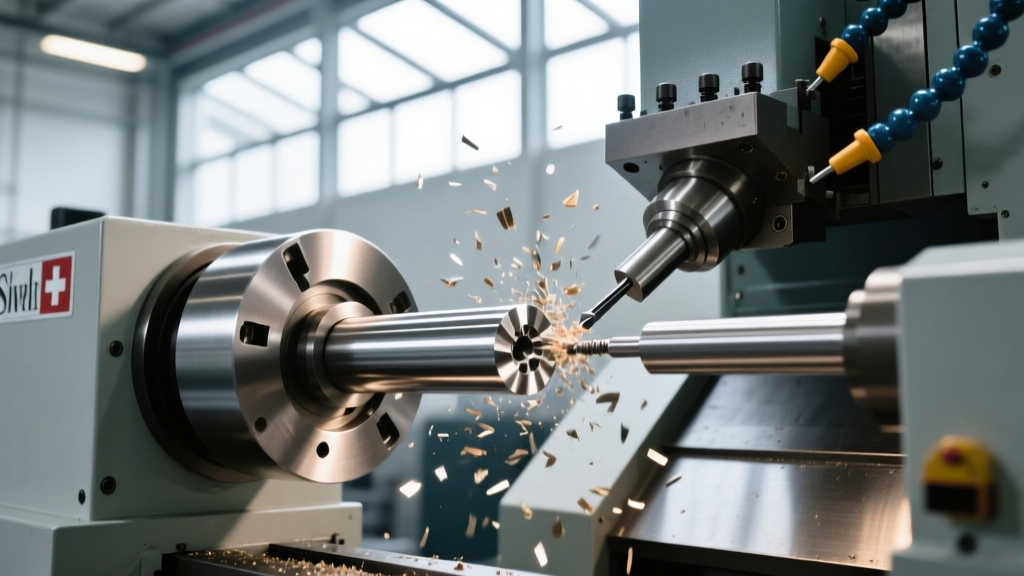
When upgrading from a standard lathe CNC machine to a mill-turn center, the tooling interface dictates your milling performance. Most entry-level mill-turns use VDI (DIN 69880) turrets. While cost-effective, VDI relies on a serrated face coupling that can deflect under heavy side-milling loads.
Expert Recommendation: BMT and CaptoFor 2026 mill-turn investments, mandate a BMT (Base Mount Tooling) turret. BMT bolts directly to the turret face, offering up to 30% higher rigidity and better thermal stability than VDI. For the main milling spindle, specify Coromant Capto C5 or C6 interfaces. The polygonal coupling of Capto ensures repeatability within 2 microns, which is critical when performing 5-axis simultaneous milling on hardened steels.
Hidden Edge Cases: Maintenance and Thermal Growth
Operating a mill-turn center introduces failure modes that simply do not exist on a standard lathe CNC machine. According to manufacturing research highlighted by the Society of Manufacturing Engineers (SME), thermal displacement is the leading cause of scrap in multitasking environments.
- Y-Axis Thermal Drift: The Y-axis ball screw on a mill-turn center is subjected to asymmetrical heat generation during heavy off-center milling. Without active ball screw cooling (a $12,000+ option on most mid-tier machines), you will experience 15-25 microns of Y-axis drift over a 4-hour shift, ruining tight-tolerance keyways.
- Chip Evacuation in Deep Cavities: When milling deep, off-center pockets on a horizontal spindle, chips do not fall away by gravity as they do in a VMC. They pack into the cavity, recut, and destroy end mills. High-pressure coolant (minimum 1,000 PSI) directed through the spindle is mandatory, not optional, for mill-turn operations.
- Spindle Crash Economics: On a standard lathe CNC machine, a crash usually damages a static tool or the chuck jaw. On a mill-turn center, a programming error can drive the $65,000 B-axis milling spindle directly into the main turning spindle. Kinematic verification software is a non-negotiable insurance policy.
Final Decision Framework
Do not abandon the traditional lathe CNC machine simply because it lacks axes. If your parts are 80% turning and 20% simple cross-holes, a standard lathe with a basic live-tooling package (C-axis and radial drill holders) will yield a faster ROI. Reserve capital-intensive mill-turn centers and Swiss-type alternatives for parts where secondary setup time exceeds 25% of the total production lifecycle, or where geometric complexity physically prevents re-chucking.