Swiss CNC Machine Shop Training: Operator Best Practices
Master Swiss CNC machine shop operations with expert operator training protocols, setup tolerances, and troubleshooting frameworks for sliding headstocks.
The Paradigm Shift: Standard CNC vs. Swiss-Type Architecture
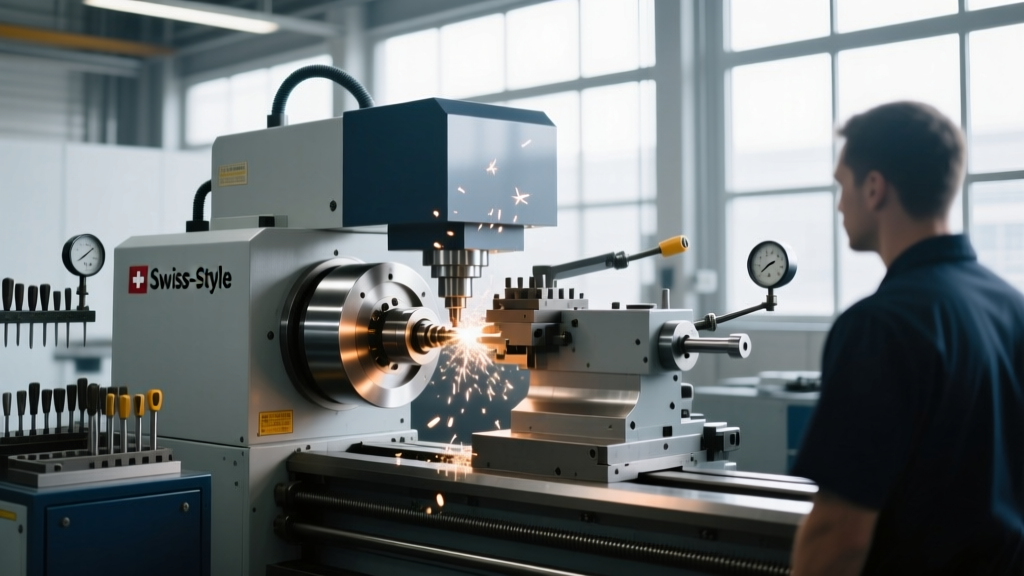
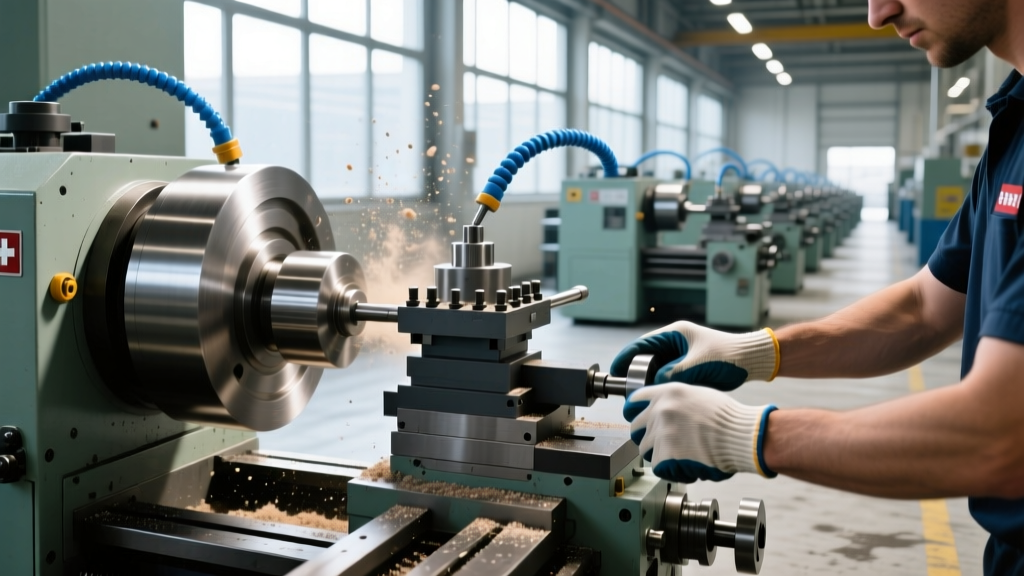
Transitioning an operator from a standard chucker lathe to a Swiss-type sliding headstock machine requires a fundamental rewiring of their spatial and mechanical understanding. In a standard CNC lathe, such as a Haas ST-10, the workpiece is held stationary in a chuck while the cutting tools move along the X and Z axes to remove material. In a Swiss CNC machine shop, the architecture is inverted: the cutting tools remain stationary (or move radially), while the bar stock feeds axially through a guide bushing.
This sliding headstock design means the machining operation always occurs within millimeters of the guide bushing support, eliminating part deflection and enabling the production of high-aspect-ratio components (e.g., 30:1 length-to-diameter ratios) that would instantly chatter on a standard lathe. However, this mechanical advantage introduces severe setup complexities. Operators must master guide bushing calibration, sub-spindle synchronization, and intricate multi-axis tool paths that standard lathe training simply does not cover.
CRITICAL WARNING: Guide Bushing ClearanceThe most common cause of catastrophic scrap rates for newly trained Swiss operators is improper guide bushing clearance. If the clearance between the bar stock and the segmented bushing exceeds 0.0005 inches, high-frequency vibration will destroy the surface finish and break micro-drills. If clearance is under 0.0002 inches, the bar will gall, bind, and stall the feeder, potentially snapping the main spindle drive belt. Target clearance must be strictly maintained between 0.0002" and 0.0004" depending on the material.
Training Timelines and Capital Investment
Building a competent workforce in a Swiss CNC machine shop requires a significantly longer runway than standard machining environments. According to workforce development frameworks supported by the NIST Manufacturing Extension Partnership (MEP), the learning curve for multi-axis Swiss turning involves a steep initial investment in both time and scrapped material.
| Metric | Standard CNC Lathe (2-Axis) | Swiss-Type Lathe (5 to 9-Axis) |
|---|---|---|
| Basic Setup Competency | 3 – 6 Months | 12 – 18 Months |
| Advanced Live Tooling/B-Axis | 6 – 9 Months | 24 – 36 Months |
| Average Scrap Cost During Training | $5,000 – $12,000 | $35,000 – $60,000 |
| Primary Failure Mode During Learning | Tool crashes, dimensional errors | Guide bushing damage, sub-spindle sync failures |
Step-by-Step Setup and Calibration Protocol
A rigorous, repeatable setup protocol is the backbone of any profitable Swiss CNC machine shop. Operators must be trained to execute the following sequence without deviation, particularly when setting up machines like the Tsugami BS20V or Citizen L32XII.
1. Bar Stock Verification and Preparation
Swiss machines cannot reliably run standard cold-drawn bar stock. Operators must verify that the material is centerless ground to an h6 diameter tolerance (typically ±0.0004" for 10mm stock). Using stock with ±0.002" tolerance will cause the guide bushing to either bind or fail to support the part. Train operators to use a micrometer to check the bar diameter at three points along the length before loading the bar feeder.
2. Guide Bushing Adjustment
Operators must use a precision test bar and a dial indicator (reading in ten-thousandths of an inch) to set the segmented guide bushing. The bushing must be adjusted to exert a light, uniform drag on the test bar. Over-tightening the adjustment screws will distort the bushing bore, creating an out-of-round condition that translates directly into part taper.
3. Thermal Growth Compensation
Because Swiss machines operate with tight tolerances over long cycle times, thermal expansion of the machine casting and bar stock is a major variable. Operators must run a warm-up cycle (minimum 15 minutes of spindle and axis movement) and measure the first-off part. Z-axis offsets must be adjusted to account for the thermal growth of the spindle and the tooling, which can easily shift Z-dimensions by 0.0005" to 0.001" as the machine reaches operating temperature.
PRO TIP: Sub-Spindle Chip EvacuationWhen training operators on sub-spindle pick-off operations, mandate the use of collets with integrated air-blow or high-pressure coolant ports. Chip accumulation inside the sub-spindle collet is the leading cause of Z-axis positioning errors and crushed part ends during the transfer phase.
Advanced Tooling and Live Tooling Best Practices
Modern Swiss CNC machine shops rely heavily on live tooling and B-axis contouring to complete complex medical and aerospace components in a single setup. Operators must understand the unique rigidity and chip-evacuation challenges of these operations.
- Tool Holder Selection: For maximum rigidity in live tooling, operators should be trained to select short-reach tool holders. When using Sandvik Coromant Capto C4 or C5 interfaces, minimize the overhang. Every 0.1" of unnecessary overhang reduces cutting edge stability and accelerates insert wear.
- Chip Control in Stringy Materials: When machining 304 Stainless Steel or Inconel, continuous chips will wrap around the guide bushing and halt production. Train operators to utilize Low Frequency Vibration (LFV) cutting cycles (available on modern Citizen controls) or specialized chip-breaking inserts from Kyocera to force manageable C-shaped chips.
- Cross-Drilling and High-Pressure Coolant: Standard flood coolant is insufficient for deep cross-drilling on a Swiss lathe. Operators must configure high-pressure coolant lines (minimum 1,000 PSI) directly at the cutting edge and employ peck-drilling cycles (G83) to ensure chips are evacuated from the blind hole before the drill retracts.
Troubleshooting Common Swiss Turning Defects
Operators must be equipped with a diagnostic framework to identify and resolve defects at the machine, rather than relying solely on the quality control department. The following matrix should be memorized by every Swiss lathe operator.
Symptom: Taper on Long Shafts
- Root Cause 1: Guide bushing wear or improper adjustment.
- Root Cause 2: Bar stock diameter variation exceeding h6 tolerance.
- Corrective Action: Re-calibrate the guide bushing using a test bar. If wear is evident on the carbide segments, replace the bushing. Verify incoming bar stock with a micrometer.
Symptom: Sub-Spindle Transfer Misalignment (Crushed Parts)
- Root Cause 1: Sub-spindle centerline is out of alignment with the main spindle.
- Root Cause 2: Chip trapped inside the sub-spindle collet.
- Corrective Action: Clean the collet and internal bore with high-pressure air. If the issue persists, perform a sub-spindle alignment procedure using a precision test arbor and dial indicator to re-zero the X and Y axes of the sub-spindle.
Symptom: Poor Surface Finish on Turned Diameters
- Root Cause 1: Tool center height is off, causing the insert to rub rather than cut.
- Root Cause 2: Excessive guide bushing clearance allowing micro-vibration.
- Corrective Action: Verify tool center height using a center-finding probe or test cut. Adjust the guide bushing tension to the specified 0.0002" clearance.
Industry Standards and Continuous Certification
The complexity of Swiss-type machining demands a commitment to continuous education. Leading facilities align their internal training programs with the certification standards and competency models outlined by the Society of Manufacturing Engineers (SME). Operators should be encouraged to pursue certifications in multi-axis CNC programming and precision metrology.
'In a Swiss CNC machine shop, the machine is only as capable as the operator's understanding of metallurgy, tool geometry, and thermal dynamics. We don't just train button-pushers; we train process engineers who happen to work on the shop floor.' — Director of Manufacturing Operations, Tier-1 Medical Device Supplier.
By enforcing strict setup protocols, investing in extended training timelines, and equipping operators with deep diagnostic frameworks, shop owners can transform their Swiss turning departments from high-scrap liabilities into highly profitable, lights-out capable production centers.