CNC Swiss Screw Machining: Medical and Aerospace Case Studies
Explore real-world CNC Swiss screw machining case studies in medical and aerospace, analyzing cycle times, tooling, and L/D ratio decision matrices.
The L/D Ratio Threshold and Guide Bushing Mechanics
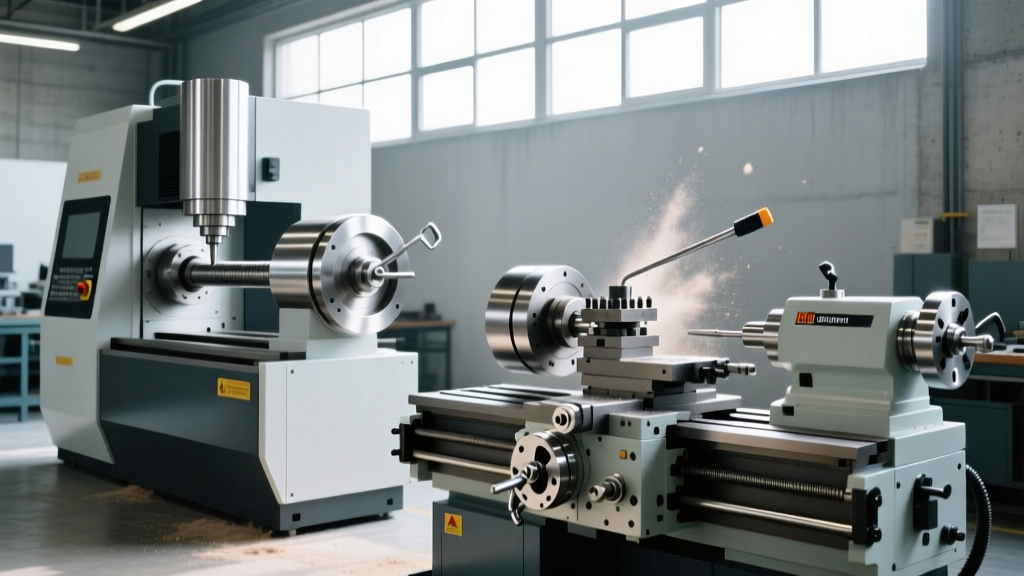
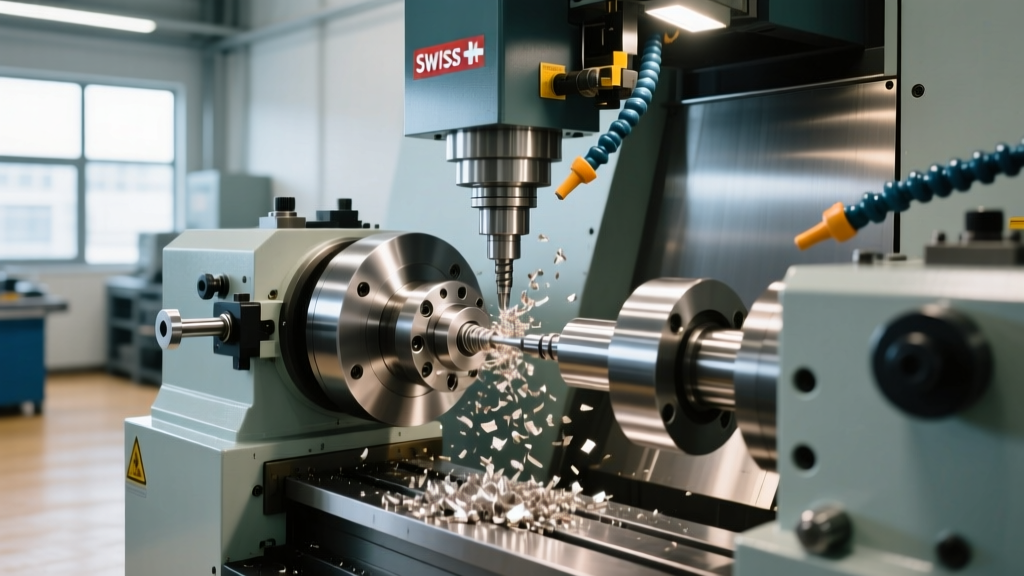
The defining mechanical advantage of CNC Swiss screw machining lies in the guide bushing. Unlike conventional turret lathes where the workpiece is held in a chuck and extends unsupported into the cutting zone, Swiss-type machines feed bar stock through a guide bushing located mere millimeters from the cutting tools. This eliminates part deflection, allowing for extreme depth-to-diameter ratios without the need for tailstock support or steady rests.
Key Metric: The breakeven point for CNC Swiss screw machining versus a standard 2-axis turret lathe typically occurs at an L/D (Length-to-Diameter) ratio of 4:1. Below 3:1, turret lathes dominate due to faster rapid traverse rates and simpler setups. Above 4:1, Swiss machines eliminate secondary operations and deflection-induced scrap.As of 2026, modern Swiss platforms like the Tsugami B0207-II and Citizen Cincom L200XII integrate thermal compensation and high-pressure coolant (HPC) systems natively, pushing the boundaries of what can be completed in a single setup. However, leveraging these capabilities requires a deep understanding of material-specific toolpaths and hidden material costs.
Case Study 1: Titanium Bone Screws (Medical Orthopedics)
The Challenge: Ti-6Al-4V ELI Thread Whirling
A tier-1 medical supplier needed to produce 4.5mm diameter, 45mm length orthopedic bone screws (L/D ratio of 10:1) from Ti-6Al-4V ELI (Extra Low Interstitial) titanium. The primary challenge was cutting the deep, sharp cancellous threads without inducing micro-fractures or requiring multiple spring passes that degrade tool life.
The Machine Setup: Tsugami B0207-II with Thread Whirling
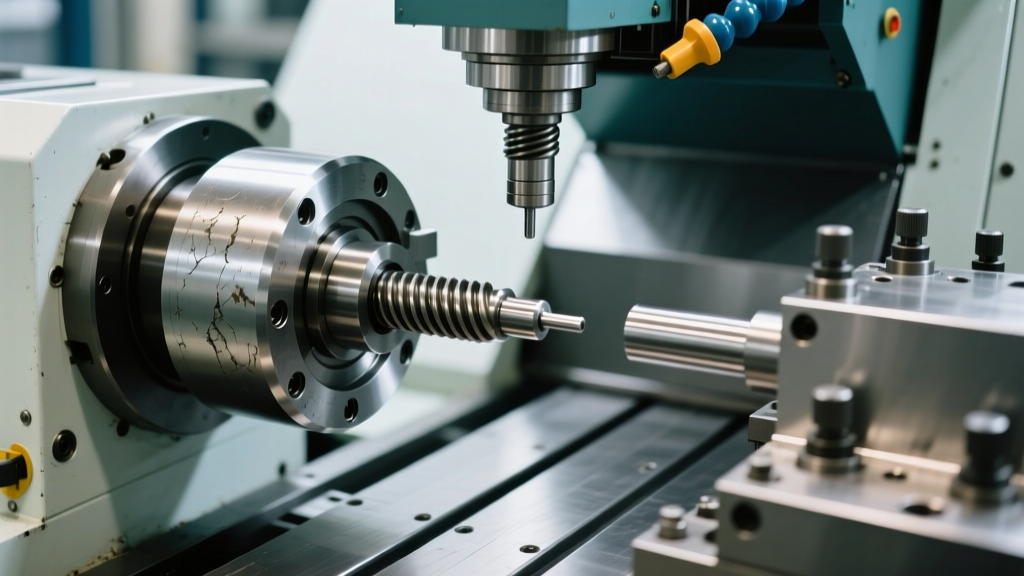
The engineering team deployed a Tsugami B0207-II equipped with a dedicated thread whirling unit. Unlike single-point threading, which requires the tool to traverse the length of the thread multiple times, thread whirling utilizes a rotating ring of carbide inserts (typically spinning at 1,500 to 3,000 RPM) that envelopes the part. The part rotates slowly (e.g., 20 RPM) while the whirling head advances.
- Tooling: Leistritz thread whirling head with 5 PVD-coated carbide inserts.
- Coolant: Neat cutting oil (Castrol Ilocut 489) at 40 bar. Water-soluble coolants are strictly avoided in Swiss-type titanium machining because the fine, needle-like chips pack into the guide bushing, causing catastrophic binding when water evaporates and leaves a sticky residue.
- Feed Rate: 0.8 mm/rev, completing the entire thread profile in a single pass.
Cost & Cycle Time Breakdown
| Metric | Single-Point Threading (Turret) | Thread Whirling (Swiss-Type) |
|---|---|---|
| Cycle Time per Part | 115 seconds | 42 seconds |
| Tool Life (Parts per Insert Edge) | 150 parts | 850 parts |
| Secondary Deburring Required? | Yes (Tumbling) | No (Clean cut) |
| Cost Per Part (at 50k volume) | $2.14 | $1.12 |
By shifting to CNC Swiss screw machining with thread whirling, the manufacturer reduced cycle time by 63% and eliminated a secondary tumbling operation, yielding a 47% reduction in total unit cost.
Case Study 2: Inconel 718 Fuel Nozzle Tips (Aerospace)
Overcoming Work Hardening with High-Pressure Coolant
Machining Inconel 718 fuel injector nozzles (8mm OD, 38mm length) presents severe work-hardening challenges. Inconel exhibits rapid strain hardening; if the cutting tool dwells or rubs instead of shearing the material, the surface hardness can spike from 40 HRC to over 55 HRC locally, instantly destroying subsequent tooling. According to metallurgical guidelines from Sandvik Coromant, maintaining a constant feed and avoiding zero-depth cuts is mandatory for heat-resistant superalloys (HRSAs).
Tooling Selection & Edge Failure Modes
An aerospace machine shop utilized a Star SR-20RIV B-type Swiss lathe to machine these nozzles. The initial failure mode was crater wear on the rake face of standard CVD-coated inserts due to the extreme heat generated at the shear zone (exceeding 1,200°F).
Warning: Never use CVD-coated carbide for finishing Inconel on a Swiss lathe. The thick CVD coating lacks the sharp edge geometry required for HRSAs. Always specify PVD TiAlN or AlCrN coatings with a honed edge (minimum 5-micron edge prep) to prevent micro-chipping.The engineering team switched to a PVD-coated Sandvik GC1125 grade insert with a positive rake angle. More importantly, they activated the machine's 150-bar (2,100 PSI) high-pressure coolant system directed precisely at the cutting edge. This pressure penetrates the vapor barrier created by the extreme heat, forcing coolant into the shear zone and breaking the notoriously stringy Inconel chips into manageable 'C' shapes.
'In Swiss machining of Inconel, chip evacuation is just as critical as the cut itself. If a stringy chip wraps around the guide bushing, it will score the bar stock and ruin the dimensional tolerance of the next 50 parts in the batch.' — Senior Manufacturing Engineer, Tier-1 Aerospace Supplier.
Decision Matrix: Turret Lathe vs. CNC Swiss Screw Machining
Selecting the right platform requires evaluating part geometry, material behavior, and volume. Use the following framework to route new part numbers to the correct machine type.
| Evaluation Criteria | Standard CNC Turret Lathe | CNC Swiss Screw Machining |
|---|---|---|
| L/D Ratio | < 3:1 (Short, stubby parts) | > 4:1 (Long, slender shafts) |
| Bar Stock Tolerance | Cold-drawn / Peeled (±0.05mm) | Precision Ground h6 (+0/-0.009mm) |
| Back-Working Capability | Limited (Requires sub-spindle pickup) | Excellent (Pick-off and reverse machining) |
| Setup Time | 1 - 3 Hours | 4 - 8 Hours (Guide bushing alignment) |
| Ideal Batch Size | 100 - 5,000 parts | 5,000 - 500,000+ parts |
For a deeper understanding of the kinematic differences between these platforms, the Modern Machine Shop guide to Swiss-type machining provides an excellent breakdown of the sliding headstock mechanics versus fixed headstock turret operations.
Hidden Costs in Swiss Machining: Bar Stock & Guide Bushing Setup
When calculating the ROI for CNC Swiss screw machining, shops frequently underestimate the hidden material and setup costs inherent to the guide bushing system.
The h6 Ground Bar Premium
Because the guide bushing must maintain a clearance of only 0.005mm to 0.015mm around the bar stock to prevent deflection, standard cold-drawn or peeled bar stock cannot be used. Shops must purchase centerless-ground bar stock, typically certified to ISO h6 tolerances. As of 2026, the premium for h6 precision ground bar stock remains 18% to 25% higher than standard peeled stock. For high-volume runs, this material premium is easily absorbed by the cycle time savings, but for prototype runs of 50 parts, it can destroy profitability.
Collet and Bushing Matching
Setting up a Swiss lathe requires matching the guide bushing to the exact diameter of the bar stock. If a shop runs 12.00mm stock on Monday and 12.70mm (1/2 inch) stock on Tuesday, the operator must physically swap the guide bushing and recalibrate the alignment. This adds 45 to 90 minutes to the setup time per changeover. Smart shops standardize their part designs around metric or imperial bar sizes to minimize bushing changeovers across a production week.
Actionable Takeaway: Before quoting a Swiss-machined part, verify the L/D ratio and check if the customer's tolerances allow for standard turned stock. If the part is under 4:1 L/D and does not require back-working, route it to a twin-spindle turret lathe to save 20% on material costs and 60% on setup time.