Budgeting for CNC Swiss Machines: 2026 Cost Analysis
A detailed 2026 cost analysis and budget planning guide for CNC Swiss machines, covering capital expenditure, hidden tooling costs, and ROI calculations.
The True Capital Expenditure of CNC Swiss Machines
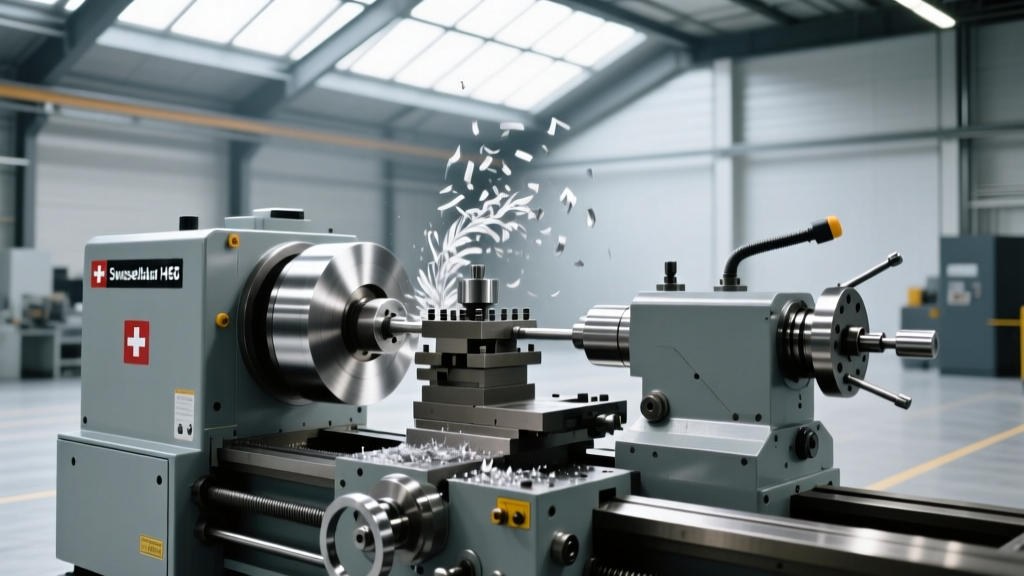
Procuring CNC Swiss machines requires a fundamentally different budgeting approach than standard chucker lathes. The capital expenditure (CapEx) is only the baseline; the true cost of ownership is dictated by peripheral integration, specialized tooling, and programming overhead. Unlike standard turning centers where a base model can often run production on day one, Swiss-type lathes demand a fully integrated ecosystem to achieve their theoretical cycle times.
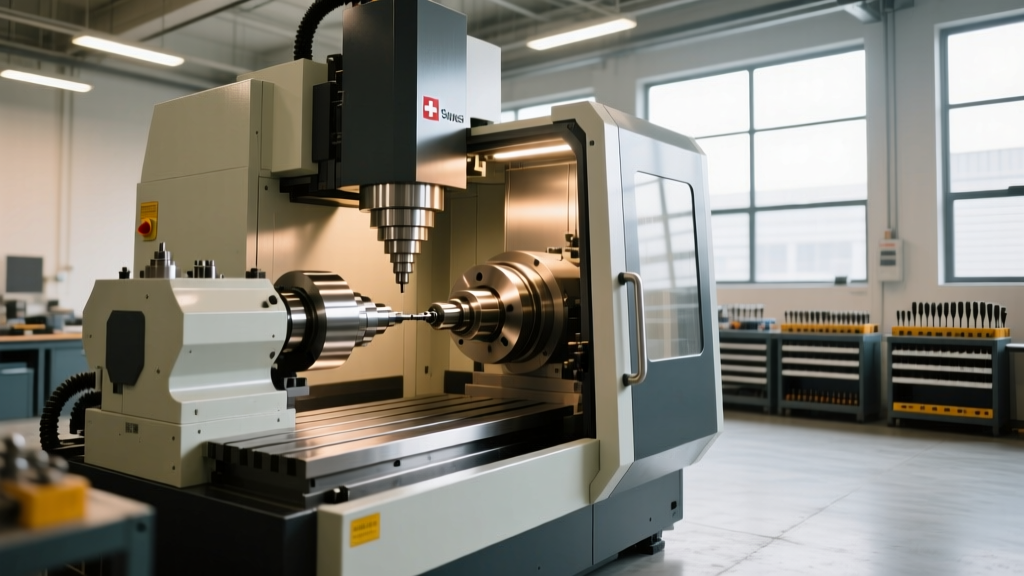
When evaluating the market in 2026, machine pricing stratifies distinctly by bar capacity, axis configuration, and control architecture. Entry-level 12mm machines serve the electronics and micro-medical sectors, while 20mm and 32mm machines dominate orthopedic, aerospace, and automotive fuel-system components.
| Machine Tier | Representative Model | Max Bar Capacity | Base Price (2026 Est.) | Fully Loaded Price |
|---|---|---|---|---|
| Entry-Level | Tsugami B012-V | 12mm | $165,000 | $215,000 |
| Mid-Range | Citizen L20-XII | 20mm | $240,000 | $315,000 |
| High-End | Star Micronics SR-32RIV | 32mm | $330,000 | $450,000+ |
The delta between the "base" and "fully loaded" price is where most shop owners experience budget shock. A fully loaded configuration includes a B-axis for angular milling, a C-axis on the subspindle, Y-axis off-center drilling capabilities, and high-pressure coolant (HPC) manifolds. Skipping the B-axis to save $35,000 upfront often forces the shop to add a secondary 5-axis milling operation later, entirely defeating the single-setup purpose of the Swiss platform.
Hidden Integration and Tooling Costs
Budgeting for CNC Swiss machines must account for the guide bushing ecosystem and automated material handling. According to manufacturing benchmarks tracked by the Society of Manufacturing Engineers (SME), peripheral integration can add 20% to 35% to the initial machine invoice.
The Bar Feeder Requirement
Swiss machines cannot operate efficiently with manual bar loading. The guide bushing requires the bar stock to be pushed with extreme precision. You must budget for a hydrodynamic or hydrostatic bar feeder.
- LNS Alpha Series (Hydrodynamic): ~$25,000 - $32,000. Ideal for standard production runs of steel and aluminum.
- Iemca Master 80 (Hydrostatic): ~$38,000 - $45,000. Mandatory for delicate, pre-polished medical tubing or abrasive materials where vibration must be eliminated.
Unlike standard lathes that use a single chuck collet, Swiss machines require a guide bushing for every specific bar diameter you run. A standard hardened steel guide bushing costs $350–$500. However, if you are machining titanium, Inconel, or glass-filled PEEK, you must upgrade to carbide-tipped guide bushings, which cost $1,100–$1,600 each. If your shop runs 15 different material diameters, budget an immediate $18,000 just for guide bushing inventory.
High-Pressure Coolant (HPC) Systems
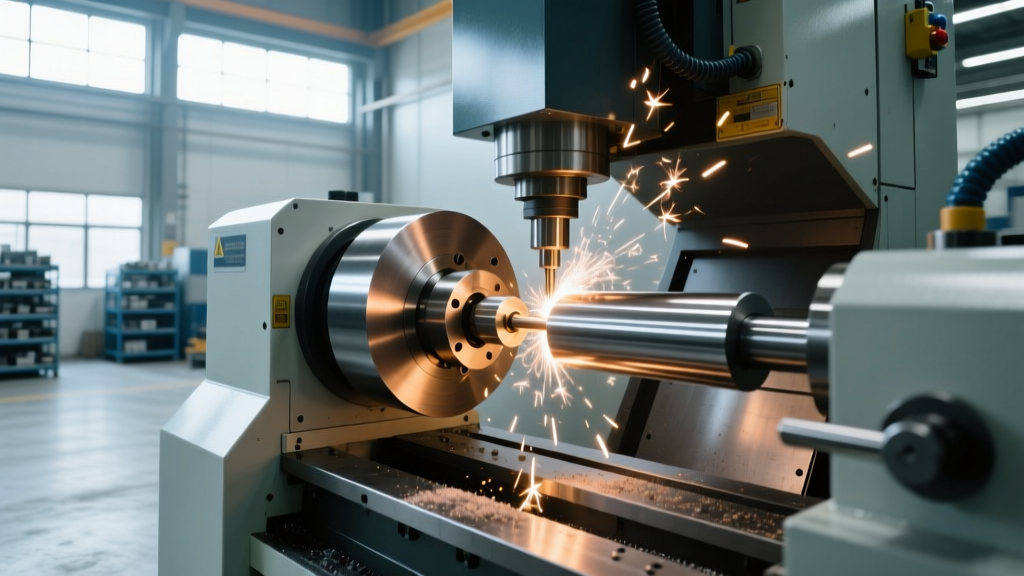
When cutting stringy materials like 316L stainless steel or tough alloys like Ti-6Al-4V, standard flood coolant fails to penetrate the cutting zone at the guide bushing interface. Integrating a 1,500 to 2,000 PSI HPC system (such as those from MP Systems or ChipBLASTER) adds $16,000 to $22,000 to the budget. This is not optional for aerospace and medical contracts; it is a requirement for chip evacuation and preventing bushing seizure.
Operational ROI: Swiss vs. Conventional Turning Centers
To justify the premium of CNC Swiss machines, production planners must calculate the elimination of secondary operations. The Association for Manufacturing Technology (AMT) frequently highlights that Swiss-type platforms excel not just in speed, but in consolidating multi-machine workflows into a single footprint.
Case Study: 0.25" Diameter Orthopedic Bone Screw
Consider a 1.5-inch long titanium bone screw featuring a hexagonal drive socket, external threading, and a cross-drilled retention hole.
| Metric | Conventional Lathe + VMC | Swiss-Type Lathe (20mm) |
|---|---|---|
| Setup Time | 4.5 hours (2 machines) | 2.0 hours (1 machine) |
| Cycle Time per Part | 4.2 mins (Lathe) + 3.5 mins (VMC) | 3.8 mins (Complete) |
| Scrap Rate (First 50 parts) | 8% (Handling damage between ops) | 1.5% (No intermediate handling) |
| Floor Space Required | 120 sq. ft. | 45 sq. ft. |
While the conventional route utilizes cheaper hourly machine rates, the labor cost of moving WIP (Work in Progress) between the lathe and the vertical machining center, combined with the 8% scrap rate on delicate titanium threads, destroys the margin. The Swiss machine pays for its $300,000 price tag through labor reduction and scrap mitigation on lots exceeding 500 pieces.
Calculating the Break-Even Point
Use the following framework to determine the minimum annual volume required to justify a mid-range Swiss machine purchase over a standard 5-axis mill-turn center.
Break-Even Formula:
Fixed Cost Differential / (Net Profit per Part on Swiss - Net Profit per Part on Conventional)
If a Citizen L20-XII costs $140,000 more than your existing lathe/mill combination, and the Swiss machine yields an additional $1.85 in net profit per part (via labor and scrap savings), you must run 75,675 parts annually on that specific machine to break even on the capital premium within year one.
For high-mix, low-volume job shops running lots of 50-100 pieces, the programming overhead of Swiss machines (which can take 8-12 hours for complex kinematic synchronization) will result in a negative ROI. Swiss platforms are strictly justified for production runs of 1,000+ pieces, or highly complex micro-parts where conventional milling is physically impossible.
Financing, Depreciation, and 2026 Tax Incentives
When structuring the capital budget for 2026, machine shop owners must account for the shifting landscape of US tax codes regarding manufacturing equipment. Under the Tax Cuts and Jobs Act (TCJA) phase-out schedule, 100% bonus depreciation expired in 2022 and has been stepping down annually.
For equipment placed in service during the 2026 tax year, bonus depreciation drops to 40%. This means if you purchase a fully loaded Star Micronics SR-32RIV for $420,000, you can immediately deduct $168,000 (40%) in the first year. The remaining $252,000 must be depreciated over the standard 5-year MACRS schedule.
Alternatively, Section 179 expensing remains a powerful tool. For 2026, the Section 179 deduction limit is projected to allow businesses to expense up to $1.22 million of qualifying equipment immediately, provided total equipment purchases do not exceed the phase-out threshold (approximately $3.05 million). Structuring your Q4 2025 or Q1 2026 purchases to maximize Section 179 before the bonus depreciation drops further is a critical strategy for CFOs and shop owners managing cash flow.
Strategic Budgeting Checklist for Buyers
- Audit Bar Stock Tolerances: Swiss machines require ground bar stock (h6 tolerance). Budget an extra $0.15–$0.30 per pound for material compared to standard peeled cold-finish bar.
- Allocate CAM Software Funds: Standard 2-axis CAM packages cannot generate Swiss G-code. Budget $25,000–$40,000 for advanced Swiss-specific CAM modules (e.g., ESPRIT or GibbsCAM Swiss-turn) and post-processor customization.
- Factor in Programmer Training: Transitioning a standard lathe programmer to Swiss kinematics requires 4-6 weeks of dedicated training. Expect a 30% drop in programming efficiency during the first 90 days of machine ownership.