5-Axis CNC Lathe Machine Aerospace Case Studies for 2026
Explore 2026 case studies showing how 5-axis CNC lathe machines reduce cycle times and eliminate secondary operations in aerospace and medical manufacturing.
The Shift to Done-in-One Machining in High-Mix Production
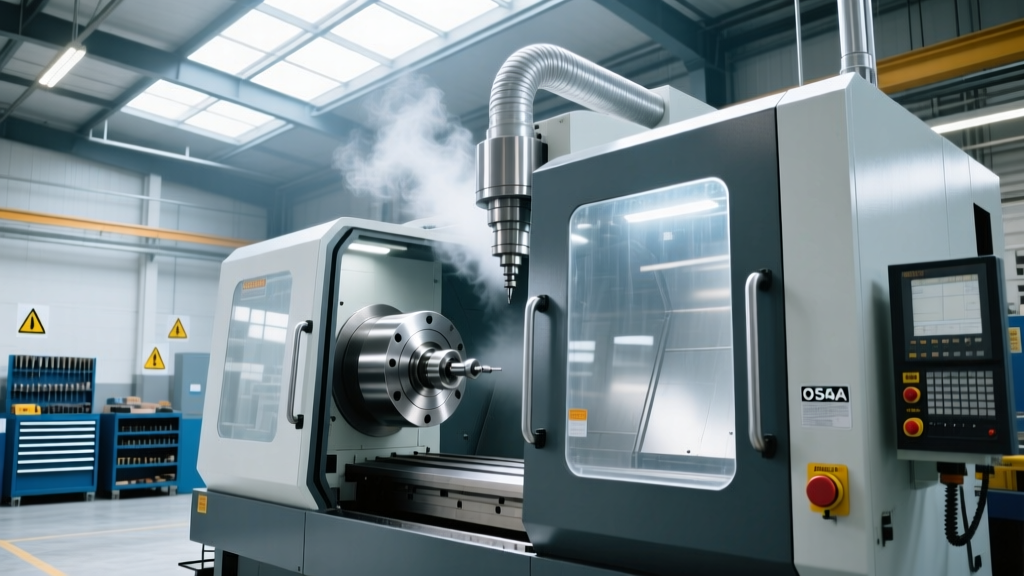
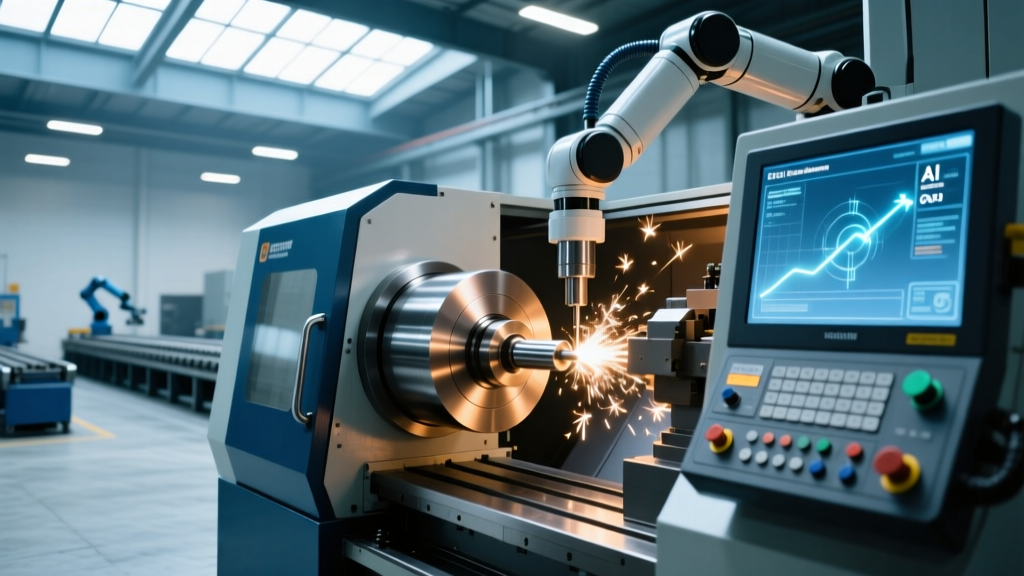
The transition from multi-setup milling to single-chucking turning operations has redefined high-precision manufacturing. As of 2026, the modern 5-axis CNC lathe machine is no longer just a cylindrical turning tool; it is a complete machining center capable of simultaneous contouring, off-center drilling, and complex threading. By integrating AI-driven thermal compensation and 150+ bar high-pressure coolant (HPC) systems, tier-1 and tier-2 suppliers are successfully machining hardened superalloys and medical-grade titanium in single setups. This eliminates cumulative tolerance stack-up and drastically reduces work-in-progress (WIP) inventory.
Below, we examine two distinct production environments where upgrading to a multi-tasking CNC lathe machine yielded measurable gains in cycle time, tool life, and surface integrity.
Case Study 1: Inconel 718 Turbine Blade Roots
The Challenge: Interrupted Cuts and Thermal Cratering
Machining the fir-tree root profile of a turbine blade from Inconel 718 is notoriously difficult. The material's high nickel-chromium content causes rapid work hardening, while its low thermal conductivity traps heat at the cutting edge. Historically, manufacturers relied on 5-axis milling or specialized broaching machines. However, broaching requires expensive, dedicated tooling for each part number, and milling leaves the part vulnerable to chatter during the interrupted cuts of the fir-tree geometry.
The Setup: DMG MORI NLX 2500 with Targeted HPC
A mid-sized aerospace supplier in Ohio replaced their 3-axis mill-turn setup with a DMG MORI NLX 2500, a heavy-duty 5-axis CNC lathe machine equipped with a B-axis milling spindle and CELOS controller. The critical upgrade was the integration of a 150-bar HPC system delivering coolant directly to the shear zone via through-tool nozzles.
- Material: Inconel 718 (Solution treated and aged, 42 HRC)
- Tooling: Kyocera KCS25B grade carbide inserts with AlTiN nano-layer coating
- Cutting Parameters: Vc = 45 m/min, f = 0.12 mm/rev, ap = 1.5 mm (roughing)
- Strategy: B-axis contouring with constant chip thickness to prevent edge micro-chipping
According to Sandvik Coromant's superalloy machining guidelines, maintaining a constant cutting edge engagement and preventing the tool from dwelling in the cut is critical to avoiding notch wear. The NLX 2500's high-rigidity bed and B-axis interpolation allowed the shop to maintain continuous contact, effectively eliminating the dwell points that previously caused thermal cratering.
Performance Metrics: Traditional Mill-Turn vs. 5-Axis Turning
| Metric | Legacy 5-Axis Mill-Turn | 5-Axis CNC Lathe Machine (NLX 2500) | Variance |
|---|---|---|---|
| Total Cycle Time | 34 minutes | 16.5 minutes | -51.4% |
| Tool Life (Edges per Insert) | 14 parts | 48 parts | +242% |
| Setup / Fixturing Time | 45 minutes (custom vise) | 4 minutes (hydraulic chuck) | -91.1% |
| Surface Finish (Ra) | 1.2 µm | 0.6 µm | 50% smoother |
Case Study 2: Ti-6Al-4V ELI Spinal Screws via Swiss-Type Turning
Micro-Turning and Stringy Chip Evacuation
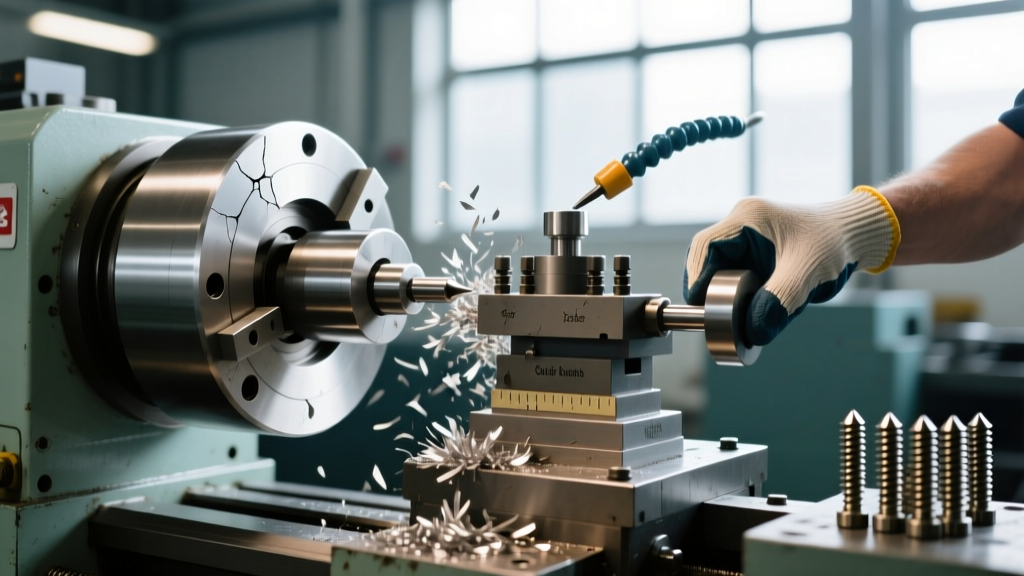
Medical implants demand flawless surface finishes to prevent bacterial adhesion and ensure biocompatibility. A medical device manufacturer producing 4.5mm diameter Ti-6Al-4V ELI spinal screws faced severe bottlenecks. The stringy nature of titanium chips was wrapping around the micro-tools, causing catastrophic tool breakage and scratching the finished bone-thread profiles. Furthermore, achieving the required Ra 0.2 µm surface finish previously mandated a secondary vibratory tumbling process, which risked altering the tight thread tolerances.
The Setup: Tornos SwissNano 13
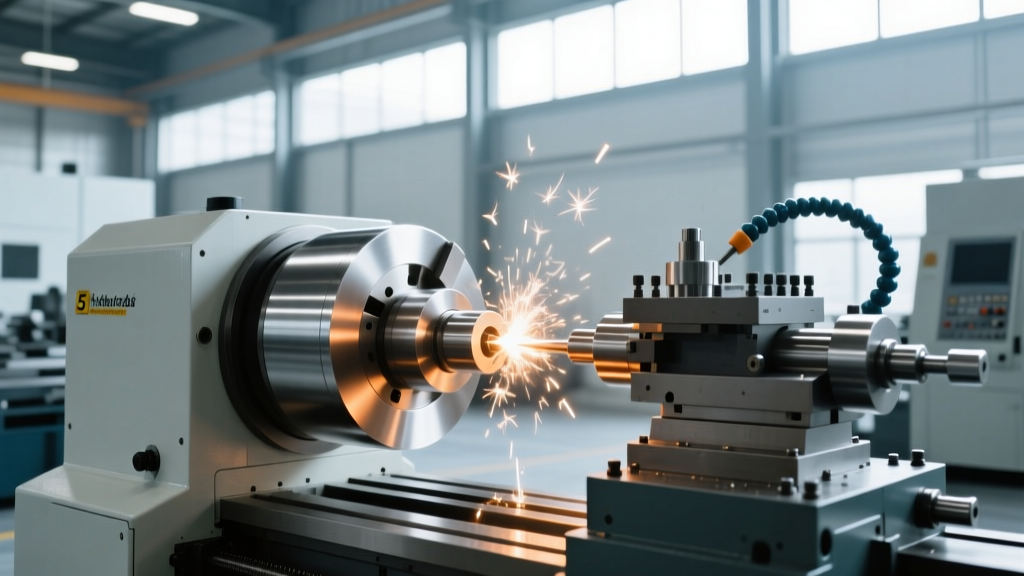
The facility invested in a Tornos SwissNano 13, a specialized Swiss-type CNC lathe machine designed for micro-machining. The sliding headstock design supports the bar stock millimeters away from the cutting action, eliminating deflection even at high L/D (length-to-diameter) ratios.
'By moving to a dedicated Swiss-type architecture with a 5-micron oil filtration system, we completely eliminated the secondary tumbling operation. The surface finish comes off the machine at Ra 0.15 µm, fully compliant with ISO 13485 medical device standards.' — Lead Manufacturing Engineer, Orthopedic Division.
To manage the titanium chips, the shop implemented a dual-phase cooling strategy: 80-bar oil coolant for lubrication and heat extraction, paired with a targeted high-pressure air blast to physically fracture and evacuate the stringy chips before they could recirculate. Data from Mazak's medical manufacturing division corroborates that high-pressure air assist is mandatory for unattended micro-machining of reactive alloys like titanium.
Whirlwind Milling Integration
Instead of single-point threading, the SwissNano 13 utilized a whirlwind milling attachment. Spinning at 3,000 RPM while the main spindle rotated at 45 RPM, the whirlwind cutter generated the complex bone thread in a single pass. This reduced the threading cycle time from 42 seconds to 9 seconds per screw, while extending the thread mill life by 300% due to the interrupted cutting action allowing the carbide edges to cool between engagements.
ROI Framework: Justifying the $520,000 Investment
Upgrading to a multi-tasking or Swiss-type CNC lathe machine requires significant capital. Here is the verified 2026 payback model for the medical facility mentioned above:
- Capital Expenditure: $520,000 (Machine, bar feeder, 5-micron chiller, and tooling)
- Eliminated Assets: Sold two legacy CNC mills and one vibratory tumbler (Recovered $115,000)
- Labor Reallocation: Reduced manual loading/unloading and secondary inspection, saving 18 labor hours per week at a fully burdened rate of $65/hour ($60,840 annual savings)
- Scrap Reduction: Titanium bar stock costs approximately $42/lb. Eliminating the 4% scrap rate from secondary tumbling damage saved $22,000 annually.
- Floor Space Recovery: Reclaimed 240 sq. ft. of production floor, valued at $45/sq. ft. annually in localized facility overhead.
Total Year-One Net Savings: $148,500. Estimated Payback Period: 28 months at 65% spindle utilization.
Decision Matrix: Selecting the Right Architecture
Choosing between a standard 5-axis CNC lathe machine and a Swiss-type turning center depends entirely on part geometry, material behavior, and production volume. Use this framework to guide your 2026 capital equipment planning:
When to Specify a 5-Axis Turning Center (e.g., DMG MORI NLX, Mazak INTEGREX)
- Part Geometry: Stubby, complex aerospace fittings, turbine hubs, and valve bodies with an L/D ratio under 3:1.
- Secondary Operations: Parts requiring heavy off-center milling, deep cross-drilling, or complex 3D contouring on the face and OD.
- Material: High-temperature superalloys (Inconel, Waspaloy) requiring massive spindle torque (1,000+ Nm) and rigid bed damping.
When to Specify a Swiss-Type CNC Lathe Machine (e.g., Tornos, Citizen, Tsugami)
- Part Geometry: Long, slender shafts, bone screws, and micro-pins with an L/D ratio exceeding 4:1.
- Secondary Operations: Micro-threading, tiny radial holes, and fine knurling where part deflection would ruin tolerances.
- Material: Medical-grade titanium, MP35N, and Nitinol, where guide-bushing support is mandatory to prevent chatter.
Strategic Sourcing and Future-Proofing
The baseline for competitive machining in 2026 requires more than just rigid iron; it demands intelligent software integration. When sourcing a new CNC lathe machine, mandate that the controller supports open-architecture MTConnect or OPC-UA protocols. This allows the machine's spindle load, thermal growth, and axis servo data to feed directly into your shop's ERP or predictive maintenance AI. Research supported by NIST's advanced machining initiatives highlights that shops leveraging real-time spindle load data to predict insert wear reduce unplanned downtime by up to 38%.
Ultimately, the decision to adopt a 5-axis or Swiss-type CNC lathe machine is not just a tooling upgrade—it is a fundamental shift toward done-in-one manufacturing. By eliminating secondary setups, shops protect their most valuable assets: part integrity, floor space, and skilled labor hours.