CNC Machining Turning Safety: 2026 Compliance Guide
Navigate 2026 safety compliance for CNC machining turning. Covers ISO 23125 containment, OSHA interlocks, mist extraction, and audit frameworks.
The Regulatory Stakes of CNC Machining Turning
Operating a modern turning center without strict adherence to international safety standards exposes manufacturing facilities to catastrophic kinetic failures and severe regulatory penalties. In the realm of CNC machining turning, the primary hazards involve high-velocity workpiece ejection, entanglement in rotating spindles, and prolonged exposure to atomized metalworking fluids (MWFs). Regulatory bodies have intensified their scrutiny on machine tool guarding, shifting from basic physical barriers to comprehensive, electronically monitored safety architectures.
⚠️ Compliance Warning: Under current OSHA enforcement guidelines, a willful violation of machine guarding standards (such as bypassing a chuck guard interlock) carries a maximum penalty exceeding $161,000 per instance. Repeat offenders face multipliers that can push fines well past $500,000, exclusive of civil litigation following an injury.Facility managers and safety engineers must align their CNC turning operations with the intersection of OSHA 1910.212 General Requirements for All Machines and the highly specific technical parameters outlined in ISO 23125 and ANSI B11.0.
ISO 23125 Containment Standards: Polycarbonate vs. Acrylic
The most critical physical safeguard in CNC machining turning is the chuck guard. A frequent and dangerous error observed in machine shops is the retrofitting of manual-lathe style acrylic (PMMA) shields onto CNC turning centers. Acrylic is brittle; upon impact from a ejected 3-pound steel workpiece spinning at 4,000 RPM, it shatters into high-velocity shrapnel.
The ISO 23125:2015 Safety of Machine Tools standard mandates specific containment grades based on the kinetic energy potential of the machine. CNC lathes universally fall into Grade 2 or Grade 3 containment requirements, necessitating the use of uncoated, UV-stabilized polycarbonate (such as Lexan or Makrolon) paired with steel reinforcement frames.
| Chuck Diameter | Max Spindle RPM | ISO 23125 Grade | Min. Polycarbonate Thickness |
|---|---|---|---|
| 6-inch (150mm) | 6,000 RPM | Grade 2 | 8 mm (5/16") |
| 10-inch (250mm) | 4,000 RPM | Grade 3 | 12 mm (1/2") |
| 15-inch (380mm) | 2,500 RPM | Grade 3 | 15 mm (5/8") + Steel Mesh |
Pro-Tip on Degradation: Polycarbonate degrades when exposed to certain synthetic coolants and UV light. Implement a mandatory 24-month replacement cycle for all viewing windows, or utilize specialized coolant-resistant coatings like Makrolon GP, which resist chemical crazing that obscures operator visibility and weakens structural integrity.
Safety Interlock Architecture: Defeating the "Cheater Key"
Physical guarding is useless if operators can bypass it to clear chips or adjust tooling while the spindle is in motion. Early magnetic reed switches were easily defeated by taping a spare magnet to the sensor. Modern CNC machining turning compliance requires RFID-coded solenoid interlocks, such as the Schmersal AZM400 or Fortress Ambrist series.
Required Interlock Specifications for CNC Lathes
- RFID Coding: The actuator must have a unique electronic signature. The sensor will not engage if presented with a generic magnet or an unpaired actuator, eliminating the "cheater key" workaround.
- Guard Locking (Solenoid): The door must remain mechanically locked until the spindle reaches zero RPM. This requires the interlock to monitor the machine's safe-speed signal (often via a safe-motion module on the CNC drive) rather than just a simple timer.
- Holding Force: Minimum 10,000 Newtons (approx. 2,200 lbs) to prevent operators from physically forcing the door open during heavy interrupted cuts that cause severe machine vibration.
- PL d / Category 3: The wiring must utilize dual-channel monitoring with cross-fault detection integrated into the machine's safety PLC.
"The most dangerous component on a CNC lathe isn't the spindle; it's the zip-tie in the operator's pocket. If your safety architecture relies on operator discipline rather than engineered defeat-resistance, you are already non-compliant." — Industrial Safety Engineering Consensus, 2025.
Coolant Mist Extraction and Air Quality Compliance
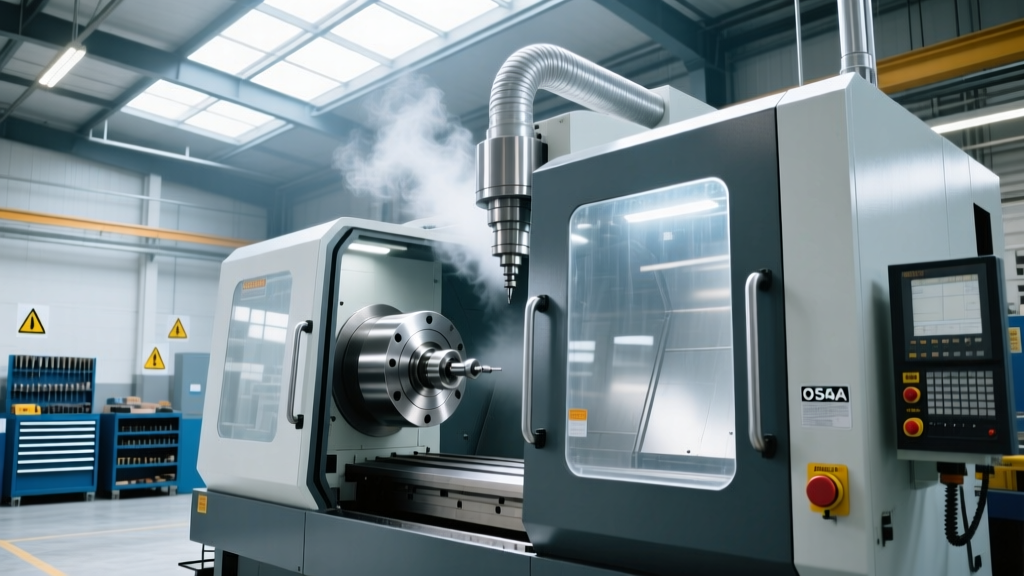
High-pressure coolant delivery systems (operating at 1,000 to 3,000 PSI) are standard on modern turning centers to break chips in tough alloys like Inconel or titanium. However, this pressure atomizes the coolant, creating sub-micron aerosols that pose severe respiratory risks.
While the OSHA Permissible Exposure Limit (PEL) for metalworking fluids is 5.0 mg/m³ as an 8-hour TWA, the NIOSH Recommended Exposure Limit (REL) is drastically lower at 0.4 mg/m³. To meet modern compliance and protect worker health, shops must deploy localized mist collection systems directly integrated into the lathe's enclosure.
Sizing and Ducting Requirements
Undersized mist collectors lead to positive pressure inside the lathe enclosure, forcing coolant vapor out through cable glands and door seals. To calculate the required CFM (Cubic Feet per Minute) for a standard 2-axis CNC lathe:
- Base Enclosure Volume: Calculate the internal cubic footage of the machine.
- Air Exchange Rate: Target a minimum of 4 to 6 air exchanges per minute to maintain negative pressure.
- Ducting Velocity: Maintain a minimum transport velocity of 3,500 FPM (Feet Per Minute) in the exhaust ducting to prevent liquid aerosol dropout and subsequent duct corrosion.
For operations using neat (straight) oils rather than water-soluble synthetics, HEPA filtration stages are mandatory to capture the finer smoke particulates generated during high-speed turning.
The Overlooked Hazard: Chip Conveyor Entanglement
Safety audits frequently focus on the primary machining envelope while ignoring the chip conveyor. Hinge-belt and scraper conveyors present severe nip-point and entanglement hazards. Under ANSI B11.0, the drive motor of a chip conveyor must be integrated into the machine's safety circuit. If the conveyor guarding is opened for maintenance, the drive must instantly drop power via a safety-rated contactor. Furthermore, torque-limiting clutches or safety-rated motion monitoring (SMM) must be installed to halt the conveyor instantly if a jam occurs, preventing the belt from snapping and whipping back at the operator.
The 5-Point CNC Turning Compliance Audit Framework
Use this diagnostic matrix to evaluate your current turning center fleet against 2026 enforcement priorities:
| Audit Checkpoint | Verification Method | Common Failure Mode |
|---|---|---|
| 1. Guarding Integrity | Visual inspection for micro-fractures and chemical crazing on poly windows. | Using Windex/ammonia cleaners which instantly degrade polycarbonate. |
| 2. Interlock Defeat | Attempt to initiate a cycle with the door closed but the actuator removed. | Operators taping spare actuators to sensors to bypass lock-out delays. |
| 3. E-Stop Drop Test | Trigger E-Stop during max RPM spindle rotation; measure stopping distance. | E-Stop wired to standard PLC instead of hardwired safety relay, causing delayed braking. |
| 4. Mist Collector Vacuum | Use a manometer to check negative pressure inside the enclosure. | Clogged pre-filters causing positive pressure and vapor leaks at door seals. |
| 5. Foot Pedal Guarding | Verify chuck open/close pedals have full shrouds and require active downward force. | Resting heavy tools on the pedal, accidentally triggering chuck release during setup. |
Achieving full compliance in CNC machining turning requires moving beyond basic physical barriers. By implementing RFID-coded interlocks, adhering to ISO 23125 containment thicknesses, and maintaining strict negative-pressure mist extraction, facilities can eliminate catastrophic risks while ensuring uninterrupted production in a heavily regulated environment.