Comparing CNC Swiss Machine Shops vs Standard Turning Centers
Decide between CNC Swiss machine shops and standard turning centers. Compare costs, tolerances, and lead times for precision part sourcing.
The Core Mechanical Difference: Guide Bushing vs. Chuck
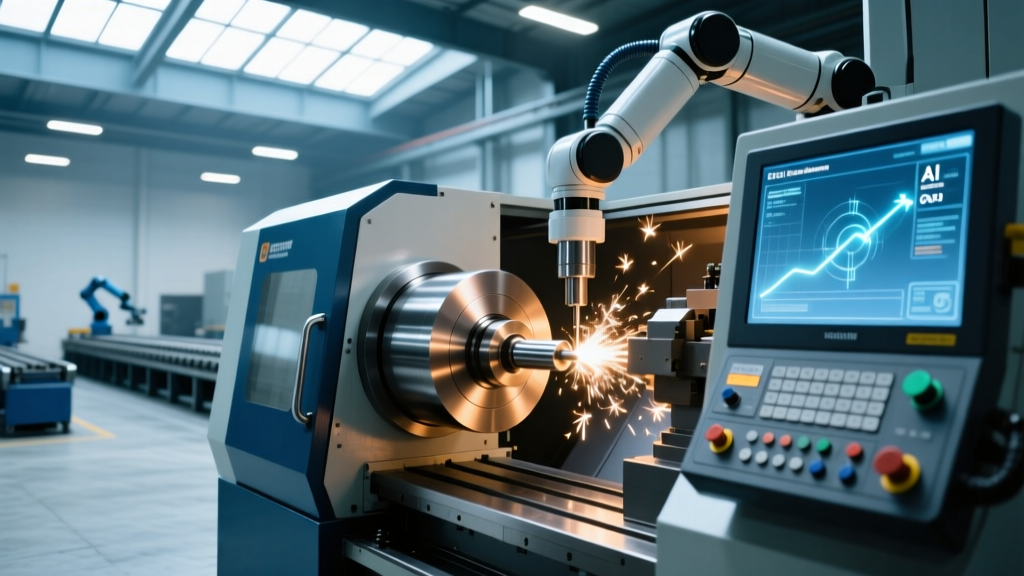
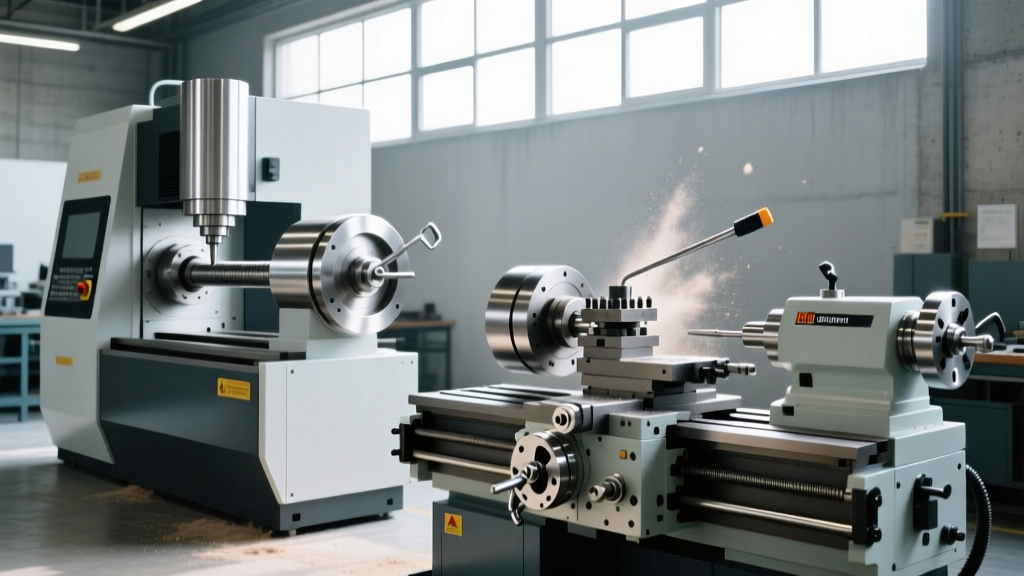
Sourcing precision cylindrical components requires matching part geometry to the correct kinematic platform. Buyers evaluating quotes frequently encounter a divergence in manufacturing approaches: specialized CNC Swiss machine shops versus standard CNC turning centers. The fundamental difference lies in workholding and vibration dampening.
Standard CNC lathes utilize a fixed headstock and a chuck to grip the raw material. As the cutting tool engages, the unsupported length of the part extends outward, making it susceptible to radial deflection and chatter. This limits the viable length-to-diameter (L:D) ratio, typically capping out at 3:1 or 4:1 before part quality degrades.
Conversely, CNC Swiss machine shops operate sliding-headstock lathes. The material is clamped by a collet and fed through a guide bushing positioned mere millimeters from the cutting tools. As the headstock slides along the Z-axis, the guide bushing provides continuous, rigid support directly at the point of cut. This mechanical advantage allows Swiss-type machines—such as the Tsugami B0125 or Citizen M32-VII—to machine extremely slender components with L:D ratios exceeding 10:1 while holding ultra-tight tolerances of ±0.0002 inches (5µm) on the outer diameter.
The 3:1 L:D Ratio Rule
If your component's length is more than three times its maximum outer diameter, standard turning will require secondary support (like a tailstock or steady rest), which increases cycle time and limits tool access. Parts exceeding a 3:1 L:D ratio should automatically be routed to CNC Swiss machine shops for single-setup completion.
The Material Yield and Stock Preparation Factor
A frequently overlooked variable when comparing quotes from CNC Swiss machine shops against standard turning suppliers is raw material preparation and yield. The guide bushing on a Swiss-type lathe requires the bar stock to be precision ground. The diameter tolerance of the raw material must typically be held to ±0.0005 inches to ensure smooth sliding without slippage or excessive vibration. Standard lathes, however, can run cold-drawn or rough extruded bar stock directly from the mill, which is significantly cheaper per pound.
Furthermore, material yield differs due to remnant lengths. A Swiss machine's pusher collet and guide bushing assembly require a longer unsupported butt-end (remnant) at the end of the bar, often 3 to 6 inches depending on the machine model and bar feeder brand. Standard CNC lathes equipped with a sub-spindle and parts catcher can sever the part much closer to the chuck, minimizing scrap. For high-volume production runs (e.g., 100,000+ pieces) of larger diameter parts, this scrap differential can heavily skew the total landed cost in favor of standard turning centers.
Cost Breakdown: Hourly Rates vs. Total Piece Price
It is a common misconception that Swiss machining is universally more expensive. While the hourly shop rate for CNC Swiss machine shops is higher—typically ranging from $130 to $180 per hour compared to $85 to $120 for standard turning centers—the total piece price for complex geometries often favors the Swiss process.
This paradox is driven by the "Done-in-One" capability of modern Swiss lathes. Machines equipped with B-axis milling heads and Y-axis cross-working can mill flats, drill off-center cross-holes, and cut complex contours without unclamping the part. Sending a part to a standard lathe and subsequently moving it to a 3-axis or 5-axis vertical machining center (VMC) for secondary milling operations introduces cumulative tolerances, extra fixturing costs, and additional handling time.
| Sourcing Metric | CNC Swiss Machine Shops | Standard Turning Centers |
|---|---|---|
| Max Practical Diameter | 1.25" (32mm) standard; up to 2.25" on heavy models | 2" to 12"+ depending on chuck size |
| Typical Hourly Rate | $130 - $180 / hour | $85 - $120 / hour |
| Setup Time & Complexity | 4 - 10 hours (guide bushing, collets, complex CAM) | 1 - 3 hours (soft jaws, standard tooling) |
| Secondary Operations | Rarely required (B-axis/Y-axis milling integrated) | Frequently required for off-center milling/drilling |
| OD Tolerance Capability | ±0.0002" (5µm) | ±0.0005" (12µm) |
The programming overhead also dictates the break-even volume. Generating collision-free toolpaths for a multi-channel Swiss lathe requires advanced CAM software like Esprit or GibbsCAM SwissTurn, and verifying the kinematics via 3D simulation is mandatory to prevent catastrophic crashes. Therefore, CNC Swiss machine shops are economically unviable for prototype quantities of 1 to 5 parts, but highly competitive for production runs of 500+ complex components.
Evaluating a CNC Swiss Machine Shop: 4 Non-Negotiable Capabilities
Not all Swiss turning facilities possess the same level of technological maturity. When auditing a potential supplier, verify the presence of the following infrastructure to ensure they can maintain tight Cpk (Process Capability Index) requirements over long, unattended runs:
- High-Pressure Coolant Systems (1,000+ PSI): Swiss machining generates significant heat in a confined cutting zone. Shops must utilize high-pressure coolant pumps to break chips in gummy materials like 316L Stainless Steel or Titanium Grade 5, preventing bird-nesting that halts unattended production.
- Marposs In-Process Gauging: To hold medical and aerospace tolerances, top-tier shops integrate Marposs or Renishaw touch probes and optical measurement systems directly inside the machine enclosure. This allows the control to automatically adjust tool wear offsets in real-time without operator intervention.
- Advanced Bar Feeders (Iemca or LNS): A Swiss lathe is only as automated as its material delivery. Look for hydrostatic bar feeders like the Iemca Master 80 or LNS Hydrobar, which dampen bar vibration and allow the machine to run lights-out over weekends.
- Industry-Specific Certifications: If sourcing for medical devices, the shop must hold ISO 13485 certification. For aerospace, AS9100 Rev D is mandatory. These frameworks ensure traceability of the ground bar stock and strict calibration of the micrometers used for first-article inspections.
For a broader understanding of industry standards and technological advancements in this sector, procurement teams should review Modern Machine Shop's Swiss Machining coverage, which regularly details the latest kinematic innovations and shop-floor strategies.
Decision Flowchart: Which Shop Type Do You Need?
Use the following logic tree to route your RFQ to the correct manufacturing partner:
- Step 1: Check the Diameter. Is the maximum outer diameter greater than 1.25 inches (32mm)?
→ YES: Route to a Standard CNC Turning Center (Swiss guide bushings rarely accommodate this size efficiently).
→ NO: Proceed to Step 2. - Step 2: Check the L:D Ratio. Is the part length more than 3 times the diameter?
→ YES: Route to CNC Swiss Machine Shops (deflection will ruin the part on a standard lathe).
→ NO: Proceed to Step 3. - Step 3: Evaluate Secondary Features. Does the part require off-center cross-drilling, angled milled flats, or deep, small-diameter axial holes?
→ YES: Route to CNC Swiss Machine Shops (utilizing B-axis and high-speed peck drilling cycles to eliminate VMC operations).
→ NO: Proceed to Step 4. - Step 4: Check Volume and Material. Is the volume under 50 pieces, and is the material a standard, unground alloy?
→ YES: Route to a Standard CNC Turning Center (avoid the setup cost and ground-stock premium of Swiss).
→ NO: Route to CNC Swiss Machine Shops for high-volume, lights-out production.
By aligning your component's geometric constraints and volume requirements with the correct kinematic platform, you eliminate unnecessary secondary operations, reduce scrap rates, and secure the most accurate pricing for your precision manufacturing supply chain.