2026 Tech Trends Reshaping CNC Turning and Machining
Discover the 2026 technology trends transforming CNC turning and machining. Explore AI toolpath optimization, closed-loop sensors, and hybrid manufacturing.
The Shift from Reactive to Predictive CNC Turning and Machining
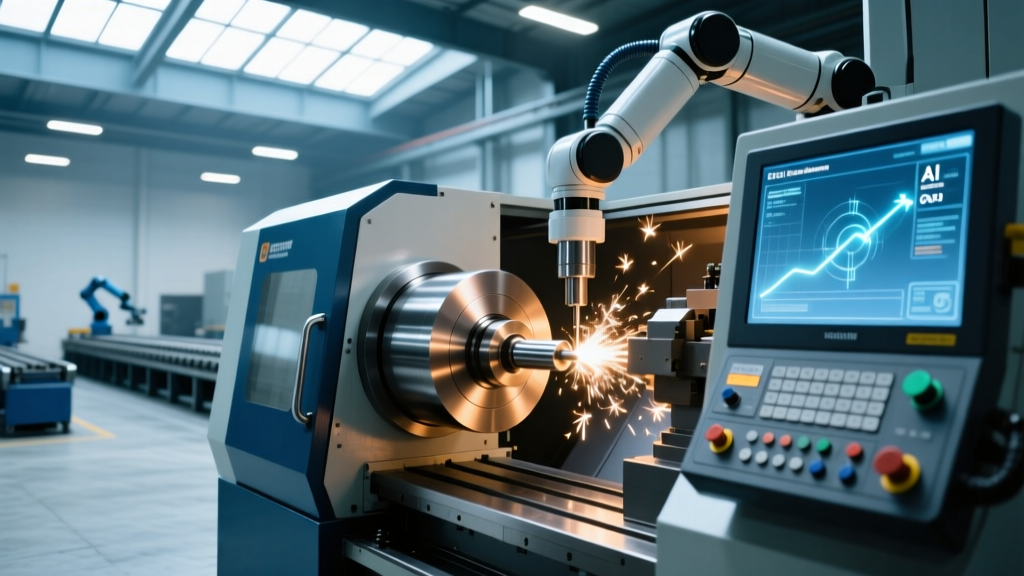
By 2026, the baseline expectation for CNC turning and machining has fundamentally transitioned from open-loop numerical control to fully integrated, cyber-physical systems. The days of relying solely on operator intuition to manage thermal drift or tool wear are over. Modern turning centers now leverage the ISO 23247 digital twin framework to simulate spindle growth, tool deflection, and chip evacuation in real-time before a single cut is made.
According to data from the National Institute of Standards and Technology (NIST), facilities that have adopted closed-loop smart manufacturing protocols report an average scrap reduction of 18% and a 22% increase in Overall Equipment Effectiveness (OEE). This shift is not merely about buying newer machines; it is about integrating artificial intelligence, advanced metrology, and hybrid additive processes directly into the turning workflow.
2026 Industry Adoption Data:- 74% of Tier 1 aerospace suppliers now mandate closed-loop thermal compensation on multi-axis turning centers.
- 41% of job shops have integrated AI-driven CAM software to reduce cycle times on high-volume production runs.
- $165,000 is the current median entry price for a mid-size CNC lathe equipped with native edge-computing and IoT sensor arrays.
AI-Driven Toolpath Optimization and Generative CAM
Traditional CAM software generates toolpaths based on static geometry and predefined feeds and speeds. In 2026, AI-driven generative CAM systems analyze the exact volume of material removed per millisecond, dynamically adjusting the feed rate and spindle speed to maintain a constant tool engagement angle and cutting force. This is particularly critical in CNC turning and machining of work-hardening materials like 316L stainless steel or Inconel 718.
For example, when turning a 316L shaft on a Doosan PUMA 2600, utilizing AI-optimized dynamic motion toolpaths extends the life of a Sandvik Coromant CNMG 432 carbide insert from an average of 140 parts to 195 parts. The software prevents the sudden spikes in cutting forces that typically cause micro-chipping on the insert's cutting edge.
| Metric | Traditional CAM (Static) | AI-Generative CAM (2026 Standard) |
|---|---|---|
| Cycle Time Reduction | Baseline | 18% - 24% faster |
| Insert Tool Life | 140 parts (CNMG 432) | 195+ parts (39% increase) |
| Spindle Load Variance | +/- 15% fluctuation | +/- 2% (Constant engagement) |
| Surface Finish Consistency | 64 Ra (variable) | 32 Ra (consistent) |
Closed-Loop Sensor Integration on the Shop Floor
The most significant hardware advancement in modern CNC turning and machining is the integration of closed-loop metrology directly into the machine tool's control architecture. Systems like the Blum-Novotest LaserControl MicroCompact NT and Renishaw Equator gauging systems now communicate directly with the CNC controller via high-speed protocols like FOCAS (for FANUC) or SINUMERIK ONE's native edge interfaces.
Thermal growth remains the silent killer of tight-tolerance turning. As a machine runs, the friction in the ball screws and spindle bearings causes the Z-axis and X-axis to drift. In 2026, advanced turning centers utilize embedded temperature sensors and AI thermal compensation algorithms to map this growth. If the spindle expands by 12 microns over an 8-hour shift, the control automatically offsets the tool geometry by -12 microns in real-time, without requiring the operator to stop the machine and manually adjust offsets.
"The integration of inline laser tool setting with real-time thermal compensation has effectively reduced our CMM inspection queue by 60%. We are holding 5-micron diametral tolerances on aerospace hydraulic spools straight off the lathe, completely eliminating the secondary grinding operations we relied on five years ago."
— Director of Manufacturing Engineering, Tier 1 Aerospace Supplier
Hybrid Manufacturing: Combining Turning with Additive Tech
Hybrid machines, which combine subtractive CNC turning with Directed Energy Deposition (DED) additive manufacturing, have moved from experimental prototypes to production-floor workhorses. The Siemens SINUMERIK ONE control platform has been instrumental in this, allowing seamless switching between laser deposition and hard turning within a single G-code program.
Machines like the DMG MORI NTX 2000 series allow manufacturers to build up complex geometries on a base tube using a laser, and then immediately machine the deposited material to final tolerances using a live-tooling turret. This is highly lucrative for the oil and gas sector, where applying Stellite 6 wear-resistant overlays to valve bodies and subsequently turning them to a mirror finish is a high-value operation.
The Hybrid Turning Workflow
- Substrate Preparation: The base part (e.g., 17-4 PH stainless steel) is loaded into the main spindle and turned to create a rough profile for additive bonding.
- DED Laser Deposition: The additive head indexes into position. The laser melts metal powder (e.g., Inconel 625) onto the substrate, building near-net-shape features like flanges or sealing surfaces.
- In-Situ Metrology: An onboard touch probe scans the deposited material to map the exact 3D topography, updating the CAM model dynamically.
- Finish Turning: The turning turret indexes in with CVD-coated carbide inserts to machine the additively deposited Inconel to final dimensional tolerances (+/- 0.0005 inches).
Strategic Framework: Upgrade vs. Retrofit
Shops looking to modernize their CNC turning and machining capabilities face a critical capital allocation decision. Do you purchase new, fully integrated smart machines, or do you retrofit existing iron with IoT sensors and edge-computing gateways?
Decision Matrix for 2026 Machine Upgrades:- Choose Retrofit ($4,500 - $8,500 per machine): If your existing lathes (e.g., Haas ST-20, Mazak QT-250) have less than 10,000 spindle hours and maintain mechanical rigidity. Install an MTConnect adapter, a Renishaw spindle probe, and an edge-computing gateway to enable predictive maintenance and basic closed-loop offsetting.
- Choose New Machine Acquisition ($165,000 - $450,000+): If you are machining exotic alloys requiring advanced thermal compensation, or if you need multi-tasking capabilities (B-axis milling/turning). New machines like the Okuma GENOS L3000-e with the OSP-P500 control feature native AI thermal shielding and servo-navigation that cannot be retrofitted onto older castings.
Calculating the ROI on Smart Turning Tech
The return on investment for AI and sensor integration is found in the margins. Consider a shop running a $120,000 annual consumable tooling budget. Implementing AI-driven toolpath optimization and closed-loop wear compensation typically yields a 25% reduction in insert consumption, saving $30,000 annually. Furthermore, eliminating a single scrapped aerospace titanium part due to thermal drift can save upwards of $15,000 in raw material and lost machining time. In the current economic landscape, the payback period for a $6,500 smart-sensor retrofit is frequently under four months.
Ultimately, the future of CNC turning and machining belongs to facilities that treat data as a critical cutting fluid. By embracing digital twins, AI toolpaths, and hybrid additive workflows, manufacturers can achieve unprecedented levels of precision, speed, and profitability.