Rapid Prototyping CNC Machining: In-House vs Outsourcing in 2026
Evaluate the true costs and tech capabilities of in-house production versus outsourcing rapid prototyping CNC machining in 2026. Data-driven decision guide.
The Economic and Technological Shift in Prototyping
The calculus for bringing rapid prototyping CNC machining in-house versus outsourcing to a contract machine shop has shifted fundamentally. Historically, the decision hinged solely on volume and lead time. Today, the integration of AI-assisted CAM software, automated metrology, and decentralized supply chain networks has altered the break-even points. Engineering teams must now evaluate capital expenditure (CapEx) against the technological agility offered by advanced tier-one contract machinists.
2026 Industry Benchmark: The average fully burdened hourly cost for an in-house 5-axis CNC prototyping cell (including machine depreciation, software, metrology, and operator labor) is $145–$185/hr. Conversely, top-tier outsourced rapid prototyping CNC machining services leverage lights-out manufacturing to offer effective rates of $85–$110/hr for complex geometries, with zero upfront CapEx.The True Cost of In-House CNC Prototyping
Establishing an internal rapid prototyping CNC machining center requires navigating severe capital and operational bottlenecks. The cost of the machine tool is merely the entry fee; the peripheral ecosystem required for precision prototyping often doubles the initial investment.
CapEx Breakdown: The 5-Axis Prototyping Cell
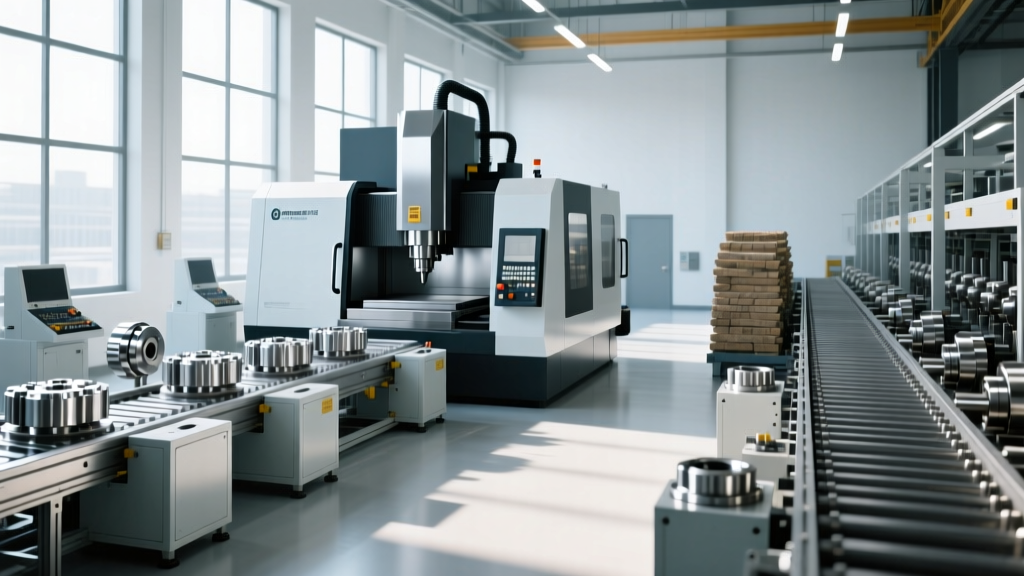
To compete with modern contract shops, an in-house team requires simultaneous 5-axis capability to machine complex aerospace and medical prototypes in a single setup. Below is a realistic 2026 capital expenditure model for a fully equipped prototyping cell.
| Equipment / Resource | Specific Model / Standard | Estimated Cost (USD) |
|---|---|---|
| 5-Axis CNC Mill | Haas UMC-500SS (with probing) | $185,000 - $210,000 |
| Automated Metrology | Renishaw Equator or Zeiss O-INSPECT | $45,000 - $65,000 |
| CAM & Verification Software | Mastercam 2026 + VERICUT licenses | $18,000 - $25,000 |
| Tooling & Workholding | Sandvik Coromant, EROWA pallets | $15,000 - $22,000 |
| Facility Upgrades | 3-phase power, coolant filtration, air | $12,000 - $18,000 |
| Total Initial CapEx | Minimum Viable Prototyping Cell | $275,000 - $340,000 |
The Metrology and Quality Assurance Bottleneck
Rapid prototyping is only as fast as its inspection cycle. In-house teams frequently bottleneck at the CMM (Coordinate Measuring Machine). Programming a CMM to verify complex 3D contours on a 7075-T6 aluminum aerospace bracket can take longer than machining the part itself. According to the Society of Manufacturing Engineers (SME), the shortage of qualified metrologists and GD&T-certified inspectors remains a critical constraint for internal machine shops, forcing engineers to rely on slow manual inspection methods that negate the speed advantages of CNC machining.
Outsourcing to Advanced Contract Machine Shops
The modern contract machine shop is no longer a job shop with a few manual mills and a single VMC. Tier-one rapid prototyping CNC machining partners operate as advanced manufacturing nodes, utilizing digital twins and automated material handling.
Lights-Out Manufacturing and Pallet Pools
Leading outsourced partners utilize automated pallet pool systems, such as the Fastems MSL (Multi-Level System), which allow machines to run unattended through the night and over weekends. When you upload a CAD model to an advanced partner's secure portal, their ERP system automatically nests the part, generates the toolpath via AI-driven CAM modules, and schedules the billet on an available pallet. This means your prototype is often being machined at 2:00 AM on a Saturday, compressing lead times from weeks to 48 hours without paying expedite fees.
'Supply chain resilience in 2026 relies on digital inventory and distributed manufacturing nodes. Companies that outsource prototyping to digitally integrated machine shops reduce their physical material footprint while accelerating iteration cycles.' — NIST Advanced Manufacturing Portal
Material Agnosticism and Digital Inventories
Sourcing exotic materials for a single prototype is a logistical nightmare for in-house teams. Purchasing one billet of PEEK, Ultem, or Inconel 718 involves high minimum order quantities (MOQs) and lead times exceeding three weeks. Contract shops maintain vast digital and physical inventories of aerospace and medical-grade polymers and superalloys, absorbing the material procurement friction so your engineering team can iterate freely.
Decision Matrix: In-House vs. Outsourced Prototyping
Use the following framework to determine the optimal manufacturing route based on your specific engineering requirements and organizational constraints.
| Criteria | Keep In-House | Outsource to Contract Shop |
|---|---|---|
| Iteration Speed | Same-day tweaks for basic 2.5D fixtures and jigs. | 48-72 hour turnaround for complex 5-axis geometries. |
| Tolerances | +/- 0.001' or looser; standard fits. | +/- 0.0002' requiring climate-controlled CMM inspection. |
| Material Types | Standard 6061-Al, 1018 Steel, Delrin. | Exotics (Titanium, Inconel), Medical PEEK, Copper alloys. |
| IP Security | Highly classified defense projects requiring air-gapped networks. | Standard commercial IP (protected by NDA and ISO 27001 ITAR compliance). |
| Annual Volume | High frequency of simple parts (>500 setups/year). | Low-to-medium volume of complex prototypes (1-50 parts/design). |
Hidden Bottlenecks in Internal Prototyping Operations
When evaluating the ROI of an in-house CNC cell, engineering managers frequently overlook the soft costs that erode productivity:
- CAM Programming Overhead: Generating collision-free 5-axis toolpaths for organic, topology-optimized geometries requires senior-level programmers. If your lead programmer is out sick, the machine sits idle.
- Tool Life and Breakage: Prototyping involves unmapped material inconsistencies and aggressive roughing strategies. In-house teams bear the full cost of broken end mills and scrapped billets, whereas contract shops amortize tooling costs across hundreds of diverse jobs.
- Post-Processing Limitations: A machined prototype often requires anodizing, passivation, or heat treatment. In-house shops must outsource these secondary operations anyway, adding logistical delays that erase the time saved by machining the part internally.
The Strategic Hybrid Model for 2026
The most agile hardware and robotics companies do not choose strictly between in-house and outsourced rapid prototyping CNC machining; they deploy a hybrid model. The optimal strategy involves keeping a 3-axis CNC mill (like a Haas CM-1 or Desktop Metal/Markforged hybrid system) on the engineering floor strictly for soft-jaw machining, custom fixtures, and rapid design verification of non-critical interfaces.
Simultaneously, all complex 5-axis structural components, tight-tolerance fluid manifolds, and final validation prototypes are routed to an outsourced, digitally integrated contract partner. This hybrid approach caps internal CapEx below $80,000 while leveraging the advanced metrology, exotic material inventories, and lights-out automation of tier-one machine shops, ensuring engineering teams maintain maximum velocity without the burden of running a full-scale production facility.