Cellular vs Batch Workflows for Complex CNC Machining Jobs
Compare cellular and batch-and-queue workflows for CNC machining jobs. Discover which lean manufacturing setup reduces lead times and scrap rates.
When shop owners analyze the profitability of their CNC machining jobs, the bottleneck is rarely the spindle speed or the CAM toolpath. The true constraint lies in workflow architecture. How parts move from raw stock to the shipping dock dictates work-in-progress (WIP) levels, floor space utilization, and ultimate cash flow. In modern contract machining, the debate centers on two dominant lean manufacturing alternatives: traditional batch-and-queue processing versus cellular one-piece flow. Choosing the wrong layout for your specific order book can inflate lead times by 400% and hide critical quality defects until final inspection.
The Core Alternatives: Batch-and-Queue vs. Cellular Manufacturing
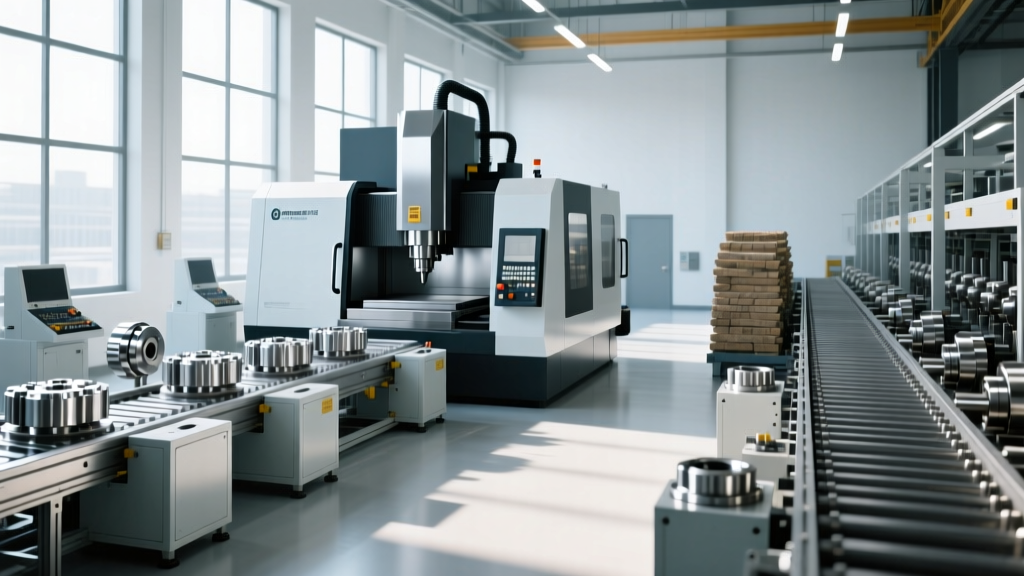
Before comparing specific metrics, it is necessary to define the operational mechanics of both systems as they apply to CNC machine shop operations. Batch-and-queue relies on a 'push' production schedule where large lots of identical parts are machined, then moved in bins to a centralized deburring area, and finally to a quality control room. Cellular manufacturing utilizes a 'pull' system, arranging dissimilar machines (e.g., a 5-axis mill, a CNC lathe, and a CMM) into a U-shaped or linear cell where a single part flows continuously from operation to operation without stopping in WIP staging areas.
Workflow Comparison Matrix for CNC Machining Jobs
| Metric | Batch-and-Queue (Traditional) | Cellular (One-Piece Flow) | Impact on CNC Machining Jobs |
|---|---|---|---|
| Setup Time per Part | High (45-90 mins per batch) | Low (3-10 mins via SMED) | Cellular enables high-mix profitability |
| Work-In-Progress (WIP) | Massive (Days to weeks of inventory) | Minimal (Minutes to hours) | Cellular frees up 18-22% in carrying costs |
| Defect Detection | Delayed (Discovered after batch run) | Immediate (Caught at next station) | Cellular prevents catastrophic scrap events |
| Floor Space Required | High (Requires WIP staging aisles) | Low (Compact U-shaped footprint) | Cellular increases revenue per square foot |
| Best Application | High-volume, low-mix commodity parts | High-mix, low-to-medium volume precision | Determines quoting strategy and margins |
Batch-and-Queue: When the Traditional Push System Wins
Batch processing is often vilified in lean manufacturing literature, but it remains a necessary alternative for specific types of CNC machining jobs. If a shop holds a contract to produce 50,000 identical titanium bone screws annually, running them in batches of 5,000 on a dedicated Swiss-type lathe is highly efficient. The setup is amortized over a massive quantity, and the machine runs lights-out for days.
Warning: The Hidden Cost of Batch WIPWhile batch machining maximizes spindle uptime, it masks inefficiencies. According to the NIST Manufacturing Extension Partnership, excess WIP ties up working capital and obscures quality issues. If a CNC mill machines 500 aerospace brackets with a subtle tool-wear error, the defect might not be caught by the CMM until the entire batch is finished, resulting in 500 scrapped parts rather than just one.
Cellular Manufacturing: Architecting the One-Piece Flow Cell
For high-mix CNC machining jobs—such as prototyping, custom automation components, or aerospace fittings—cellular manufacturing is the superior alternative. A modern CNC cell is not just a grouping of machines; it is a tightly integrated workflow. Consider a cell designed for complex prismatic parts: it might feature a Haas UMC-500SS 5-axis machining center, an automated part-washing station, and a Zeiss GOM ATOS 5 structured light scanner, all tended by a single operator or a FANUC CRX-25iA collaborative robot.
The Physical Layout of a Lean CNC Cell
- Raw Material Infeed: Located at the start of the 'U', pre-sawn blanks are staged on gravity flow racks.
- Primary Machining: The 5-axis mill executes Op 10. Instead of using traditional Kurt vises that require manual bolting, the machine utilizes a zero-point clamping system.
- Secondary Operations: The operator (or cobot) transfers the pallet directly to a secondary CNC lathe or manual deburring station located exactly one arm's reach away.
- Inline Metrology: Final inspection occurs inside the cell using a shop-floor hardened CMM, eliminating the trip to the central quality lab.
The SMED Enabler: Zero-Point Workholding
Cellular manufacturing for CNC machining jobs completely fails if setup times remain high. The transition from batch to cellular flow requires the implementation of Single-Minute Exchange of Dies (SMED) principles. In CNC milling, this is achieved through zero-point workholding systems like the Schunk Vero-S or Röhm KRP.
By standardizing the machine table with zero-point receivers (costing approximately $2,500 per machine) and outfitting all workholding fixtures with matching pull-studs ($120-$150 per pallet), operators can swap out complex, pre-indicated fixtures in under 15 seconds with a repeatability of 0.005mm. This reduces setup times from 45 minutes to under 3 minutes, making it economically viable to run batch sizes of 5 or 10 parts, which is the lifeblood of cellular flow.
Expert Tip: Standardize Tooling Across the CellDo not just standardize workholding. Standardize your cutting tool stick-out lengths and toolholder types (e.g., using exclusively HSK-A63 or CAT40 hydraulic chucks) across all machines in the cell. This allows a tool preset offline to be immediately loaded into any machine in the cell without requiring a new Z-axis offset probe cycle, saving 4-6 minutes per tool change.
Decision Framework: Matching Workflow to Your Order Book
Shop managers must objectively analyze their historical job data to determine which workflow alternative to implement. Use this practical decision matrix to evaluate your upcoming CNC machining jobs:
- IF your average order quantity exceeds 1,000 parts AND part geometry requires only one primary operation THEN retain a Batch-and-Queue workflow with dedicated, automated bar-feeders or pallet-pool HMCs.
- IF your order quantities range from 1 to 50 AND parts require milling, turning, and strict GD&T inspection THEN transition to a Cellular Manufacturing layout utilizing zero-point fixturing and inline metrology.
- IF your parts require external processing (e.g., heat treating, anodizing, or passivation) THEN implement a Hybrid workflow: run one-piece flow internally, but batch parts only at the external processing bottleneck, utilizing Kanban cards to trigger the external vendor pickup.
Real-World ROI and Capital Expenditure
Transitioning to a lean cellular workflow requires upfront capital, but the return on investment is highly quantifiable. Implementing a fully automated CNC cell with a $35,000 collaborative robot, $5,000 in zero-point workholding, and $40,000 in shop-floor metrology equipment represents a ~$80,000 capital expenditure. However, the Lean Enterprise Institute notes that cellular layouts routinely reduce WIP carrying costs by over 20% and slash floor space requirements by 30%.
For a mid-sized machine shop generating $5M in annual revenue, reducing WIP from 14 days to 3 days frees up approximately $300,000 in trapped working capital. Furthermore, the EPA's sustainability guidelines on lean manufacturing highlight that cellular flow drastically reduces the energy consumption associated with running compressed air lines and coolant pumps for machines that are sitting idle while waiting for large batches to clear downstream bottlenecks.
Ultimately, the choice between batch and cellular alternatives is not about picking the 'best' lean tool in a vacuum. It is about aligning your physical shop floor architecture with the specific volume, mix, and complexity of the CNC machining jobs you intend to win in the market. Shops that master zero-point SMED techniques and one-piece flow will consistently undercut competitors on lead times, turning workflow design into their most formidable competitive advantage.