Precision CNC Machining Inc. Lean Workflow & Specs
Explore the technical specs and lean manufacturing workflow of Precision CNC Machining Inc., detailing 5-axis optimization, spindle metrics, and cell layout.
Deconstructing the Lean CNC Blueprint
When evaluating top-tier contract manufacturers, the operational blueprint of a facility modeled after Precision CNC Machining Inc. provides a masterclass in merging lean manufacturing principles with high-end technical specifications. Lean manufacturing in a CNC environment is not merely about organizing tools with shadow boards; it is the rigorous synchronization of machine kinematics, automated material handling, and real-time telemetry to eliminate non-value-added time. In 2026, the gap between a standard job shop and a lean-optimized production cell is defined by spindle uptime, thermal stability metrics, and automated metrology integration.
This technical teardown examines the exact hardware specifications, cellular layouts, and digital workflows required to achieve an Overall Equipment Effectiveness (OEE) of 82% or higher in a high-mix, low-volume (HMLV) machining environment.
The Hardware Baseline: Machine Specifications for Lean Cells
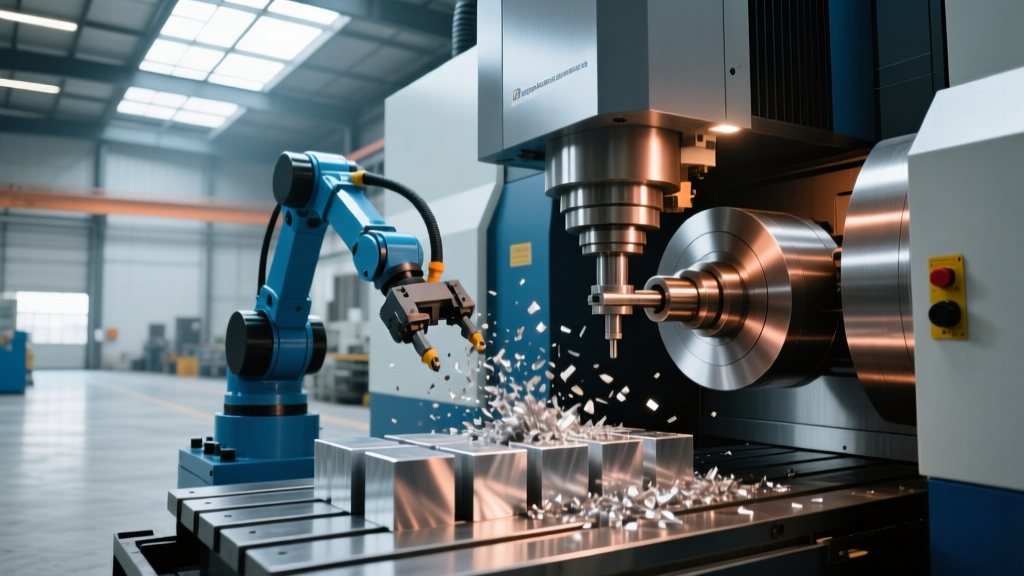
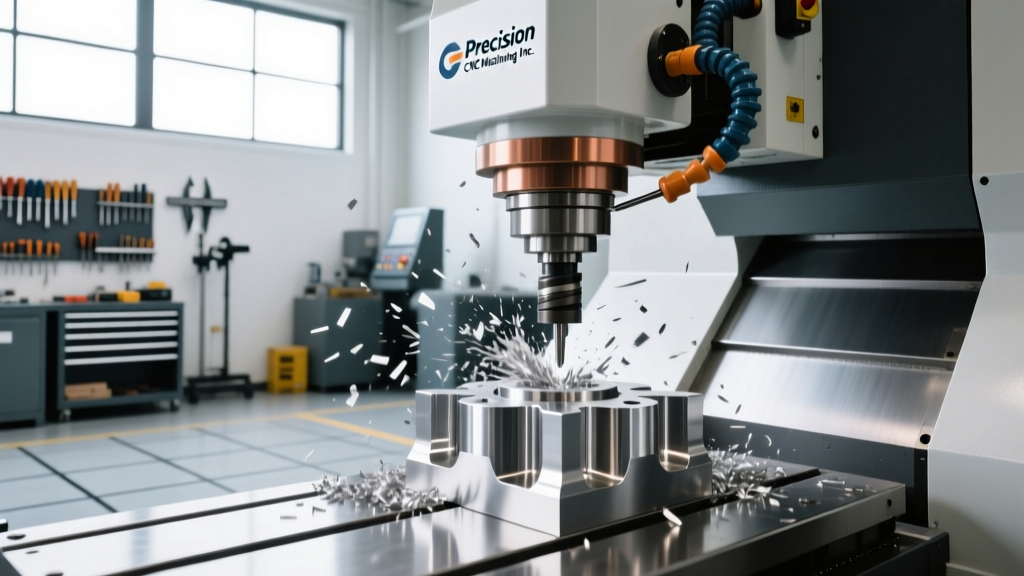
A lean workflow breaks down instantly if the underlying hardware cannot support continuous, untended operation. Facilities operating at the level of Precision CNC Machining Inc. specify 5-axis universal machining centers with distinct technical thresholds designed to minimize setup times and maximize cutting engagement.
| Technical Specification | Standard Job Shop Machine | Lean-Optimized Production Cell |
|---|---|---|
| Spindle Configuration | Belt-driven, 10,000 RPM, 15 kW | Direct-drive, 15,000-20,000 RPM, 35 kW with liquid cooling |
| Tool Magazine & Changer | 24-tool arm, 2.5s chip-to-chip | 60+ tool matrix, 1.2s chip-to-chip, RFID tool identification |
| Axis Drive Technology | Ball screws on all linear axes | Linear motors on X/Y, direct-drive torque motors on B/C |
| Coolant Delivery | Flood coolant, 300 PSI through-spindle | 1,000 PSI through-spindle, programmable multi-angle nozzles |
| In-Cycle Metrology | Manual probing, basic tool breakage | Renishaw OMP600 spindle probe, NC4 non-contact laser tool setting |
The shift from ball screws to linear motors on the X and Y axes eliminates backlash and reduces positioning settling time to under 15 milliseconds. When combined with direct-drive torque motors on the trunnion table (B and C axes), the machine maintains a positioning accuracy of ±0.0002 inches (5 µm) during simultaneous 5-axis interpolation, effectively eliminating the need for secondary finishing operations on complex aerospace contours.
Cellular Layout and Automated Material Flow
Lean manufacturing dictates that material must flow continuously without backtracking or waiting. The physical layout of a modern CNC cell relies on U-shaped configurations integrated with automated pallet pools.
Technical Spotlight: Pallet Pool Integration
Systems like the Fastems FMS or DMG MORI PH Cell utilize a central rail-guided vehicle (RGV) to manage pallets. The technical requirement here is the pallet clamping repeatability. High-end lean cells specify Erowa or System 3R chuck systems with a clamping force of 6,000 N and a repeatability of ≤ 2 µm. This ensures that a part moved from a load station to the machine spindle requires zero indicator dial-in, saving 15 to 40 minutes per setup.
Chip management is another critical, often overlooked, lean specification. Continuous untended machining of aluminum alloys (like 6061-T6 or 7075) generates massive volumes of stringy chips. Lean-optimized machines are equipped with steeply angled stainless steel interior enclosures (minimum 60-degree slope) and high-pressure coolant wash-down systems (80 PSI) to prevent chip nesting around the trunnion table, which can cause thermal expansion errors and axis crashes.
The Digital Thread: CAD/CAM to Spindle Telemetry
Physical hardware is only half the workflow. The digital thread ensures that the machine never waits for instructions, toolpaths, or offsets. Following ISO 13399 standards for cutting tool data representation, modern shops maintain a centralized, cloud-synced digital tool library that feeds directly into CAM software and the machine's CNC controller.
- CAM Programming & Kinematic Simulation: Toolpaths are generated in software like hyperMILL or Mastercam 2026. Before reaching the shop floor, the G-code is run through a digital twin environment (e.g., VERICUT) that simulates the exact mass, torque limits, and kinematic singularities of the specific 5-axis machine model.
- MTConnect Data Ingestion: Utilizing the MTConnect standard, machines are equipped with edge-computing adapters that translate proprietary controller data (Fanuc FOCAS, Siemens OPC-UA) into standardized XML/JSON streams. This allows the shop's ERP to monitor spindle load and axis feedrates in real-time.
- Automated Offset Compensation: During a production run, the non-contact laser tool setter measures tool length and diameter wear every 50 cycles. If wear exceeds the 0.0005-inch tolerance band, the macro program automatically updates the tool offset registry in the CNC controller without pausing the cycle.
- First-Article In-Cycle Probing: The spindle probe measures critical datums immediately after the roughing pass. If thermal drift has shifted the part by more than 3 µm, the workpiece coordinate system (G54) is dynamically updated before the semi-finishing toolpath begins.
Troubleshooting Workflow Bottlenecks: A Decision Matrix
Even in highly optimized environments resembling Precision CNC Machining Inc., workflow anomalies occur. Lean methodology requires systematic root-cause analysis rather than reactive fixes. Below is a technical decision matrix for diagnosing common OEE drops in 5-axis production cells.
| Symptom (OEE Drop) | Technical Root Cause | Lean Workflow Correction |
|---|---|---|
| Spindle idle time spikes by 18% during shift changes. | Manual fixture loading and indicator dial-in exceeding takt time. | Implement off-machine pre-staging on twin pallets; utilize System 3R macro pallets with 2 µm repeatability to eliminate dial-in. |
| Surface finish degradation (Ra > 32 µin) on Inconel 718 parts. | Through-spindle coolant (TSC) pressure dropping below 700 PSI at the cutting edge due to rotary union bypass leakage. | Schedule predictive maintenance on rotary unions every 2,000 spindle hours; install inline flow meters to trigger MTConnect alerts at 650 PSI. |
| Unexpected tool breakage on deep-cavity milling operations. | Chip evacuation failure causing recutting; standard flood coolant cannot penetrate the cavity. | Switch to 1,000 PSI TSC with specialized coolant-through end mills; program peck-milling cycles with 0.100" retract for chip clearing. |
| Trunnion table (B-axis) positional drift of 0.001" over an 8-hour shift. | Thermal growth in the direct-drive torque motor due to inadequate chiller flow or ambient shop temperature fluctuations. | Isolate machine foundation from shop HVAC drafts; calibrate chiller to maintain coolant at exactly 68°F (20°C) ± 0.5°; run thermal compensation macros. |
Measuring True Lean Success via OEE
According to SME Smart Manufacturing guidelines, calculating OEE in a CNC environment requires strict adherence to data integrity. Availability is measured from the moment the first pallet is clamped to the final part unload, excluding planned preventative maintenance. Performance is the ratio of actual cutting time to theoretical cutting time based on the CAM simulation. Quality is the percentage of parts that pass CMM (Coordinate Measuring Machine) inspection on the first run without requiring manual deburring or re-machining.
"A machine shop that claims to be 'lean' but relies on manual tool presetting and paper-based setup sheets is merely practicing good housekeeping, not lean manufacturing. True lean CNC operations are defined by the uninterrupted flow of data and material, governed by sub-micron hardware repeatability and real-time telemetry."
By aligning the technical specifications of the machine tool—such as direct-drive kinematics and high-pressure coolant delivery—with the physical and digital workflows of a palletized cell, manufacturers can replicate the high-efficiency models pioneered by industry leaders like Precision CNC Machining Inc. The result is a predictable, scalable, and highly profitable machining operation capable of holding aerospace tolerances at automotive production rates.