CNC Machining Industry: Architectural Facades vs. Laser & Waterjet
Compare CNC routing, waterjet, and laser cutting for architectural facades. Discover tolerances, costs, and material limits for metalwork.
Parametric architecture and complex building envelopes have shifted the burden of precision from the construction site to the machine shop. When designing custom architectural facades—such as sunshades, brise-soleil systems, and structural curtain wall brackets—architects and general contractors must navigate a critical manufacturing decision. The cnc machining industry offers 3D contouring and integrated hardware tapping, but 2D alternatives like abrasive waterjet and fiber laser cutting often promise faster turnaround for flat profiles. This analysis dissects the technical boundaries, cost structures, and material limitations of these processes for architectural metalwork in 2026.
2026 Architectural Facade Manufacturing Baselines
- Average Panel/Bracket Thickness: 0.125" (3mm) to 1.5" (38mm)
- Standard AESS Tolerance Requirement: ±1/16" (±1.5mm) for exposed structural elements
- Primary Alloys: 6061-T6 Aluminum, 316L Stainless Steel, ASTM A588 (Corten)
- Typical Lot Size: 50 to 2,500 unique, non-repeating parametric components
Process Comparison Matrix: CNC vs. Waterjet vs. Laser
Selecting a manufacturing method requires matching the process physics to the facade's structural and aesthetic demands. Below is a direct comparison of the three dominant cutting and shaping technologies used by contract machine shops for architectural metalwork.
| Process | Max Precision Thickness | Tolerance (±) | Edge Finish Quality | 3D Contouring | 2026 Avg. Hourly Rate |
|---|---|---|---|---|---|
| 5-Axis CNC Milling | 4.0"+ (100mm+) | 0.005" (0.12mm) | Machined (Requires deburring) | Yes (Full 3D) | $110 - $165 / hr |
| Abrasive Waterjet | 6.0"+ (150mm+) | 0.015" - 0.030" | Matte/Satin (Tapered kerf) | No (2D/2.5D only) | $130 - $190 / hr |
| Fiber Laser Cutting | 0.75" (19mm)* | 0.005" (0.12mm) | Smooth (Oxide layer present) | No (2D only) | $80 - $120 / hr |
*Note: While fiber lasers can pierce thicker steel, edge squareness and kerf degradation make them unsuitable for precision architectural mating surfaces above 0.75".
Deep-Dive: When the CNC Machining Industry Wins
The cnc machining industry dominates architectural metalwork when components require compound angles, integrated fastening features, or strict Architecturally Exposed Structural Steel (AESS) category 3 or 4 tolerances.
1. Parametric Sunshades and Compound-Angle Brackets
Modern parametric facades rarely feature flat, orthogonal panels. Sunshade blades often require a continuous twist (e.g., a 15-degree rotation over a 4-foot span) to optimize solar shading based on the building's exact geolocation. 2D processes like waterjet and laser cutting cannot produce this geometry. A 5-axis CNC machining center, such as the Haas UMC-750SS or the DMG MORI duoBLOCK, can mill a twisted aerodynamic profile directly from a 6061-T6 aluminum billet or thick plate, ensuring the mounting brackets integrate seamlessly with the curtain wall mullions.
2. Integrated Tapping and Hardware Features
Facade panels must be anchored to the building structure. CNC machining allows for the milling of counterbores, precision dowel pin holes, and helical thread tapping in a single setup. Relying on laser or waterjet cutting requires secondary operations (drilling and tapping on a manual mill or drill press), which introduces cumulative tolerance stack-up and increases handling costs by 20% to 35%.
Edge Cases: When Waterjet or Laser is the Superior Alternative
Despite the versatility of CNC milling, it is not always the most economical choice for architectural metalwork. Understanding the limitations of subtractive milling is critical for procurement managers.
The Waterjet Advantage: Thick-Plate 2D Profiling
For structural base plates, gussets, or heavy Corten steel (ASTM A588) facade anchors exceeding 1.5 inches in thickness, abrasive waterjet cutting is superior. According to manufacturing process comparisons, waterjets do not introduce mechanical cutting forces that can distort thick, high-strength steels. However, engineers must account for the "kerf taper"—the waterjet stream naturally widens at the bottom of the cut. For 1-inch aluminum, expect a 0.010" taper unless the shop utilizes advanced taper-compensating cutting heads like the Flow Dynamic Waterjet.
The Laser Advantage: Thin-Gauge Nesting
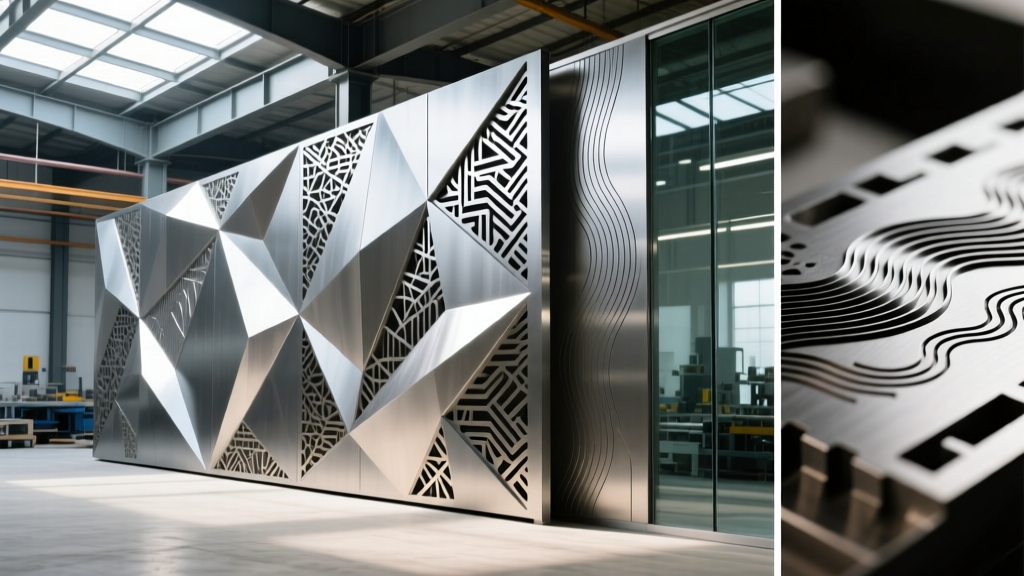
If the facade design utilizes hundreds of thin-gauge (14ga to 10ga) stainless steel sunscreen blades with intricate 2D perforation patterns, fiber laser cutting (e.g., Trumpf TruLaser series) is the undisputed leader. Lasers allow for dynamic nesting of hundreds of unique parts on a single 4x8 sheet, cutting a 0.060" kerf at speeds exceeding 1,000 inches per minute. CNC routing thin sheet metal requires complex vacuum fixturing and is prone to chatter and part vibration.
⚠️ Critical Warning: Coastal Corrosion & Heat-Affected Zones (HAZ)When specifying 316L Stainless Steel for coastal or marine-environment facades, avoid fiber laser cutting with oxygen assist gas. The high heat input depletes the chromium in the cut zone, creating a Heat-Affected Zone (HAZ) susceptible to intergranular corrosion and rust streaking on the building exterior. If laser cutting must be used, mandate nitrogen assist gas. Alternatively, specify CNC milling or waterjet cutting, which are cold-cutting processes that preserve the passive oxide layer of the 316L alloy.
2026 Cost and Lead Time Economics
When evaluating bids from architectural metalwork suppliers, look beyond the raw hourly machine rate. The true cost driver in facade fabrication is fixturing, material yield, and secondary finishing.
- CNC Machining Setup Costs: High. Designing and machining custom soft jaws or vacuum fixtures for unique parametric panels can add $1,500 to $4,000 in non-recurring engineering (NRE) costs per project phase. However, once fixtured, cycle times are highly predictable.
- Waterjet Consumable Costs: Moderate to High. While the machine rate is $130/hr, the cost of abrasive garnet adds $30 to $45 per hour of cutting time. Cutting 1-inch thick stainless steel consumes garnet rapidly, making waterjet expensive for high-volume, thick-material runs.
- Laser Cutting Economics: Low setup, high throughput. Nitrogen-assisted laser cutting of thin aluminum facades yields the lowest cost-per-part, provided the nesting software can achieve >80% material utilization.
Material-Specific Decision Framework
Use this framework to select the manufacturing process based on your specified facade material:
| Material | Primary Application | Recommended Process | Technical Rationale |
|---|---|---|---|
| 6061-T6 Aluminum | Parametric blades, extrusions, decorative screens | 5-Axis CNC Milling | Allows 3D contouring, excellent surface finish, easy to anodize post-machining. |
| 316L Stainless Steel | Coastal brackets, tension rod anchors | CNC or Waterjet (Cold) | Preserves corrosion resistance by avoiding laser-induced chromium depletion. |
| ASTM A588 (Corten) | Heavy structural base plates, aesthetic rust facades | Abrasive Waterjet | Handles high thickness; avoids HAZ which disrupts the natural patina/rusting process. |
| 14ga 304 Stainless | Perforated flat-panel rain screens | Fiber Laser (N2 Assist) | Unmatched speed for thin-gauge 2D profiling and complex hole patterns. |
Contract Machining Procurement Checklist
Before issuing an RFP for architectural facade components, ensure your documentation addresses the following machining-specific variables to prevent change orders and site-fit failures:
- Define AESS Categories Explicitly: Do not just state "architectural finish." Specify AESS Category 3 (minimum) for exposed structural brackets, which dictates that all weld seams must be ground flush and all laser/cut edges must be deburred to a specific radius.
- Specify Datum Structures for Parametric Parts: For 5-axis CNC machined components, provide a clear GD&T (Geometric Dimensioning and Tolerancing) datum structure on your 3D STEP files so the machine shop knows exactly which surfaces mate with the building structure.
- Mandate Protective Masking: CNC machined aluminum facade parts are easily scratched during transit. Require the shop to apply 3-mil or 5-mil peelable protective masking film immediately after machining and before assembly.
- Request First-Article Mockups: For facades exceeding 500 panels, mandate a full-scale, first-article physical mockup of the most complex geometry to verify site-fit tolerances and aesthetic edge profiles before full production begins.
By aligning the geometric requirements of the building envelope with the physical capabilities of the cnc machining industry, laser cutting, and waterjet profiling, project teams can eliminate field rework, control budgets, and achieve the exacting aesthetic standards demanded by modern architecture.