2026 CNC Machining Hourly Rate for Architectural Facades
Analyze the 2026 CNC machining hourly rate for architectural facades. Explore 5-axis specs, toolpath strategies, and tolerances for parametric metalwork.
The Mechanics of Parametric Architectural Metalwork
Architectural facades and structural metalwork have evolved from simple extruded mullions to complex, mathematically driven parametric surfaces. Producing these components—ranging from custom curtain wall brackets to organic 3D structural nodes—requires advanced subtractive manufacturing. When evaluating the cnc machining hourly rate for these projects, facility managers and architects must look beyond simple spindle time. The true cost is dictated by machine kinematics, material removal rates (MRR), and the metrology required to verify non-standard geometries.
Technical Insight: Parametric facade panels often feature varying compound curvatures. While 3-axis milling can handle single-curvature surfaces (developable surfaces), non-developable doubly-curved surfaces strictly require simultaneous 5-axis interpolation to maintain the cutting tool's normal vector to the surface, preventing gouging and ensuring aerodynamic or aesthetic continuity.Machine Kinematics and the 2026 CNC Machining Hourly Rate
The hourly rate is directly tethered to the machine's physical envelope and axis configuration. Architectural nodes, particularly those connecting complex space frames or diagrid facades, often exceed standard vise capacities. Evaluating the cnc machining hourly rate requires matching the part geometry to the correct machine class.
| Machine Class | Axis Config | Typical Envelope | Spindle Taper | 2026 Hourly Rate |
|---|---|---|---|---|
| Standard VMC | 3-Axis | 40" x 20" x 20" | CAT 40 | $85 - $115 |
| 5-Axis Trunnion | 3+2 / 5-Axis | 30" x 20" x 20" | CAT 40 | $135 - $175 |
| 5-Axis Swivel Head | Simultaneous 5 | 50" x 40" x 30" | CAT 50 | $180 - $240 |
| Large Gantry Mill | 5-Axis | 120" x 60" x 40" | HSK 100A | $260 - $350 |
For heavy structural steel nodes (e.g., cast steel replacements machined from billet), a swivel-head configuration like those found in Haas Automation's 5-axis lineup or DMG MORI's duoBLOCK series is mandatory. Trunnion tables struggle with the 1,000+ lb payloads typical of architectural steel billets, leading to axis sag and geometric inaccuracy. Consequently, the cnc machining hourly rate for swivel-head machines commands a 30-40% premium over trunnion setups due to the higher capital cost and complex calibration requirements.
Material-Specific Toolpath Strategies
Machining 6061-T6 Aluminum for Sunshades and Louvers
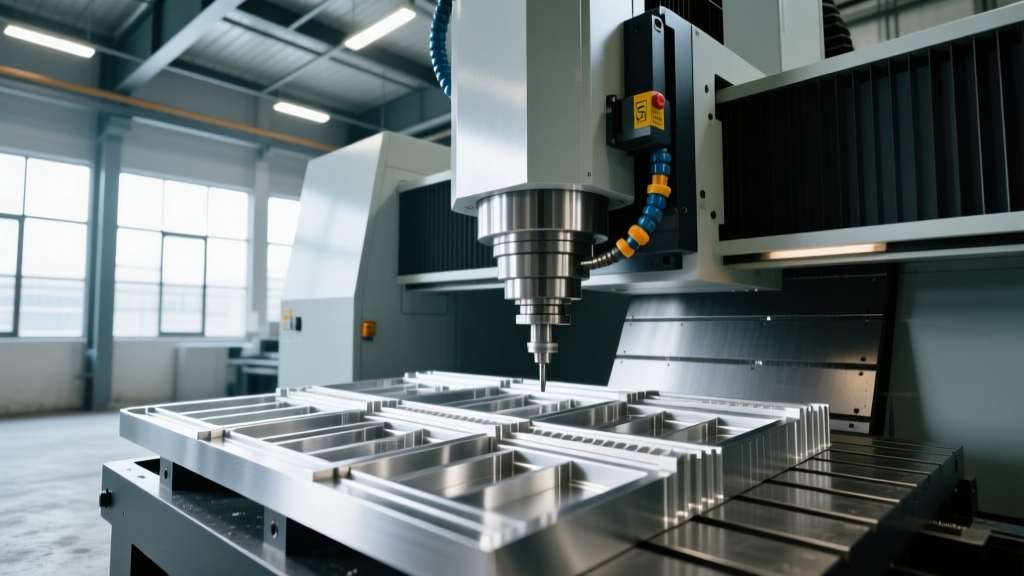
Aluminum 6061-T6 remains the baseline for exterior sunshades and parametric louver systems due to its high strength-to-weight ratio and anodizing compatibility. The primary challenge in machining large-format aluminum facade panels is managing thermal expansion and chatter on thin walls.
- Tooling: 3-flute uncoated carbide end mills with a 45° helix angle to evacuate chips efficiently and prevent re-welding.
- Feeds & Speeds: Roughing at 1,500+ SFM (Surface Feet per Minute) with a chip load of 0.008" - 0.012" per tooth.
- Fixturing: Vacuum tables are mandatory for panels exceeding 0.250" thickness. For thinner skins, specialized double-sided tape combined with low-profile toe clamps prevents Z-axis lift during high-speed gantry passes.
Tackling 316L Stainless Steel for Coastal Structural Nodes
Structural nodes in coastal or high-humidity environments require 316L stainless steel for its superior pitting resistance. Machining 316L introduces severe work-hardening risks. If the cutting tool dwells or rubs instead of shearing, the surface hardness can spike from 200 HB to over 350 HB, destroying carbide tooling instantly.
Warning: Never use conventional climb milling on the finishing passes of 316L architectural nodes. Always employ trochoidal milling or dynamic motion toolpaths to maintain a constant radial engagement angle, as recommended by Sandvik Coromant's milling guidelines. This keeps heat in the chip rather than transferring it into the workpiece.To mitigate work hardening, machine shops utilize AlTiN (Aluminum Titanium Nitride) coated carbide end mills. The aluminum content in the coating forms a protective alumina layer at high temperatures, allowing for cutting speeds up to 350 SFM while maintaining edge integrity. Expect the cnc machining hourly rate to effectively double when switching from 6061 aluminum to 316L stainless, not just because of slower feed rates, but due to a 300% increase in tooling consumption and extended cycle times.
Fixturing: The Hidden Multiplier in Facade Production
When reviewing a quote, the setup cost often eclipses the actual cnc machining hourly rate for short-run architectural components. Parametric facades rarely feature parallel datum surfaces, making standard vise workholding impossible.
- Custom Soft Jaws: For a run of 50 identical structural brackets, machining custom 6061 soft jaws takes 2-4 hours of 3-axis spindle time. This is a fixed upfront cost.
- Modular Fixturing: Systems like BluClaw or Mitee-Bite allow for rapid reconfiguration. While the initial capital outlay for the shop is high, it reduces setup time per part from 45 minutes to under 10 minutes.
- Thermally Stable Substrates: For ultra-precise curtain wall nodes requiring ±0.002" tolerances, shops must machine the fixture from the same material as the part (or use Invar) to ensure matched coefficients of thermal expansion (CTE) during long 12-hour milling cycles.
Metrology and Tolerancing for Curtain Wall Integration
The final variable influencing the cnc machining hourly rate is the inspection protocol. Architectural metalwork must interface seamlessly with glass, composite panels, and extruded aluminum mullions. The Council on Tall Buildings and Urban Habitat (CTBUH) frequently highlights that facade failure often stems from cumulative tolerance stack-up in structural connections, rather than single-point failures.
Inspection Methods by Geometry Type
Standard 2.5D Brackets: Touch-probe CMM (Coordinate Measuring Machines) are sufficient. Features like slot widths, hole true positions, and perpendicularity are verified to ±0.005". This adds roughly 15% to the total inspection time.
Organic 3D Nodes: Touch probes fail to adequately capture freeform NURBS surfaces. Shops must deploy non-contact laser scanning arms (e.g., FARO ScanArm). The point cloud data is imported into PolyWorks or Geomagic Control X to generate a 3D color deviation map against the original CAD model. This metrology step requires a specialized technician and can add $150-$200 per hour to the quality assurance phase of the project.
By understanding the intersection of machine kinematics, metallurgy, and metrology, architects and general contractors can accurately forecast budgets. The cnc machining hourly rate is merely the baseline; the true cost of precision architectural metalwork is engineered in the CAM programming, fixturing, and rigorous inspection required to ensure a building's facade performs flawlessly for decades.