CNC Machining ABS for Architectural Facade Prototyping & Metal Jigs
Technical guide on CNC machining ABS for architectural facade prototyping, scale models, and custom metalwork jigs before final metal production.
The Hybrid Workflow: ABS Prototyping for Architectural Metalwork
Modern architectural metalwork and parametric facades demand extreme precision, often involving thousands of unique, non-repeating structural nodes and curved mullions. Before committing expensive 5-axis CNC time to 6061-T6 aluminum or 316 stainless steel, advanced fabricators utilize CNC machining ABS (Acrylonitrile Butadiene Styrene) to validate complex geometries. This thermoplastic serves as a critical bridge in the manufacturing pipeline, enabling rapid 1:1 scale wind-tunnel models, client-facing visual mockups, and highly accurate custom holding jigs for the final metal welding and assembly phases. By leveraging ABS for the iterative stages of facade engineering, machine shops drastically reduce tooling costs and accelerate the transition to final metal production.
Material Specifications: Machine-Grade ABS vs. Architectural Metals
Understanding the mechanical and thermal deltas between ABS and standard architectural metals is essential for programming accurate toolpaths and managing expectations regarding part rigidity. Machine-grade ABS (often sourced in extruded blocks or sheets) offers excellent dimensional stability and machines cleanly, but it lacks the structural load-bearing capacity of metal. According to McMaster-Carr's material database, ABS is ideal for fixturing and prototyping due to its low density and high machinability.
| Property | Machine-Grade ABS | 6061-T6 Aluminum | 304 Stainless Steel |
|---|---|---|---|
| Tensile Strength | 6,000 psi (41 MPa) | 45,000 psi (310 MPa) | 73,200 psi (505 MPa) |
| Density | 1.04 g/cm³ | 2.70 g/cm³ | 8.00 g/cm³ |
| Softening / Melting Point | 221°F (105°C) | 1,080°F (582°C) | 2,550°F (1,400°C) |
| Typical CNC Feed Rate (1/2" End Mill) | 250 - 400 IPM | 80 - 150 IPM | 20 - 45 IPM |
| Approximate Material Cost (12"x24"x2" Block) | $85 - $110 | $280 - $350 | $600 - $850 |
Toolpath Engineering and Thermal Management
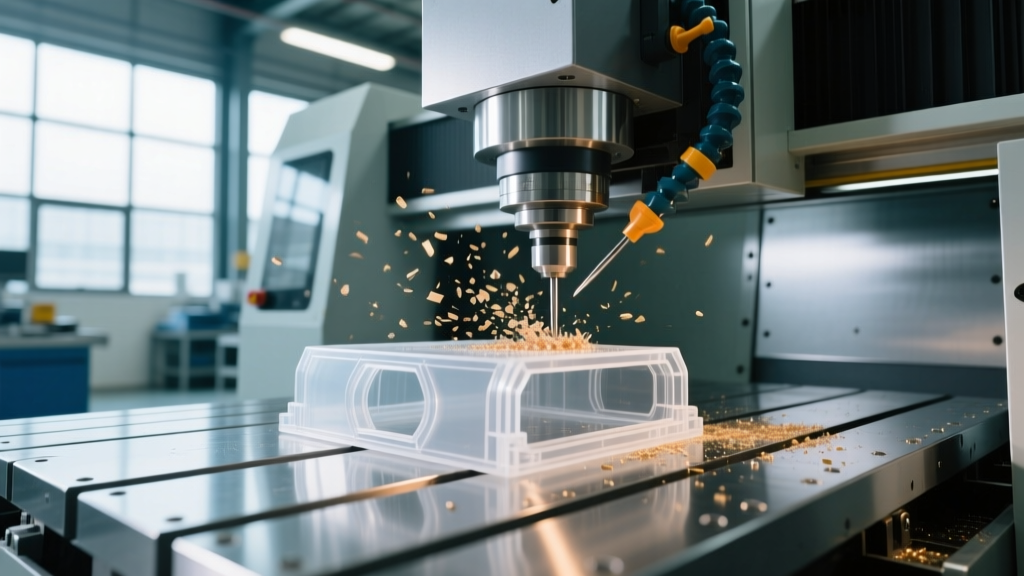
The primary failure mode when CNC machining ABS is thermal accumulation. ABS has a relatively low glass transition temperature of approximately 105°C (221°F). If the cutting tool generates excessive friction, the plastic will melt, re-weld to the cutter flutes, and ruin the surface finish of the architectural prototype or jig.
Thermal Management Directive: Never use standard flood coolant on ABS unless it is a specifically formulated, low-temperature synthetic mist. Flood coolant can cause thermal shock, leading to micro-cracking in thick sections. Instead, utilize a high-pressure compressed air blast directed at the cutting zone to evacuate chips and dissipate heat.To mitigate heat generation, tooling selection is critical. Standard 3-flute or 4-flute end mills designed for aluminum will clog with ABS chips. Fabricators should utilize specialized single-flute (O-flute) or 2-flute solid carbide end mills with high helix angles (40° or greater) and polished flutes. As detailed by cutting tool experts at Harvey Tool, the polished flute geometry ensures rapid chip evacuation, preventing the chips from being re-cut and generating secondary heat.
Recommended Feeds and Speeds for 1/2" O-Flute Carbide End Mill
- Spindle Speed: 12,000 - 16,000 RPM (Avoid exceeding 18,000 RPM to prevent friction melting)
- Feed Rate: 250 - 350 IPM (Inches Per Minute)
- Depth of Cut (DOC): Up to 1.5x tool diameter for roughing; 0.010" - 0.020" for finishing passes
- Stepover: 40% - 50% of tool diameter for adaptive clearing toolpaths
Engineering Custom Jigs for Parametric Metal Facades
In 2026, biomimetic and parametric architectural facades feature complex, doubly-curved aluminum and steel extrusions that cannot be held securely in standard machine vises. CNC machining ABS allows shops to produce custom, conformal holding jigs rapidly and cheaply. These ABS jigs act as negative molds that cradle the curved metal components during secondary operations, such as robotic TIG welding or 5-axis trimming.
- 3D Surface Extraction: The architectural CAD model (typically Rhino/Grasshopper) is exported, and the negative mold cavity is generated with a 0.005" clearance offset to account for the metal part's tolerance.
- ABS Roughing: A 3-axis or 5-axis CNC mill roughs out the ABS block using adaptive clearing toolpaths, removing 80% of the material at 300 IPM.
- Finishing Passes: A 1/4" ball nose end mill executes a 3D contour finish pass at a 0.015" stepover, yielding a smooth surface that will not mar the anodized or powder-coated finish of the architectural metal panel.
- Jig Integration: The finished ABS jig is bolted to the CNC table or welding platen. The aluminum mullion is seated into the ABS cavity, held firmly by the exact geometric contour, allowing for precise welding or drilling without custom metal fixturing.
G-Code Strategies and Absolute Positioning
When programming architectural facade nodes, maintaining strict spatial accuracy across multiple setups is non-negotiable. CNC machining ABS for these applications requires strict adherence to G90 (Absolute Positioning) rather than G91 (Incremental). Because ABS prototypes are often machined in multiple setups or flipped to access different faces, absolute positioning tied to a fixed Work Coordinate System (WCS) ensures that the datum points align perfectly with the final metal machining operations.
Furthermore, plunging directly into ABS with a flat end mill creates a vacuum effect that can pull the plastic upward, causing delamination or chipping. Programmers must employ ramping toolpaths (entering the material at a 2° to 5° angle) or use helical interpolation. For deep holes required for jig mounting, peck drilling cycles (G83) are mandatory. The pecking action clears the stringy ABS chips from the flute, preventing the drill bit from binding and snapping inside the workpiece.
Post-Processing and Surface Finishing for Architectural Mockups
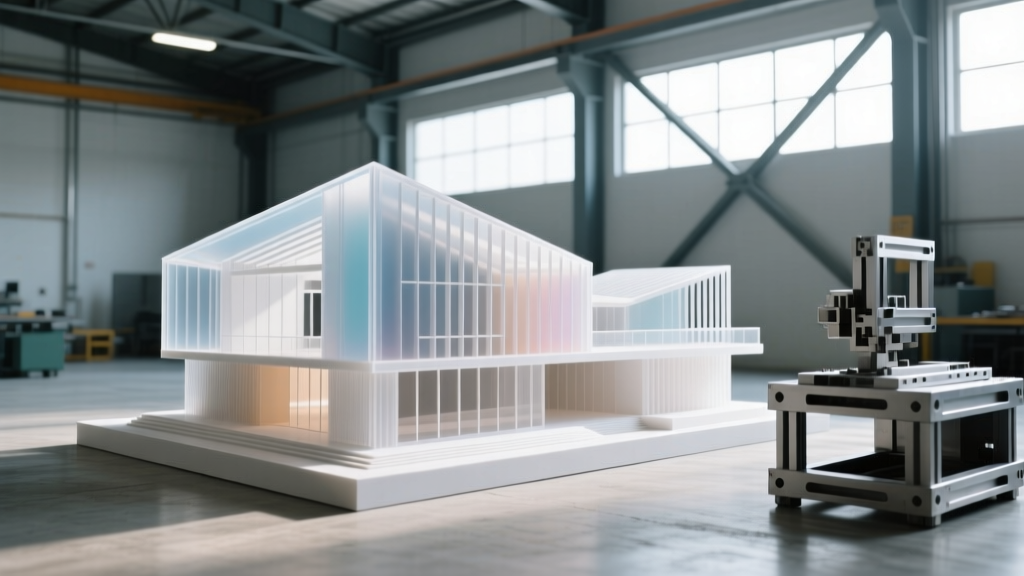
When CNC machining ABS is utilized for 1:1 scale architectural mockups intended for client presentations or municipal planning approvals, the raw machined surface must be elevated to a premium aesthetic. Unlike metal, which might be sent out for anodizing or media blasting, ABS requires chemical and mechanical post-processing.
After machining, the ABS part is hand-sanded progressively from 220 to 600 grit. Following mechanical sanding, fabricators utilize acetone vapor smoothing. The part is suspended in a sealed chamber with heated acetone vapor for 15 to 30 minutes. The vapor melts the outermost microscopic layer of the ABS, erasing all CNC tooling marks and leaving a glossy, injection-molded finish. Once cured, the ABS mockup can be primed and painted with automotive-grade PVDF (polyvinylidene fluoride) coatings to perfectly simulate the final architectural metal finish specified by the American Institute of Steel Construction (AISC) and architectural guidelines.
Transitioning from ABS Prototypes to Final Metalwork
The ultimate value of CNC machining ABS in the architectural metalwork pipeline is the seamless data transition to final metal production. The G-code used to machine the ABS prototype cannot simply be copy-pasted for 6061-T6 aluminum or Corten steel. The programmer must adjust the feed rates, reduce the spindle speeds, and account for tool deflection, which is virtually non-existent in ABS but highly prevalent when machining hard metals.
However, the WCS datums, the 3D toolpath contours, and the fixturing logic remain identical. By validating the complex parametric geometries in ABS first, machine shops eliminate the risk of scrapping a $2,000 block of aerospace-grade aluminum due to a CAM software collision or a flawed architectural CAD surface. This hybrid material workflow represents the pinnacle of efficiency in modern contract machining for the architectural sector.