Tight-Tolerance Plastic Parts CNC Machining for Enclosures
Discover how tight-tolerance plastic parts CNC machining achieves ±0.0005" for electronics enclosures using PEEK, Ultem, and specialized workholding.
The Hidden Complexity of Electronics Enclosures
High-frequency telecommunications, aerospace avionics, and medical diagnostic equipment increasingly rely on non-conductive, lightweight, and thermally stable housings. While aluminum remains a staple in general electronics, advanced polymers offer superior RF transparency, weight reduction, and chemical resistance. However, executing tight-tolerance plastic parts CNC machining for these critical electronics enclosures requires navigating severe thermal expansion and stress-relaxation challenges that simply do not exist in metalworking.
When an engineer specifies a ±0.0005-inch tolerance on a 12-inch Ultem enclosure flange, standard machine shop practices will fail. The cutting forces, heat generation, and clamping pressures that are negligible in 6061 aluminum become catastrophic variables in high-performance thermoplastics. This guide breaks down the exact material science, tooling strategies, and metrology required to hold aerospace-grade tolerances in polymer enclosures.
Critical Data Point: Thermal ExpansionThe coefficient of thermal expansion (CTE) for unreinforced PEEK is approximately 50 µm/m-°C, which is roughly twice that of 6061 aluminum. A 10-inch enclosure can physically grow by 0.005 inches with just a 10°C temperature spike during aggressive milling. If the part is measured while warm from the spindle, it will shrink below tolerance once it returns to the 20°C (68°F) metrology lab standard.
Material Selection Matrix for Tight-Tolerance Enclosures
Not all engineering plastics react identically to the cutting edge. Selecting the right polymer grade is the first step in ensuring dimensional stability. Below is a comparison of the most common high-performance polymers used in precision electronics housings.
| Polymer Grade | CTE (µm/m-°C) | Max Operating Temp | Machinability & Stability | Approx. Raw Cost (2026) |
|---|---|---|---|---|
| Victrex PEEK 450G | 50 (Unfilled) | 250°C (482°F) | Excellent stability, requires sharp tooling to prevent burring. | $85 - $110 / lb |
| SABIC Ultem 1000 (PEI) | 56 | 170°C (338°F) | Highly amorphous, prone to internal stress if cooled unevenly. | $45 - $60 / lb |
| DuPont Delrin 150 (POM) | 85 | 90°C (194°F) | Superior surface finish, but high CTE makes ultra-tight bores difficult. | $12 - $18 / lb |
| Solvay Ryton R-4 (PPS) | 30 (40% Glass) | 220°C (428°F) | Glass-filled; highly abrasive, demands polycrystalline diamond (PCD) tooling. | $35 - $50 / lb |
Overcoming Thermal and Stress-Relaxation Failure Modes
The primary failure mode in precision polymer machining is not tool breakage; it is part deformation post-unclamping. When plastic is extruded or injection-molded into billets, internal stresses are locked into the molecular structure. Machining removes the outer skin, allowing these stresses to relax, which warps the enclosure.
The 3-Stage Stress-Relief Protocol
To hold ±0.0005" on critical mating surfaces, contract machine shops must implement a strict multi-stage workflow. Skipping the annealing phase to save lead time will result in out-of-spec parts upon final inspection.
- Roughing: Remove 90% of the material, leaving 0.020" to 0.030" of stock on all critical dimensions. Use aggressive feeds but low cutting forces.
- Annealing (Stress Relieving): Submerge the roughed parts in a temperature-controlled glycol bath or convection oven. For SABIC Ultem 1000, this typically requires heating to 180°C (356°F) at a rate of no more than 20°C per hour, holding for 2 hours per inch of thickness, and cooling at 10°C per hour.
- Finishing: Execute the final passes to achieve the net dimensions and surface finish requirements.
Tooling and Workholding Strategies
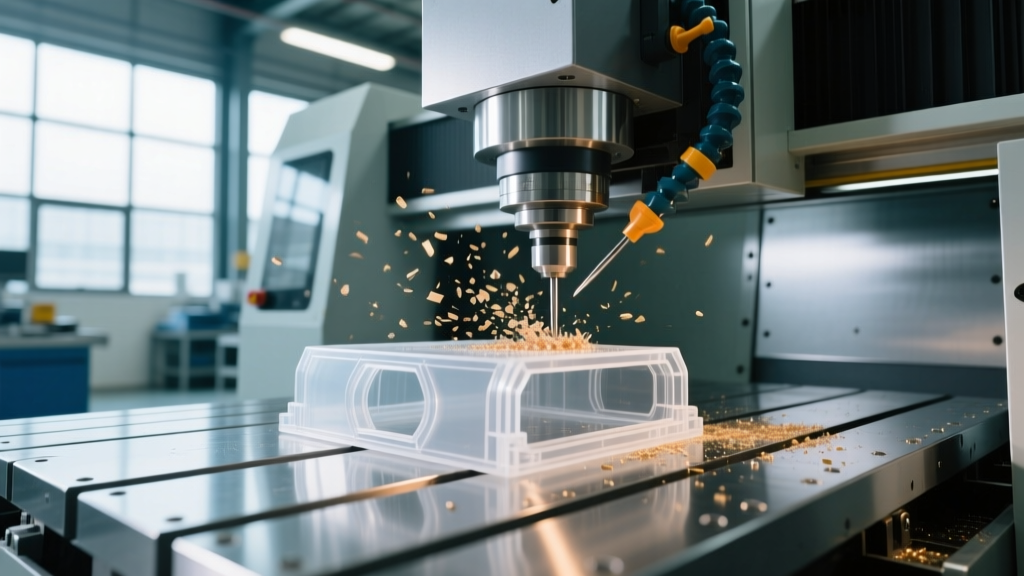
Standard carbide end mills designed for aluminum will smear, melt, or leave heavy burrs on engineering plastics. The geometry must be optimized for chip evacuation and heat reduction.
'When machining PEEK or Ultem, the goal is to shear the material cleanly without generating friction heat. We rely on uncoated, micro-grain carbide tools with high positive rake angles and polished flutes to prevent chip welding.'
— Lead Manufacturing Engineer, Aerospace Polymers Division
Specialized Tooling Geometries
For miniature features and tight internal radii in electronics enclosures, shops utilize specialized miniature end mills. According to guidelines from Harvey Tool's technical resources, tools designed specifically for plastics feature a 3-flute design with a high rake angle and a polished rake face. This geometry directs chips up and out of the cut zone, preventing the re-cutting of chips that causes localized melting and dimensional drift.
Workholding: Defeating Clamping Creep
Mechanical clamps induce point-load stresses. When a vise is tightened to 5,000 lbs of clamping force on a Delrin part, the plastic compresses. Once the vise is opened, the material rebounds, instantly throwing a held ±0.001" tolerance out to ±0.004".
- Custom Soft Jaws: Machine aluminum or high-density urethane jaws that perfectly match the contour of the roughed part, distributing clamping force over the entire surface area rather than at two pinch points.
- Vacuum Chucks: For finishing the final face of an enclosure, porous ceramic or aluminum vacuum plates holding 29 inHg of negative pressure provide immense holding force with zero mechanical distortion.
- Step Jaws: Utilizing step jaws allows the operator to clamp the raw stock on the lower step for roughing, then flip the part and clamp the machined outer profile on the upper step for finishing, minimizing re-setup error.
Coolant Selection: Air vs. Mist vs. Flood
Applying standard flood coolant to plastics is a frequent cause of scrap. Many polymers, particularly Nylon and certain grades of POM, are hygroscopic and will absorb moisture from water-soluble coolants, causing the part to swell unpredictably over the following 48 hours.
Warning: Thermal Shock in PTFE and POMBlasting ice-cold flood coolant onto a hot PTFE or POM cutting zone can induce micro-cracking and thermal shock, compromising the structural integrity of thin-walled enclosure ribs. Always verify the material's moisture absorption and thermal shock resistance before enabling flood coolant.
The Industry Standard: Minimum Quantity Lubrication (MQL) paired with a high-pressure compressed air blast. The air clears the chips from the cut zone (preventing re-welding), while the microscopic mist of synthetic lubricant reduces friction without soaking the part. For glass-filled materials like Ryton R-4, flood coolant is sometimes mandatory to suppress abrasive dust, but it must be paired with immediate post-machining baking to drive out absorbed moisture.
Metrology: Measuring Without Deforming
You cannot inspect a ±0.0005" tolerance on a soft polymer using standard handheld calipers or micrometers; the mechanical force of the thimble will compress the plastic, yielding false readings. Furthermore, standard ruby-tipped touch probes on Coordinate Measuring Machines (CMM) can indent soft materials like PTFE or unfilled PEEK.
Advanced machine shops utilize non-contact laser scanning CMMs or optical comparators for final inspection. If touch probing is required, the probe must be fitted with a large-diameter silicon nitride or specialized polymer ball tip, and the trigger force must be calibrated to the lowest possible setting (typically under 0.1 grams of force) to prevent surface indentation.
Cost Implications and Sourcing in 2026
Tight-tolerance plastic parts CNC machining commands a premium over standard metalworking due to the extended cycle times, mandatory annealing cycles, and specialized metrology required.
- Standard Plastic Machining (±0.005"): $90 - $120 per hour.
- Tight-Tolerance Enclosures (±0.001"): $140 - $170 per hour (includes MQL setup and custom soft jaws).
- Aerospace/Medical Grade (±0.0005"): $190 - $240+ per hour (includes multi-stage annealing, laser CMM inspection, and cleanroom deburring).
When sourcing a contract manufacturer for your electronics enclosures, do not simply ask if they 'machine plastics.' Review their machining capabilities and quality certifications. Demand evidence of climate-controlled inspection rooms (held at 20°C ±1°C), documented annealing protocols, and experience with non-contact metrology. A shop that treats Ultem like aluminum will inevitably deliver warped, out-of-spec enclosures that fail during final assembly.