Comparing Lean Workflows for Plastics CNC Machining
Compare batch, single-piece, and cellular workflows for plastics CNC machining. Reduce thermal distortion and WIP with lean manufacturing alternatives.
The Thermal Distortion Penalty in Batch Processing
When managing a machine shop, the default instinct for high-volume orders is often batch-and-queue processing. You mill all the top faces of 500 parts, swap the tool, drill all the holes, and then move the entire batch to deburring. While this minimizes tool change time on the spindle, it creates a hidden cost in plastics CNC machining: thermal distortion and massive Work-In-Progress (WIP) pileups.
Unlike aluminum or steel, engineering polymers possess high coefficients of thermal expansion (CTE). When a batch of 500 Delrin (POM) parts sits on a shop floor cart waiting for the next operation, they absorb ambient heat and cutting fluid residue. By the time they reach the final boring operation, their dimensions have shifted. Once machined and cooled to the metrology lab's 20°C (68°F) standard, the parts shrink out of tolerance, resulting in scrapped batches.
Material CTE Comparison (Linear, 10^-6 /°C)Understanding thermal expansion is critical for workflow design. Plastics expand significantly more than metals under identical cutting heat.
- UHMW-PE: 150 - 200
- POM (Delrin): 85 - 110
- PEEK (Unfilled): 47 - 50
- PTFE (Teflon): 110 - 135
- Aluminum 6061 (Baseline): 23
Transitioning to lean manufacturing alternatives eliminates these thermal queues. By analyzing single-piece flow and cellular manufacturing against traditional batching, shop owners can optimize their plastics CNC machining operations for both precision and throughput.
Comparing Three Shop Floor Workflow Models
Implementing lean principles in a machine shop requires moving away from functional silos (all mills in one row, all lathes in another) toward product-focused workflows. According to the Lean Enterprise Institute, the goal is to maximize value while minimizing waste (muda), specifically the waste of waiting and overproduction.
Model 1: Traditional Batch-and-Queue
In this model, parts are processed in large lots. A 5-axis mill might run 200 PEEK insulators, completing Op 10 before an operator manually flips them for Op 20. The primary advantage is reduced setup frequency. The disadvantage is high WIP, long lead times, and the thermal expansion risks mentioned above. If a tool breaks on part 180, the entire batch may require rework.
Model 2: Single-Piece Flow (Continuous)
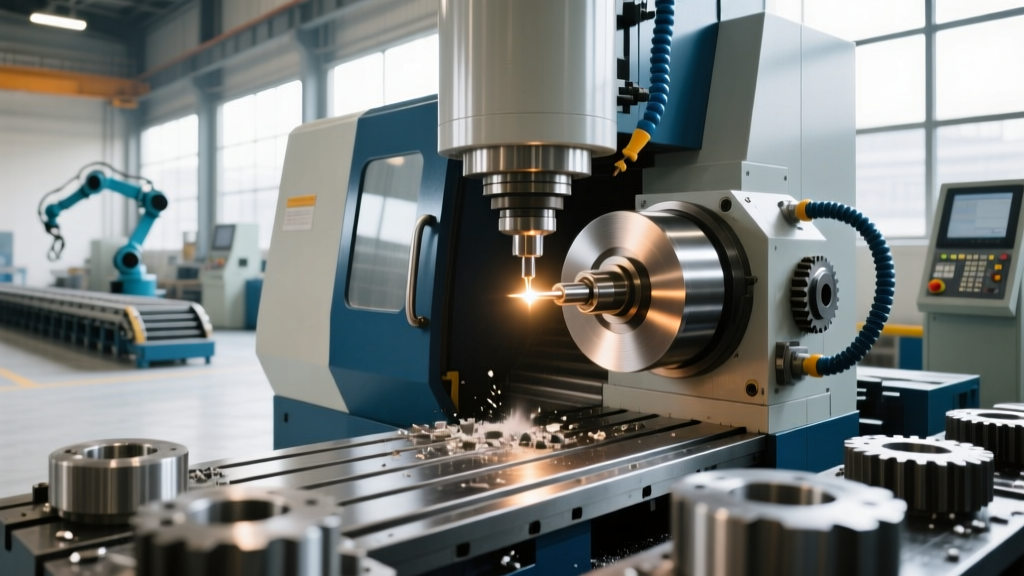
Single-piece flow dictates that a part moves to the next operation immediately after the previous one is completed. In plastics CNC machining, this often means utilizing a 5-axis machine with a tombstone or trunnion table to complete Op 10 and Op 20 in a single clamping. The part never leaves the fixture until it is finished. This eliminates thermal cooling periods between ops and reduces WIP to near zero.
Model 3: U-Shaped Cellular Manufacturing
A manufacturing cell groups dissimilar machines (e.g., a CNC lathe, a 3-axis mill, and a vibratory deburring bowl) into a tight U-shape. One operator manages the entire cell, moving a single plastic component from raw stock to finished good. This is highly effective for families of parts, such as various sizes of PTFE valve seats, allowing for rapid changeovers and continuous flow.
| Metric | Batch-and-Queue | Single-Piece Flow | U-Shaped Cell |
|---|---|---|---|
| Avg WIP Level | High (Hundreds of parts) | Low (1-5 parts) | Low (1-10 parts) |
| Thermal Distortion Risk | High (Parts sit and cool) | Minimal (Single clamping) | Low (Rapid transit) |
| Setup Time Impact | Amortized over large batch | Requires SMED optimization | Requires modular fixturing |
| Defect Detection | Delayed (End of batch) | Immediate (In-process) | Immediate (Operator led) |
| Best Application | Low-tolerance commodity parts | Complex 5-axis aerospace parts | High-mix, low-volume families |
Adapting Lean Tooling for Plastics CNC Machining
Lean workflows fail if setup times are too long. The NIST Manufacturing Extension Partnership emphasizes that reducing changeover time is a prerequisite for smaller batch sizes. In plastics machining, this requires specific tooling adaptations.
SMED and Modular Soft Jaws
Single-Minute Exchange of Die (SMED) is critical when moving to single-piece flow. Machining plastics like Nylon or Acetal requires careful clamping; excessive mechanical force causes elastic deformation, leading to out-of-round parts when unclamped. Instead of machining custom aluminum soft jaws for every part number—which takes 45 minutes per setup—lean cells utilize high-density urethane or Ren Shape base plates. Operators can rapidly swap modular, pre-machined urethane jaw inserts that grip the plastic securely without inducing stress, reducing changeover times from 45 minutes to under 8 minutes.
Vacuum Fixturing vs. Mechanical Clamping
For flat, thin-walled plastic components (such as UHMW wear pads or PEEK semiconductor trays), mechanical clamping introduces unacceptable distortion. Lean cells increasingly rely on porous carbon vacuum chucks integrated directly into the machine pallet system. By utilizing a standardized grid plate, operators can drop a vacuum fixture onto the machine, engage the pneumatic lines, and begin machining in under two minutes. This supports the lean mandate of rapid changeovers while eliminating the clamping forces that ruin polymer tolerances.
In-Process Quality Control Integration
In a batch workflow, quality control relies on a post-process CMM (Coordinate Measuring Machine) in a temperature-controlled lab. In a lean single-piece flow cell, waiting for CMM results creates a bottleneck. To maintain flow, shops must integrate in-process probing and tool setting directly into the CNC cycle.
For plastics CNC machining, this requires specialized probe routines. Because plastics yield under pressure, standard Renishaw touch probes can deflect the material slightly, yielding false readings. Advanced lean cells utilize non-contact laser tool setting and low-force strain-gauge probes. Furthermore, because plastics are sensitive to ambient temperature, the machine's internal thermal compensation models must be calibrated specifically for the polymer's CTE, not the default steel or aluminum settings provided by the OEM.
Decision Framework: Which Workflow Fits Your Shop?
Selecting the right lean alternative depends on your part geometry, tolerance requirements, and volume. Use this framework to audit your current plastics CNC machining operations:
- Stick with Batch-and-Queue ONLY if: You are machining low-cost, high-tolerance commodity plastics (e.g., HDPE cutting boards) where thermal expansion will not push the part outside the +/- 0.010" tolerance band, and setup times exceed 4 hours.
- Transition to Single-Piece Flow if: You are machining tight-tolerance (+/- 0.001" or tighter) engineering plastics like Glass-Filled PEEK or Torlon for aerospace or medical devices. The cost of scrapping a batch due to thermal shrinkage far outweighs the cost of 5-axis tombstone fixturing.
- Implement U-Shaped Cells if: You produce high-mix, low-volume families of parts (e.g., various diameters of PTFE seals). Grouping a lathe and a mill allows one operator to manage the entire value stream, drastically reducing floor space and WIP.
As of 2026, integrating collaborative robots (cobots) into lean plastic machining cells has become highly accessible. Cobots equipped with soft-touch pneumatic grippers can load raw polymer blanks into vacuum fixtures, maintaining single-piece flow across multiple shifts without inducing the clamping marks associated with traditional hard-automation gantry loaders.
By abandoning the batch-and-queue mentality and embracing cellular or single-piece workflows, machine shops can eliminate the thermal distortion risks inherent to plastics CNC machining. The result is a shop floor with drastically reduced WIP, faster lead times, and a first-pass yield rate that protects your bottom line.