G Zero CNC Machining Maintenance: Prototyping vs Production
Compare maintenance schedules for G Zero CNC machining in rapid prototyping versus high-volume production. Discover exact intervals, costs, and calibration specs.
The Operational Divide: Prototyping vs. Production in G Zero CNC Machining
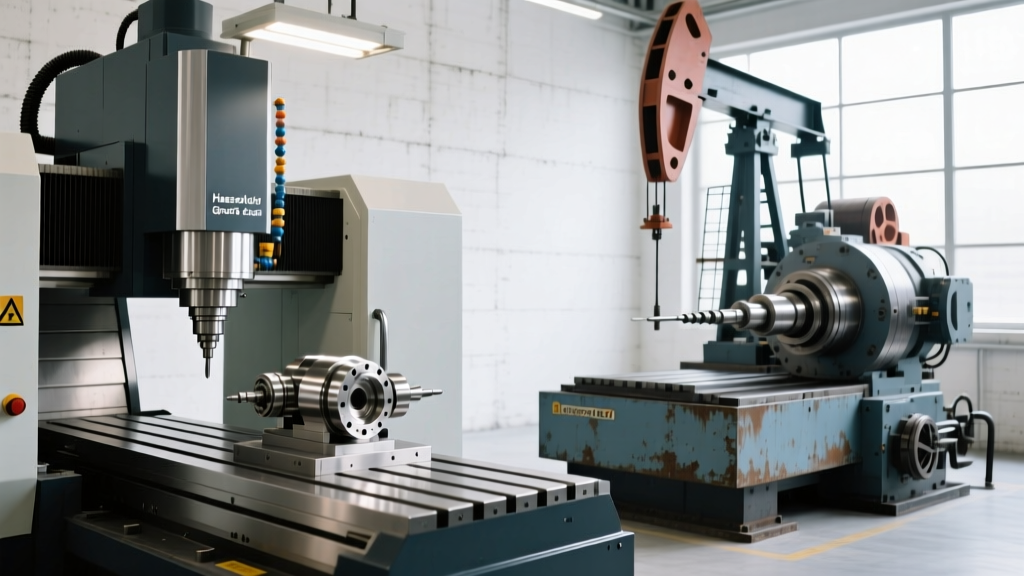
G Zero CNC machining relies on the integration of zero-point clamping systems and zero-deflection toolpath strategies to achieve micron-level repeatability. However, the mechanical stress profile of a machine executing rapid prototyping differs fundamentally from one running high-volume production. In a prototyping environment, a 5-axis trunnion machine like the Haas UMC-750SS experiences extreme thermal cycling, constant axis reversals, and high-frequency Automatic Tool Changer (ATC) actuation. Conversely, a horizontal production cell like the Makino a61nx endures sustained spindle loads, continuous coolant degradation, and localized way-wear from repetitive, confined toolpaths.
Defining the G Zero Methodology: In modern precision manufacturing, 'G Zero' refers to the elimination of setup-induced variables. This is achieved through pneumatic zero-point clamping bases (e.g., Schunk Vero-S or Zimmer Group systems) combined with thermal-stability compensation in the CNC controller. Maintenance schedules must protect both the physical clamping hardware and the machine's geometric accuracy.Applying a blanket preventative maintenance (PM) schedule across both operational modes leads to catastrophic inefficiencies. Prototyping machines suffer from ATC cam-box fatigue and clamping puck contamination, while production machines battle spindle bearing degradation and way-lube starvation. Below is a technical breakdown of how service schedules must diverge to protect capital equipment and maintain G Zero tolerances.
Rapid Prototyping Maintenance: Managing High-Mix, Low-Volume Wear
Rapid prototyping is characterized by high-mix, low-volume (HMLV) workflows. A machine might run a 304 stainless steel aerospace bracket in the morning and a 6061-T6 aluminum heat sink in the afternoon. This variability creates unique maintenance challenges, particularly for the zero-point clamping system and the ATC.
The Zero-Point Clamping Contamination Factor
The foundation of G Zero CNC machining is the zero-point base. In prototyping, operators manually swap fixtures multiple times per shift. Stringy stainless steel chips and fine aluminum dust inevitably infiltrate the clamping slides. If a single 15-micron chip lodges in the Schunk Vero-S locking mechanism, the Z-axis repeatability degrades from ±0.0002 inches to over ±0.0015 inches, ruining the G Zero offset.
- Daily Action: Manual purge of clamping pucks using a dedicated 40-PSI air gun and isopropyl alcohol wipe-down of the mating surfaces.
- Weekly Action: Lubrication of the internal clamping slides with low-viscosity, non-stacking grease (e.g., Kluber Isoflex NBU 15).
ATC and Spindle Thermal Cycling
Prototyping programs require vastly different tool lengths and weights, forcing the ATC arm to constantly adjust its grip and the spindle to undergo rapid thermal expansion and contraction. According to NIST Precision Engineering guidelines, thermal transients are the leading cause of geometric error in multi-axis machining. Spindle chiller units must be serviced more frequently to handle the erratic heat loads of start-stop prototyping cycles.
Prototyping Preventative Maintenance Matrix
| Component | Failure Mode in Prototyping | Service Interval | Estimated Service Cost (2026) |
|---|---|---|---|
| Zero-Point Pucks | Chip ingress causing Z-axis lift | 40 Hours (Weekly) | $180 (Labor + Grease) |
| ATC Cam Box | Roller wear from varied tool weights | 500 Hours | $3,200 (Parts & Labor) |
| Spindle Chiller | Refrigerant degradation from thermal shock | 1,000 Hours | $850 (Flush & Recharge) |
| Way Covers (Bellows) | Tearing from extreme axis travel limits | 250 Hours (Inspect) | $1,400 per axis (Replace) |
Production Machining: Combating Micro-Wear and Thermal Drift
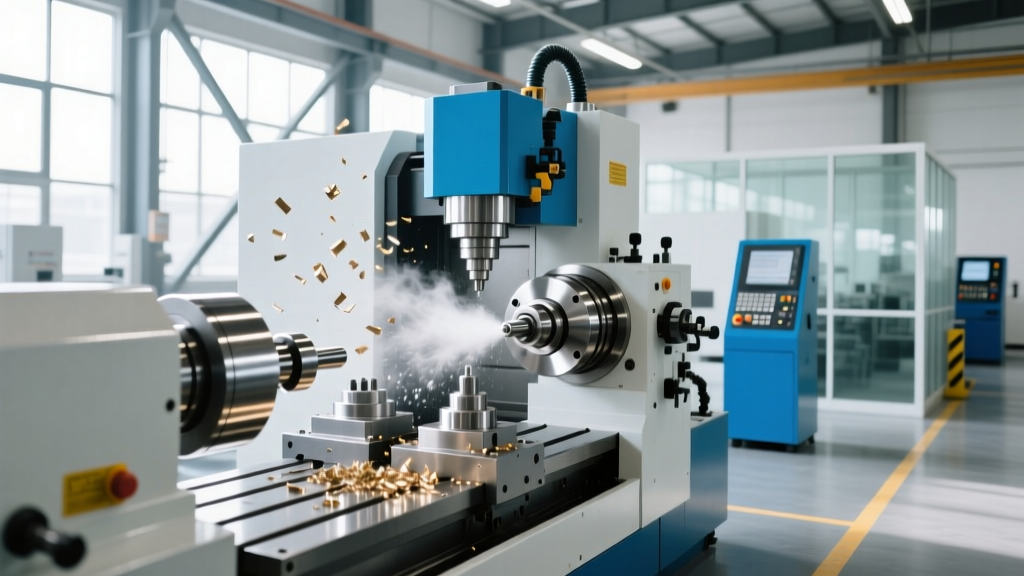
High-volume production machining operates on a low-mix, high-volume (LMHV) paradigm. The machine executes the same G-code subroutine thousands of times. The primary enemies here are not thermal cycling or ATC fatigue, but rather localized micro-wear, coolant breakdown, and harmonic vibration.
Way Lubrication and Localized Wear
In production, a CNC mill might only utilize a 6x6 inch section of the X-Y work envelope for weeks at a time. The ballscrews and linear guideways in this specific zone experience millions of cycles, while the rest of the table remains static. Standard volumetric way-lube systems often fail to deliver adequate pressure to the static zones, leading to stick-slip friction when the machine eventually requires a full-travel move for maintenance or a changeover.
Corrective Protocol: Production machines require a mandatory 'full-stroke' maintenance program. Every 72 hours, the CNC must run a macro program that drives all linear axes to their absolute positive and negative limits at rapid traverse rates to distribute way oil evenly and clear localized chip packing.
Coolant Degradation and Tramp Oil
Continuous 24/7 production introduces severe tramp oil infiltration from the spindle and axis lubrication systems. As detailed in the OSHA Metalworking Fluids Guidelines, unchecked tramp oil alters the coolant pH, promotes anaerobic bacteria growth, and compromises the lubricity required for zero-deflection finishing passes. In G Zero production environments, a drop in lubricity causes tool chatter, instantly destroying the surface finish tolerances.
High-Volume Production Service Schedule
| Component | Failure Mode in Production | Service Interval | Estimated Service Cost (2026) |
|---|---|---|---|
| Coolant System | Tramp oil saturation / pH drop | 168 Hours (Weekly) | $450 (Skimming & Trimming) |
| X/Y/Z Ballscrews | Localized pitch error from confined travel | 72 Hours (Full-Stroke Macro) | $0 (In-house programming) |
| Spindle Bearings | Micro-pitting from continuous radial load | 2,500 Hours (Vibration Analysis) | $14,500 (Rebuild/Exchange) |
| Tool Magazine Pots | Grip force loss from constant retention knob pull | 1,000 Hours | $600 (Spring replacement) |
Calibration Divergence: Laser Interferometry and Ballbar Testing
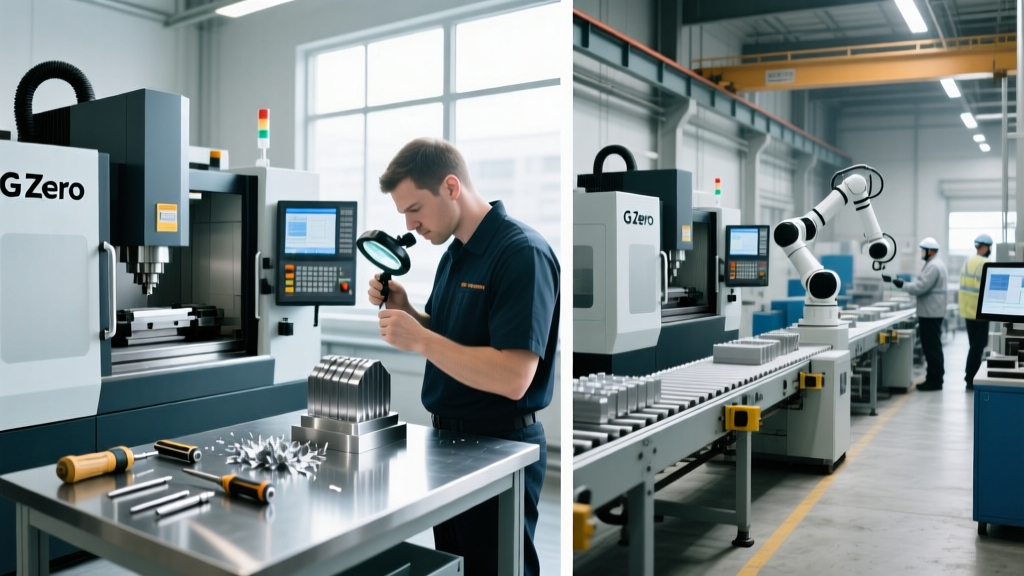
Maintaining the physical hardware is only half the battle; verifying the geometric accuracy is what sustains G Zero CNC machining capabilities. The frequency and type of calibration required diverge sharply based on the operational mode.
Warning: Relying solely on the machine controller's internal error compensation maps without physical verification will result in silent scrap. Thermal growth and mechanical wear will eventually outpace the software's ability to compensate.For rapid prototyping, the machine's kinematics are constantly stressed by 5-axis simultaneous movements. A Renishaw QC20-W wireless ballbar test should be performed monthly to check for servo mismatch and backlash in the rotary axes (B and C axes on a trunnion table). If the circular interpolation test shows a reversal spike greater than 3 microns, the rotary axis pre-load must be adjusted immediately.
For production machining, the focus shifts to linear positioning accuracy and thermal drift. Because the machine runs continuously, the ballscrews heat up and expand. API (Automated Precision Inc.) laser interferometry should be deployed bi-annually to map the thermal growth curve of the X and Y axes. This data is then fed into the CNC controller's thermal compensation parameters, ensuring that a part machined at 6:00 AM (cold machine) matches a part machined at 2:00 PM (thermally saturated machine) within a ±0.0001-inch tolerance band.
'In high-volume production, the machine is a thermal engine. If your maintenance schedule does not include quarterly verification of the spindle thermal displacement sensors, you are not doing G Zero machining; you are just hoping the heat doesn't ruin your tolerances.' — Lead Applications Engineer, Tier-1 Aerospace Machine Shop (2025 Industry Summit)
Financial Impact of Misaligned Service Schedules
Applying a production maintenance schedule to a prototyping machine results in severe under-maintenance of the ATC and zero-point clamps, leading to setup crashes. A single spindle crash caused by a failed ATC roller or a contaminated clamping puck will cost between $18,000 and $28,000 in spindle replacement, machine re-calibration, and downtime.
Conversely, applying a prototyping schedule to a production machine results in massive over-maintenance of the ATC (which rarely changes tools) and critical under-maintenance of the coolant and ballscrew systems. This leads to premature tool wear, surface finish failures, and a 12% to 18% increase in scrap rates due to unmitigated thermal drift. Optimizing your G Zero CNC machining maintenance requires aligning your service intervals with the physical reality of your G-code execution.
Frequently Asked Questions
How often should zero-point clamping pucks be replaced in a prototyping environment?
Under heavy prototyping conditions with 15+ manual changeovers per shift, the internal clamping segments and pull-stud springs should be rebuilt every 4,000 cycles (roughly 6 to 8 months). Complete puck replacement is typically only necessary if the outer mating surface sustains physical impact damage from a crane-loaded fixture.
Can AI-driven predictive maintenance replace physical PM schedules?
As of 2026, AI-driven spindle vibration monitors (like those from Kistler or Marposs) are excellent for predicting catastrophic bearing failure, but they cannot detect zero-point clamping contamination or localized way-lube starvation. Predictive analytics should supplement, not replace, the physical service matrices outlined above.
What is the acceptable runout for a G Zero production spindle?
For true G Zero precision machining in a production environment, the spindle taper (e.g., HSK-A63 or CAT40) must exhibit less than 1.5 microns (0.00006 inches) of radial runout at the gauge line. If runout exceeds 3 microns, the spindle bearings require pre-load adjustment or immediate replacement to maintain zero-deflection cutting parameters.