PVC CNC Machining: 2026 Tolerance & Surface Finish Tech
Master PVC CNC machining tolerances and surface finishes. Explore 2026 innovations in PCD tooling, cryogenic cooling, and thermal compensation.
Machining Polyvinyl Chloride (PVC) presents a unique paradox in modern manufacturing: while the material is exceptionally easy to cut, holding tight dimensional tolerances and achieving optical-grade surface finishes directly off the machine remains a significant engineering challenge. Unlike metals, rigid PVC (typically Type 1, Grade 1 per ASTM D1784) possesses a high coefficient of thermal expansion (CTE) ranging from 50 to 80 µm/m·K. This means PVC expands and contracts up to ten times more than aluminum under the same thermal load.
As contract machining demands evolve in 2026, shops are moving beyond traditional 'cut and cool' methods. By integrating adaptive toolpaths, polycrystalline diamond (PCD) insert technology, and in-process probing, manufacturers are now routinely holding ±0.001-inch tolerances and achieving 16 µin Ra surface finishes on PVC components without secondary post-processing.
⚠️ CRITICAL SAFETY WARNING: Thermal DegradationPVC begins to degrade at temperatures exceeding 300°F (149°C). If cutting zone temperatures spike due to chip packing or dull tooling, the material releases hydrogen chloride (HCl) gas. This gas is highly toxic to operators and rapidly corrodes the cast iron and steel components of your CNC machine. Strict temperature management is not just a quality metric; it is a vital safety requirement.
The Thermal Bottleneck and Dimensional Stability
The primary adversary in PVC CNC machining is friction-induced heat. Because PVC is an excellent thermal insulator (thermal conductivity of ~0.14 W/m·K), heat generated at the shear zone does not dissipate into the chips or the workpiece evenly. Instead, it concentrates at the tool tip and the immediate cut surface, causing localized melting, edge roll-over, and severe dimensional inaccuracies once the part cools to room temperature.
To combat this, modern machine shops are adopting high-speed machining (HSM) strategies specifically tuned for polymers. According to Ensinger's machining guidelines for engineering plastics, maintaining a high surface cutting speed while keeping the chip load thick enough to carry heat away is critical. For rigid PVC, this translates to surface speeds (SFM) of 800 to 1,200 with feed rates of 0.004 to 0.010 inches per tooth (IPT).
2026 Tolerance Standards: Pushing Past ±0.005"
Historically, the industry standard tolerance for machined PVC was ±0.005 inches. While acceptable for basic fluid manifolds and structural spacers, semiconductor and medical device manufacturers now require tighter specs. Achieving ±0.001 inches requires a complete overhaul of the machining environment and toolpath strategy.
| Metric | Standard Machining (Legacy) | Advanced Precision (2026 Standard) |
|---|---|---|
| Dimensional Tolerance | ±0.005" | ±0.001" (Climate Controlled) |
| Surface Finish (Ra) | 64 - 125 µin | 16 - 32 µin (Off-Machine) |
| Tooling Material | Uncoated Carbide / HSS | PCD or Mirror-Polished Carbide |
| Coolant Strategy | Flood Coolant / Air Blast | Cryogenic Air / MQL |
| Shop Environment | Ambient (65-85°F) | Strict 68°F ± 2°F (20°C) |
In-Process Thermal Compensation
The most significant innovation in holding tight PVC tolerances is the use of in-process probing cycles. Modern 5-axis CNC mills equipped with Renishaw or Heidenhain probing systems now utilize custom macro routines that measure the part mid-operation. Because PVC expands immediately upon cutting, the probe measures the thermally expanded state of the part, and the CNC controller dynamically adjusts the remaining finishing passes to account for the predicted shrinkage once the part returns to the 68°F inspection room temperature.
Achieving Sub-32 µin Surface Finishes Off-Machine
Secondary buffing or flame polishing introduces its own thermal stresses and can warp precision PVC components. The goal in 2026 is to achieve the final surface finish directly on the spindle. As detailed in industry machining guidelines from Plastics International, the geometry of the cutting edge dictates the finish quality more than the spindle speed.
Tooling Geometry and PCD Innovations
Standard carbide end mills, even when uncoated, often possess microscopic edge prep (honing) designed to strengthen the edge for metal cutting. On PVC, this slight rounding rubs and burnishes the plastic rather than shearing it, causing localized melting and a cloudy, rough surface finish (often exceeding 125 µin Ra).
- O-Flute (Single Flute) End Mills: Essential for routing and profiling. The massive gullet allows for rapid chip evacuation, preventing chips from being re-cut and melted into the surface.
- High Rake Angles: Tools ground with a 25° to 30° positive rake angle slice through the PVC polymer chains with minimal cutting force, drastically reducing heat generation.
- PCD (Polycrystalline Diamond) Inserts: For high-volume production turning and facing, PCD tooling maintains a razor-sharp edge up to 50 times longer than carbide. A PCD insert with a polished rake face will consistently yield a 16 µin Ra finish on rigid PVC over thousands of cycles.
Advanced Coolant and Workholding Strategies
Traditional flood coolant is highly discouraged for PVC machining. Water-based coolants can be absorbed by certain plastic grades, causing microscopic swelling, and the cleanup process adds unnecessary labor. Furthermore, flood coolant can mask chip accumulation, leading to sudden thermal spikes.
Cryogenic Cooling vs. Air Blast
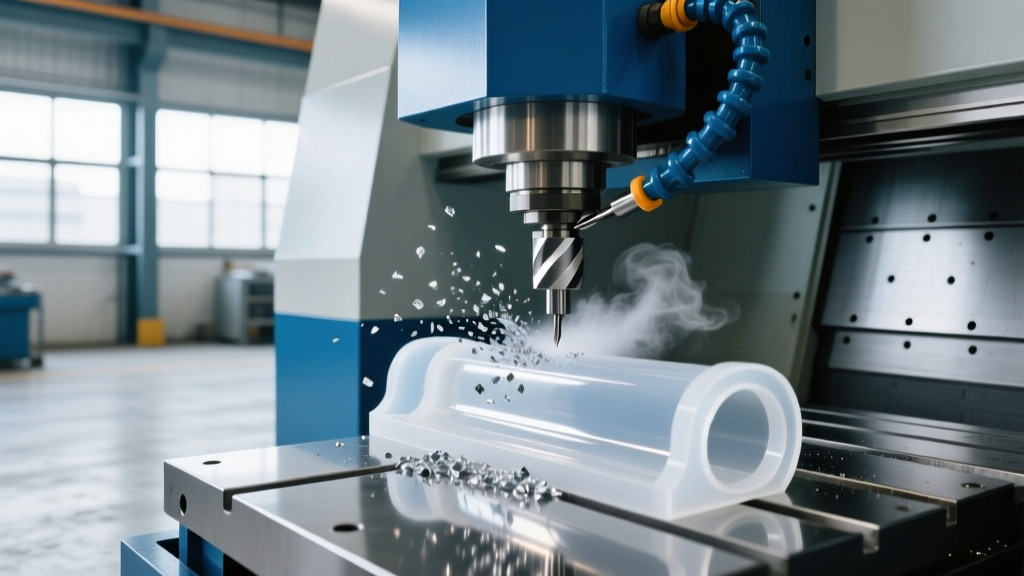
While standard compressed air blasts are the baseline for PVC, advanced shops are adopting localized cryogenic cooling systems. By delivering -50°F air directly to the cutting zone via a vortex tube, shops can keep the PVC rigid and brittle at the exact point of shear. This prevents the 'gumming' effect on the tool edge and allows for significantly higher feed rates without sacrificing surface finish. Cryogenic cooling also eliminates the risk of HCl gas release by ensuring the cutting zone never breaches the thermal degradation threshold.
💡 Pro-Tip: Workholding ElasticityPVC has a relatively low tensile yield strength (~7,500 psi) and high elasticity. If you use standard mechanical vise clamping, the part will compress during machining and spring back to an oversized state once unclamped. Always use vacuum workholding, magnetic chucks with steel backing plates, or custom-machined soft jaws that distribute clamping force evenly across the entire perimeter of the raw stock.
Design for Manufacturability (DFM) Rules for Precision PVC
Engineers designing PVC components for CNC machining must account for the material's physical limitations. Implementing the following DFM rules will reduce scrap rates and lower overall production costs:
- Internal Corner Radii: Never design sharp internal corners. PVC is notch-sensitive and prone to micro-cracking under stress. Specify internal radii that are at least 1.5 times the diameter of the required end mill to allow for continuous, high-speed toolpaths without dwelling.
- Wall Thickness Ratios: Maintain a minimum wall thickness of 0.060 inches for milled features. Walls thinner than this will deflect under cutting forces, resulting in chatter marks and poor surface finishes.
- Threaded Features: Avoid machining fine threads directly into PVC. The material lacks the shear strength to hold fine pitches under torque. Design parts to accept brass or stainless steel helical coil inserts (e.g., Heli-Coil) for any threaded fastening requirements.
- Deburring Allowances: While CNC tools can leave clean edges, a microscopic burr is common on the exit side of drilled holes. Design countersinks or chamfers on all hole exits to allow the CNC machine to cleanly break the edge in the same setup.
By treating PVC not as a 'soft metal' but as a distinct thermoplastic with unique thermal and mechanical properties, machine shops can leverage modern CNC technology to produce high-precision, flawless components that meet the rigorous demands of modern fluid handling, semiconductor, and medical applications.