Compliance in Nuclear or Power Energy CNC Machining Enclosures
Explore safety standards, ASME NQA-1 compliance, and tight-tolerance CNC machining requirements for nuclear and power energy electronics enclosures.
Machining electronics enclosures for power generation facilities requires navigating a labyrinth of regulatory standards, material traceability mandates, and unforgiving dimensional tolerances. When a printed circuit board (PCB) housing is destined for a nuclear reactor containment building or a high-voltage power substation, standard commercial machine shop practices are insufficient. The intersection of tight-tolerance CNC machining and stringent safety compliance dictates every aspect of production, from raw material sourcing to final First Article Inspection (FAI).
Regulatory Baseline Warning: Electronics enclosures classified as safety-related in nuclear applications must comply with 10 CFR 50 Appendix B and the ASME NQA-1 standard. Failure to maintain documented quality assurance programs can result in immediate vendor disqualification and severe regulatory penalties for the operating utility.The Regulatory Framework: ASME NQA-1 and IEEE 323
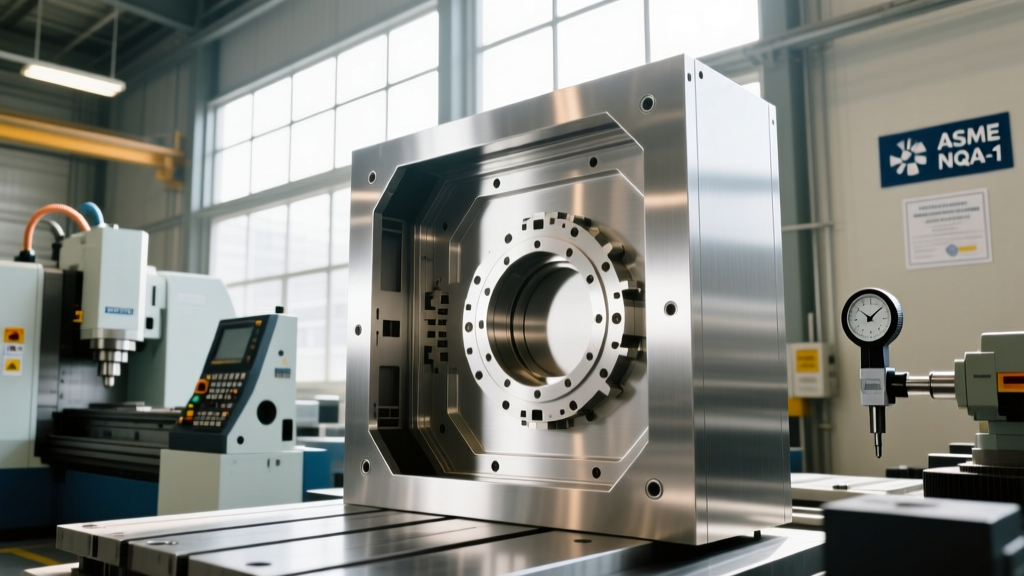
Contract machining for the energy sector is governed by rigorous quality assurance frameworks. The cornerstone for nuclear applications is ASME NQA-1 (Quality Assurance Requirements for Nuclear Facility Applications). Unlike ISO 9001, which focuses on general quality management systems, NQA-1 mandates absolute traceability, documented inspection hold points, and strict non-conformance reporting for every safety-related component.
For electronics enclosures specifically, the design must also survive environmental qualification testing as outlined in IEEE 323. This standard requires enclosures to maintain their structural and shielding integrity under extreme conditions, including seismic events, high radiation, and loss-of-coolant accident (LOCA) environments. Consequently, the CNC machine shop must prove that its manufacturing processes do not introduce micro-fractures, residual stresses, or galvanic vulnerabilities that could compromise the enclosure during a design-basis event.
Dimensional Tolerances and GD&T for Power Electronics
Power electronics generate significant heat and are highly sensitive to electromagnetic interference (EMI). The CNC machining of these enclosures requires advanced Geometric Dimensioning and Tolerancing (GD&T) to ensure perfect mating surfaces for thermal interface materials and EMI gaskets.
Critical Machining Features
- Flange Flatness: Mating flanges requiring conductive gaskets for EMI shielding must be machined to a flatness of 0.0002 inches across a 12-inch span. Any deviation compromises the RF seal.
- True Position on Connector Ports: Bulkhead connector holes for MIL-DTL-38999 circular connectors require a true position tolerance of ±0.0005 inches at Maximum Material Condition (MMC) to ensure blind-mating capability in high-vibration environments.
- PCB Mounting Bosses: Standoffs for multi-layer power boards must be height-matched within 0.001 inches to prevent solder joint cracking when the board is torqued down.
| Enclosure Feature | Standard Commercial Tolerance | Nuclear/Power Energy Tolerance | Inspection Method |
|---|---|---|---|
| EMI Gasket Groove Width | ±0.005" | ±0.0005" | Optical Comparator / CMM |
| Flange Surface Finish | Ra 63 µin | Ra 16 - 32 µin | Surface Profilometer |
| PCB Boss Height Match | ±0.010" | ±0.001" | Height Gage / CMM |
| Thread Depth (Blind Holes) | +0.020" / -0.000" | ±0.005" | Thread Depth Gage |
EMI Shielding and Environmental Sealing Compliance
Power energy environments are saturated with electromagnetic noise. Enclosures must comply with MIL-STD-461 requirements for electromagnetic compatibility. To achieve this, CNC machinists must cut precise O-ring and conductive elastomer gasket glands. According to the Parker O-Ring Handbook, the surface finish of the gland sealing surfaces is critical; a finish that is too rough will abrade the gasket during thermal cycling, while a finish that is too smooth will prevent the gasket from seating properly, leading to micro-leaks.
For nuclear-grade enclosures machined from 6061-T6 aluminum, the final surface often requires hard anodizing per MIL-A-8625 Type III. The CNC programmer must account for the precise build-up of the anodic layer (typically 0.001 to 0.002 inches per surface). This means pre-machining dimensions must be intentionally undersized to ensure the post-anodizing true position and thread clearances fall within the NQA-1 approved control limits.
Material Traceability and the MTR Mandate
In safety-related power energy CNC machining, the physical part is only half the deliverable; the documentation package is equally critical. Every billet of 316L stainless steel or aerospace-grade aluminum used for nuclear enclosures must be accompanied by a Certified Mill Test Report (CMTR).
Traceability Protocol: Machine shops must maintain a continuous chain of custody. The raw material lot number is laser-etched or vibro-peened onto the enclosure before final machining. If a CMM inspection reveals a non-conformance, the shop must be able to trace the exact cutting tool, coolant batch, operator, and machine spindle hours associated with that specific serial number.Coolant management also falls under compliance scrutiny. For enclosures destined for nuclear containment, shops must use low-halogen, low-sulfur cutting fluids. Residual chlorides or sulfides left in blind holes or thread crevices can induce stress corrosion cracking (SCC) in stainless steel components over decades of service. Post-machining ultrasonic cleaning and passivation per ASTM A967 are mandatory hold points before the part can move to the QA inspection lab.
Cost Implications and Lead Time Realities
Procurement managers must understand the financial and scheduling realities of nuclear or power energy CNC machining. The overhead of maintaining an ASME NQA-1 compliant quality management system is substantial, and machine shops pass these costs directly into the piece price.
Pricing and Timeline Matrix
- Base Machining Cost: A standard commercial CNC milled aluminum enclosure might cost $185 per unit in volumes of 500.
- NQA-1 Compliance Premium: Expect a 45% to 65% premium for nuclear-grade machining, pushing the unit cost to $268 - $305. This covers FAI documentation (AS9102 format), in-process CMM checks, and MTR reconciliation.
- Machine Hourly Rates: NQA-1 certified 5-axis milling centers typically bill between $225 and $350 per hour, compared to $120 to $160 for standard commercial job shops.
- Lead Times: While a commercial enclosure might ship in 3 weeks, nuclear-compliant enclosures require 8 to 14 weeks. This accounts for raw material procurement with verified CMTRs, third-party anodizing validation, and extensive QA paperwork review.
Qualifying a CNC Partner for Energy Sector Enclosures
Selecting a machine shop for power energy electronics enclosures requires looking beyond their equipment list. A facility boasting the latest Mazak or DMG Mori 5-axis machines is irrelevant if their quality culture is lacking. When auditing a potential supplier, demand to see their NQA-1 audit reports from the past 24 months. Request a sample First Article Inspection Report (FAIR) for a complex milled part to verify that their inspectors are properly applying GD&T callouts. Finally, ensure their ERP system enforces hard-stops; the software must physically prevent a part from shipping if a mandatory QA sign-off or material certification is missing from the digital traveler. In the realm of nuclear and power energy compliance, a robust digital quality trail is just as vital as the micron-level precision of the CNC spindle.