Troubleshooting CNC Bottlenecks: In-House vs CNC Machining China
Diagnose CNC production bottlenecks and compare in-house machining costs against outsourcing to CNC machining China for scalable, precision manufacturing.
Diagnosing In-House CNC Production Failures
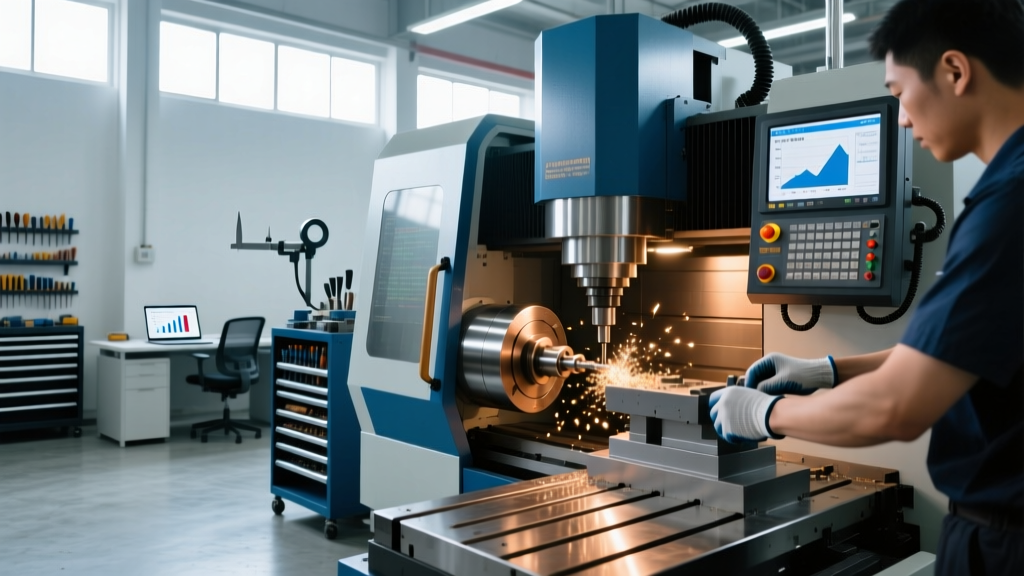
When a machine shop transitions from a predictable profit center to a chaotic bottleneck, the root cause is rarely a single broken machine. It is usually a systemic failure in capacity planning, tooling management, or labor allocation. Before deciding to outsource, you must troubleshoot your current in-house production line to identify exactly where the breakdown is occurring. Are you losing hours to setup times, or is your spindle utilization dropping below the 65% industry benchmark?
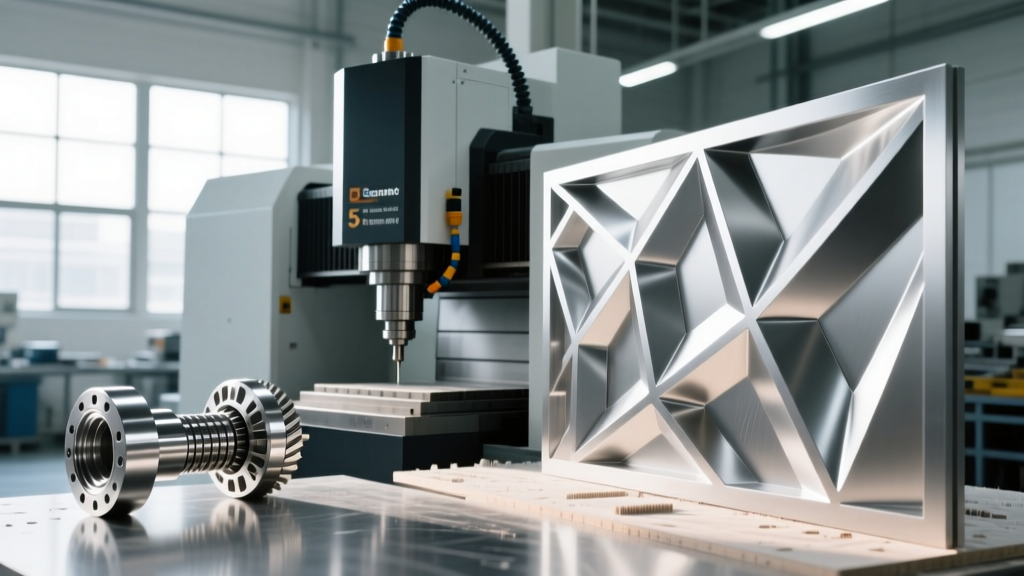
Warning: The Hidden Costs of Low Spindle UtilizationIf your 5-axis machines (like a Haas UMC-750 or DMG MORI DMC 80 U) are sitting idle during setup, your effective hourly cost skyrockets. A $600,000 machine running at only 40% utilization demands a shop rate of over $110/hour just to break even on depreciation and overhead.
Symptom Checklist for In-House Bottlenecks
- CAM Programming Backlog: Your lead times are extending because parts are waiting 2 to 3 weeks for toolpath generation and simulation.
- Excessive Scrap Rates: First-pass yield on complex 3D contoured parts drops below 92%, wasting expensive aerospace-grade materials like Titanium Ti-6Al-4V.
- Coolant and Maintenance Downtime: Unplanned spindle crashes or trunnion table failures require $8,000+ repairs and 4 weeks of lead time for OEM parts.
Root Cause Analysis: Why Domestic Machining Stalls
According to data from the NIST Manufacturing Extension Partnership, small-to-medium manufacturers frequently struggle with scaling production due to a severe shortage of skilled 5-axis programmers and setup technicians. When your lead programmer calls in sick, your entire production schedule shifts. Furthermore, the capital expenditure (CapEx) required to add capacity domestically is prohibitive in 2026. Purchasing a new Mazak INTEGREX i-400S mill-turn center, complete with high-pressure coolant and bar feeders, requires an upfront investment exceeding $850,000, not including the $40 per square foot cost for climate-controlled floor space.
The Offshore Fix: Evaluating CNC Machining China
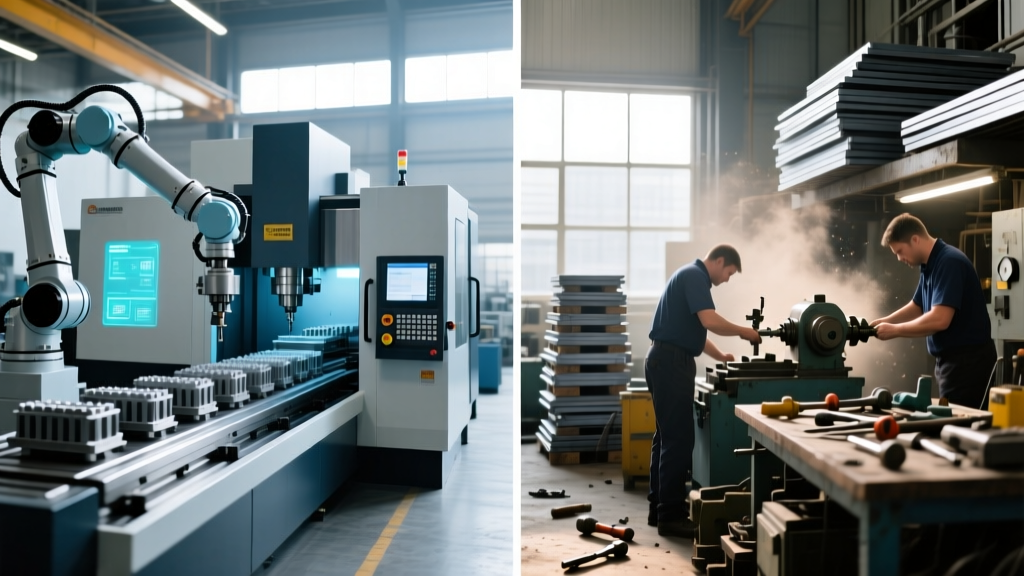
When troubleshooting reveals that your in-house CapEx and labor constraints are permanent bottlenecks, outsourcing becomes the logical repair strategy. Leveraging cnc machining china is no longer just about chasing the lowest hourly rate; it is about accessing massive, scalable capacity and advanced lights-out manufacturing ecosystems. Hubs in Shenzhen and Dongguan operate 24/7 pallet-pool systems on Makino and Brother machines, effectively eliminating the setup-time bottlenecks that plague domestic job shops.
Cost and Capacity Comparison Matrix
| Metric | In-House Production (US) | Outsourced CNC Machining China |
|---|---|---|
| Fully Burdened 3-Axis Hourly Rate | $55 - $75 / hr | $18 - $26 / hr |
| Fully Burdened 5-Axis Hourly Rate | $95 - $130 / hr | $35 - $50 / hr |
| Setup Time (Complex Mill-Turn) | 4 - 8 hours | 1 - 3 hours (Dedicated fixturing) |
| Capacity Scaling Lead Time | 12 - 16 weeks (Machine delivery) | 48 - 72 hours (Reallocating shop floor) |
| NRE (Non-Recurring Engineering) | $150 - $250 / hr | $40 - $80 / hr |
Troubleshooting the Transition: Mitigating Offshore Risks
Outsourcing introduces new failure modes, primarily regarding material substitution and geometric dimensioning and tolerancing (GD&T) misinterpretation. If you transition to an overseas partner without a rigorous troubleshooting protocol, you will simply trade domestic capacity bottlenecks for international quality failures. The Reshoring Initiative frequently cites hidden quality costs as the primary reason offshore supply chains fail. To prevent this, you must implement a strict incoming inspection and vendor-management framework.
Pro Tip: Material Specification LockChinese suppliers frequently substitute domestic GB/T 3190 aluminum for ASTM B209 6061-T6 to save costs. While chemically similar, the silicon and iron content variance can cause severe anodizing discoloration and alter yield strength. Always explicitly state 'ASTM B209 compliant, no GB/T substitutions permitted' on your purchase orders and require raw material Mill Test Reports (MTRs) with every shipment.
Step-by-Step FAI Protocol for Chinese Vendors
To repair the trust gap and ensure precision, mandate a First Article Inspection (FAI) process compliant with AS9102 standards before any production run exceeds 50 units.
- Digital Twin Verification: Require the vendor to run a full 3D CAM simulation and provide a Vericut toolpath report to prove no gouging will occur on deep-pocket features.
- CMM Surface Profilometry: Do not rely on hand gauges. Mandate that critical surfaces (e.g., Ra 0.8 µm finishes) are verified using automated Zeiss CONTURA or Renishaw REVO CMMs.
- GD&T Callout Translation: Ensure your drawings use ASME Y14.5-2018 standards. Add a secondary PDF with explicit notes translating complex datum structures, as default ISO GPS interpretations can differ slightly in profile tolerances.
- ISO Certification Audits: Verify that the facility holds a current ISO 9001:2015 certification, and for automotive or medical parts, demand IATF 16949 or ISO 13485 documentation.
Decision Framework: When to Keep It vs. When to Outsource
Use this diagnostic flowchart to determine the correct routing for your next production batch:
- Keep In-House: Volumes under 50 pieces, IP-sensitive defense contracts (ITAR restricted), or parts requiring immediate, iterative design changes where shipping times would destroy the R&D timeline.
- Outsource to China: Production runs of 500+ units, mature designs with locked GD&T, parts requiring extensive secondary operations (like hard anodizing or nickel plating) where Asian supply chains offer integrated, low-cost finishing houses.
'The most successful manufacturers in 2026 do not view domestic and offshore machining as mutually exclusive. They use domestic shops for high-mix, low-volume prototyping and troubleshooting, while offloading high-volume, mature production to Chinese partners to free up spindle time for complex, high-margin work.'
— Director of Supply Chain Strategy, Tier 1 Aerospace Manufacturer
Final Diagnostic Steps
Troubleshooting your manufacturing strategy requires looking past the emotional attachment to your own shop floor. Calculate your true fully-burdened hourly rate, including the hidden costs of scrap, rework, and machine depreciation. If your in-house 5-axis machines are spending more time cutting aluminum brackets than machining complex titanium impellers, you have a capacity allocation failure. By strategically integrating cnc machining china into your supply chain, you repair your bottleneck, lower your blended cost per part, and restore your shop's focus on high-value, complex engineering challenges.