Multi-Axis Equipment for CNC Precision Machining: 2026 Guide
Discover how to select 4-axis and 5-axis machines for complex geometries. Our 2026 buying guide covers top models, costs, and CNC precision machining specs.
The Geometry Bottleneck: Why 3-Axis Falls Short
Complex geometries—such as aerospace impellers, orthopedic knee implants, and turbine blades—demand simultaneous multi-axis interpolation. When sourcing equipment for CNC precision machining, machine shops must move beyond standard 3-axis vertical machining centers (VMCs) to eliminate secondary setups. Every time a part is unclamped and re-fixtured, you introduce a new datum shift, risking violations of tight geometric dimensioning and tolerancing (GD&T) profiles like true position and concentricity. Multi-axis equipment solves this by maintaining a single setup, but selecting the right architecture requires matching the machine’s kinematic design to your specific part envelope and material removal rates.
Quick Decision Framework:- Boxy, heavy parts (up to 1,000 lbs): Choose a Trunnion (Table/Table) 5-axis VMC.
- Long, deep, or complex undercut parts: Choose a Swivel Head (Head/Head) 5-axis machine.
- Cylindrical parts with off-center features: Choose a Mill-Turn center with a B-axis milling spindle.
Machine Architecture Selection: Trunnion vs. Swivel Head
The physical configuration of a 5-axis machine dictates its rigidity, work envelope, and suitability for specific part geometries. Understanding these mechanical differences is critical for long-term CNC precision machining accuracy.
Trunnion (Table/Table) Configurations
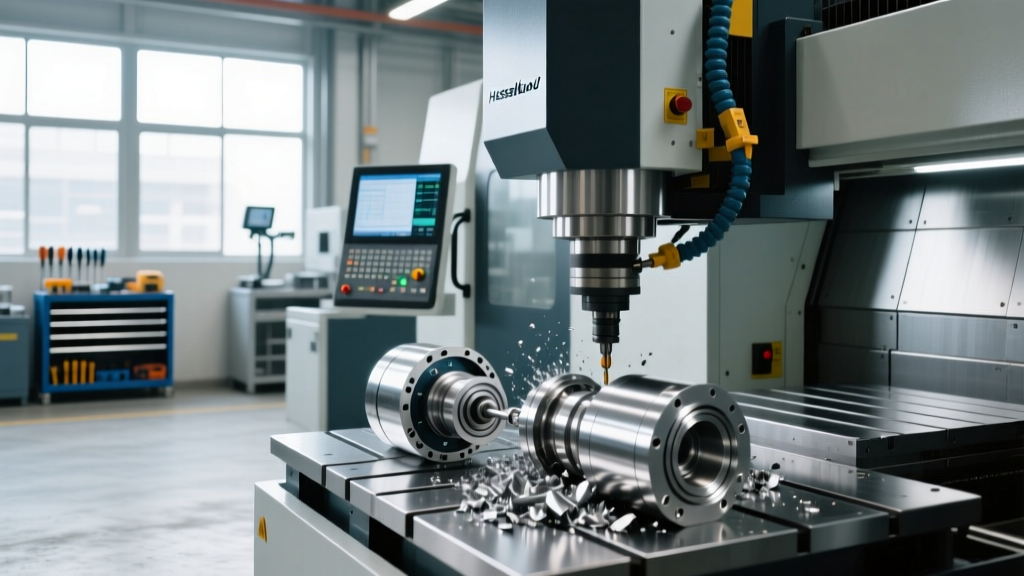
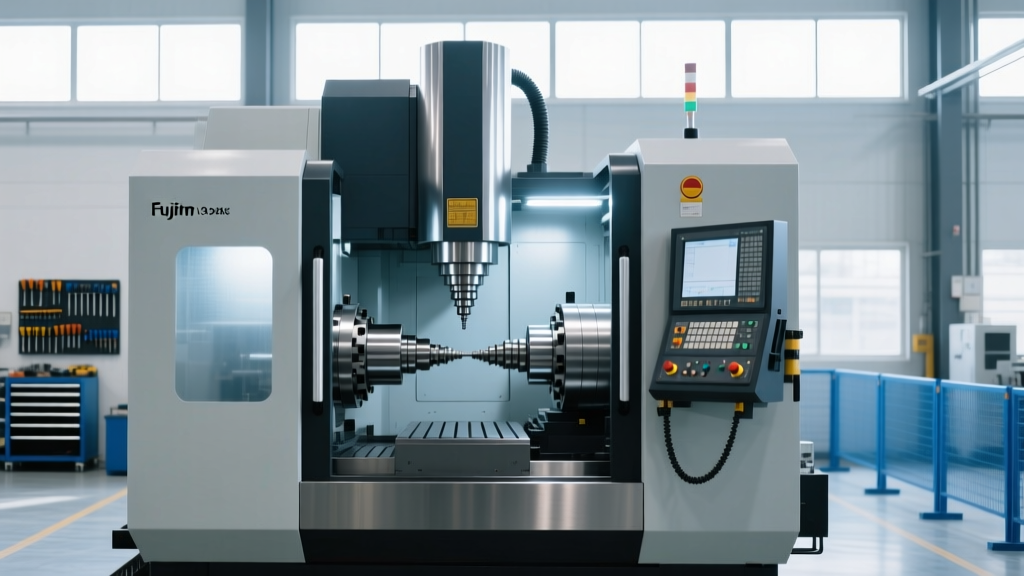
Trunnion machines utilize a tilting and rotating table (A and C axes) while the spindle moves only in X, Y, and Z. This design excels in heavy-duty roughing because the spindle column remains massively rigid. However, the trade-off is work envelope loss; as the table tilts, the effective Z-axis clearance shrinks. The Haas UMC-750 is a dominant player in this space. Priced around $165,000 (base configuration), it features a 30-taper spindle and a 500mm trunnion table capable of supporting 600 lbs. It is ideal for aluminum aerospace structural components and titanium medical devices where table rigidity under high cutting forces is paramount.
Swivel Head (Head/Head) Configurations
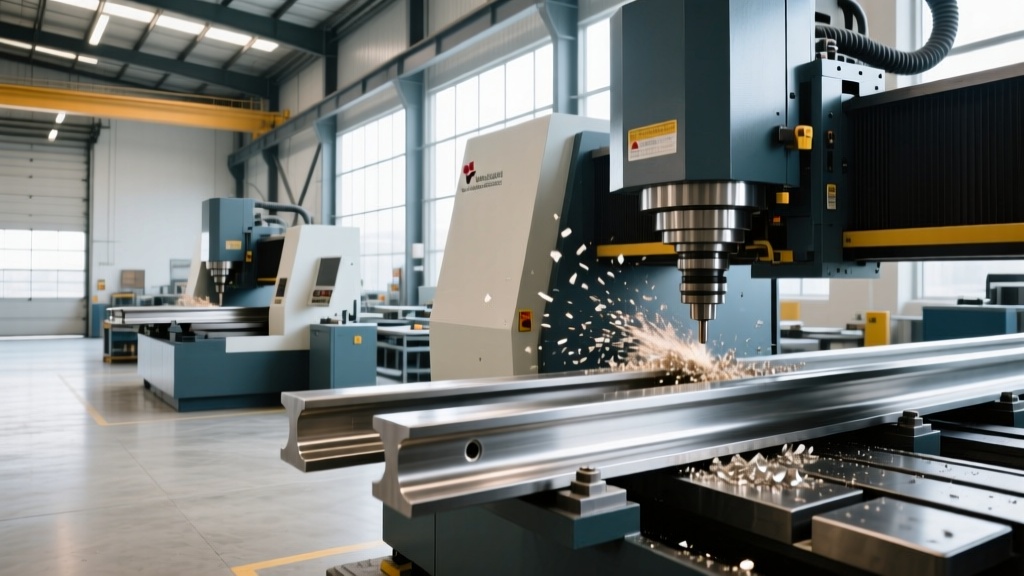
Swivel head machines mount the A and C (or B and C) rotary axes directly on the spindle head, leaving a massive, stationary worktable below. This architecture is superior for deep cavities, long parts, and heavy components that would overload a tilting table. The DMG MORI DMU 50 3rd Generation (approx. $240,000) utilizes a B-axis swivel head and C-axis rotary table, offering exceptional undercut capabilities and a highly stable work zone. According to Modern Machine Shop, swivel head designs inherently maintain better tool center point (TCP) accuracy over long Z-axis extensions because the rotational mass is isolated from the heavy workpiece.
2026 Multi-Axis Equipment Comparison Matrix
| Machine Model | Architecture | Best Application | Approx. Base Price | Spindle / Taper |
|---|---|---|---|---|
| Haas UMC-750 | Trunnion (A/C) | Mid-size prismatic parts, medical, aerospace | $165,000 | 12,000 RPM / 40-Taper |
| DMG MORI DMU 50 3rd Gen | Swivel Head (B/C) | Complex molds, deep cavities, long parts | $240,000 | 15,000 RPM / HSK-A63 |
| Mazak INTEGREX i-200S | Mill-Turn (B-Axis) | Complex shafts, oil & gas valves, aerospace fittings | $485,000 | 12,000 RPM / Capto C6 |
| Okuma MU-8000V | Trunnion (A/C) | Large heavy-duty aerospace structural components | $620,000 | 10,000 RPM / HSK-A100 |
Controller Ecosystems and Interpolation Capabilities
Hardware rigidity is only half the equation. Simultaneous 5-axis CNC precision machining requires a controller capable of processing massive amounts of kinematic data in real-time to prevent dwell marks and maintain surface finish. In 2026, three primary controller ecosystems dominate the multi-axis landscape:
- Heidenhain TNC7: Renowned in the mold and die industry, the TNC7 offers up to 2,000-block look-ahead and advanced collision avoidance. Its Dynamic Precision algorithms actively compensate for contouring errors during high-speed 5-axis interpolation, holding tolerances within ±0.0002" (5µm) on complex 3D surfaces.
- Siemens Sinumerik ONE: This platform leverages a native digital twin (Run MyVirtualMachine). Shops can simulate exact machine kinematics, tool paths, and PLC logic off-machine, drastically reducing first-part prove-out times. It excels in aerospace applications requiring highly synchronized mill-turn operations.
- Fanuc 31i-B5: The industry workhorse. Its AI Thermal Displacement Compensation and Smooth G-code processing make it highly reliable for high-volume production environments where consistency over 24/7 operation is critical.
Workholding and Kinematic Calibration
Standard vises are useless in simultaneous 5-axis CNC precision machining; they cause tool shank collisions and restrict the spindle’s B or C axis rotation. You must transition to low-profile, high-clamping-force zero-point systems.
Zero-Point Clamping Systems
Systems like the Schunk Vero-S NSE mini 100 or Erowa ITS 148 mount directly to the machine table or tombstone. They provide repeatable positioning accuracy of 0.002mm (0.00008") and pull-down forces exceeding 15,000 N. This allows operators to load pre-fixtured parts outside the machine, dropping cycle-to-cycle setup times from 45 minutes to under 3 minutes. According to the Society of Manufacturing Engineers (SME), implementing zero-point workholding on multi-axis machines typically yields a 30% to 40% increase in overall spindle utilization.
Kinematic Calibration and Probing
Out-of-the-box machine geometry is never perfect. To achieve true CNC precision machining tolerances on multi-axis equipment, shops must perform regular kinematic calibration. Using a spindle-mounted probe (such as the Renishaw OMP600 with radio transmission), the controller measures the exact center of rotation for the A, B, and C axes. This data updates the machine’s kinematic parameters (e.g., Fanuc parameter 19600 series), mathematically compensating for mechanical misalignments caused by shipping, installation, or minor crashes. Skipping this step guarantees that your 5-axis toolpaths will deviate from the CAD model by 0.005" or more at the outer edges of the work envelope.
"Investing in a 5-axis machine without budgeting for a high-end spindle probe and zero-point workholding is like buying a supercar and putting cheap tires on it. The machine’s mechanical capability will always be bottlenecked by how poorly the part is held and measured."
— Lead Applications Engineer, Advanced Manufacturing Tech Center
ROI and Cost Justification Framework
When presenting a capital expenditure request for multi-axis equipment, focus on the reduction of non-cut time. A standard 3-axis VMC might cost $85,000, but machining a complex titanium aerospace bracket requires three separate fixtures, three setups, and 4 hours of operator handling. A $240,000 5-axis swivel-head machine completes the part in one setup, reducing cycle time by 60% and eliminating scrap caused by datum shift errors. For shops running high-mix, low-volume complex geometries, the ROI on multi-axis CNC precision machining equipment is typically realized within 14 to 18 months through labor savings, scrap reduction, and the ability to bid on previously inaccessible, high-margin complex contracts.