Lean vs Traditional CNC Machining for Medical Devices Workflows
Compare lean single-piece flow against traditional batch CNC machining for medical devices. Analyze setup times, ISO 13485 traceability, and costs.
Manufacturing orthopedic implants, surgical robotics components, and neurostimulator housings demands sub-micron tolerances and absolute lot traceability. When sourcing cnc machining for medical devices, procurement and engineering teams typically encounter two distinct operational philosophies: traditional batch-and-queue manufacturing and lean single-piece flow. Choosing between these workflows dictates not only unit economics but also regulatory compliance speed, scrap rates, and time-to-market for life-critical hardware.
The Core Divergence: Batch-and-Queue vs. Single-Piece Flow
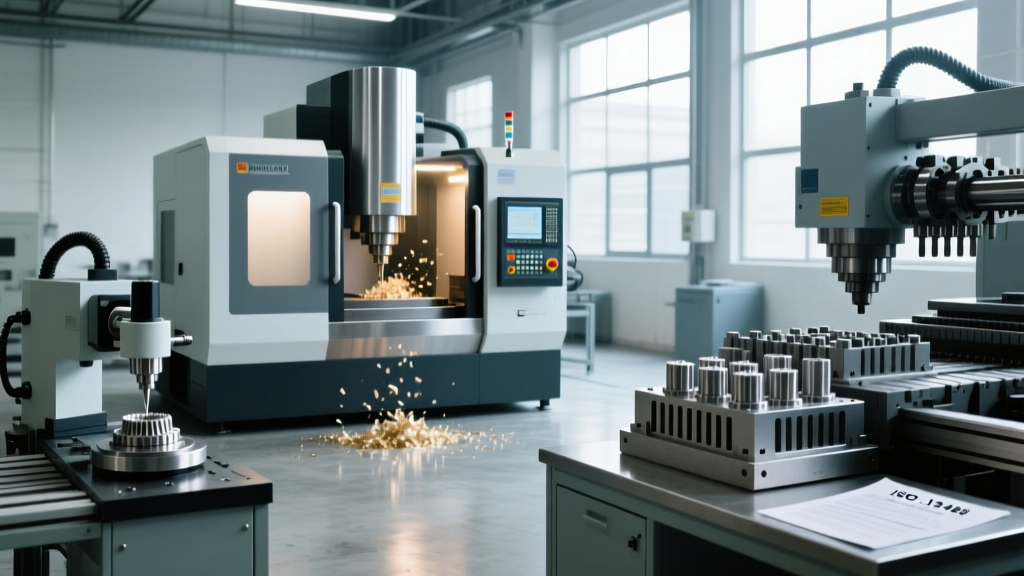
Traditional machine shops optimize primarily for machine spindle utilization. They run massive batches of 316L stainless steel bone screws or PEEK spinal cages to amortize the 3-to-5-hour setup times required on 5-axis milling centers. Conversely, lean medical machine shops optimize for material flow. By utilizing Single-Minute Exchange of Die (SMED) methodologies and automated pallet pools, they achieve continuous single-piece or small-lot flow. According to the NIST Manufacturing Extension Partnership, lean implementations in precision machining environments routinely reduce work-in-process (WIP) inventory by up to 80%. This is a critical financial lever when machining medical-grade titanium alloys like Ti-6Al-4V ELI, which can exceed $150 per kilogram for certified, implant-grade bar stock.
Workflow Comparison Matrix: Traditional vs. Lean Medical CNC
| Operational Metric | Traditional Batch Workflow | Lean Single-Piece Flow |
|---|---|---|
| Setup Strategy | Dedicated fixtures, manual indicating (120-300 mins) | SMED, zero-point pallet pools (15-45 mins) |
| Inspection Protocol | Post-process CMM batch inspection (Bottleneck) | In-process probing & automated Equator gauging |
| WIP Inventory | High (Weeks of parts sitting on shop floor) | Low (Hours of parts, strict Kanban limits) |
| Traceability (DHR) | Manual paper travelers, batch-level sign-offs | Integrated MES, serial-level digital tracking |
| Scrap Detection | Discovered after full batch run (High loss) | Detected on first part (Minimal loss) |
Evaluating Lean CNC Workflows for Medical Implants
Setup Time Reduction (SMED) in 5-Axis Milling
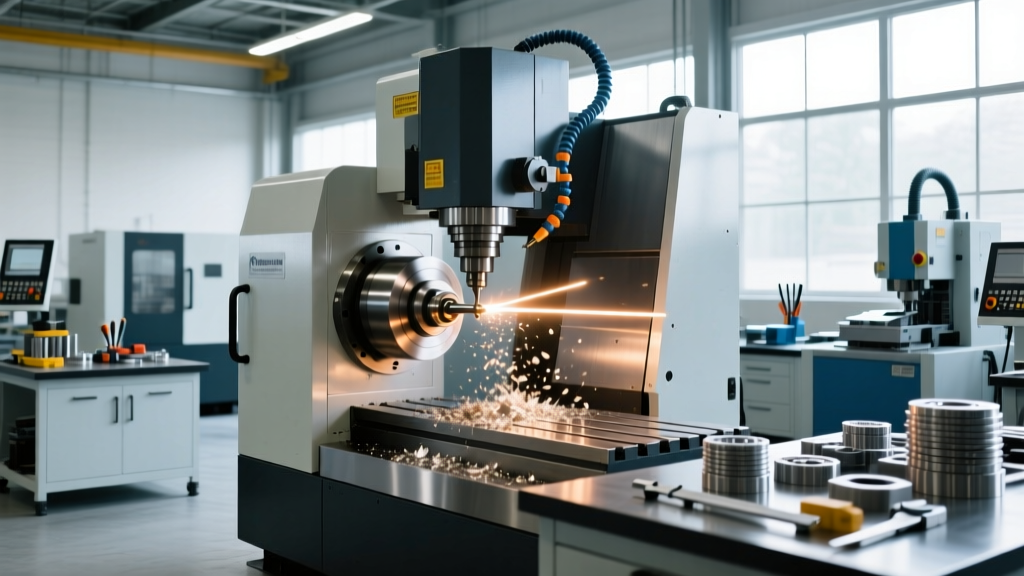
In traditional shops, setting up a Willemin-Macodel W508MT 5-axis mill-turn center for a complex knee tibial tray involves manual fixture indicating, tool length verification, and dry runs that consume upwards of 240 minutes. Lean facilities externalize these tasks. By employing System 3R MacroMagnum zero-point pallet systems, operators load and indicate raw PEEK or Cobalt-Chrome blanks onto pallets outside the machine envelope while the spindle is actively cutting the previous part. When the cycle finishes, the machine's automated pallet changer swaps the finished part for the pre-staged blank in under 45 seconds. Combined with RFID tool chips that automatically upload tool geometry into the CNC control, total spindle downtime drops from 4 hours to roughly 35 minutes.
In-Process Metrology vs. CMM Batch Inspection
The most severe bottleneck in traditional medical CNC workflows is the Coordinate Measuring Machine (CMM). A batch of 500 machined hip stems must wait in queue for a technician to manually load them onto a Zeiss Contura CMM, inspecting critical GD&T callouts like true position and profile of a surface. If a tool wear issue caused the last 100 parts to drift out of the 0.005mm tolerance band, the entire batch is scrapped. Lean workflows eliminate this queue by integrating Renishaw OMP60 high-accuracy touch probes directly into the 5-axis spindle. The machine probes critical datums mid-cycle, automatically updating tool offsets in real-time to compensate for thermal growth and tool wear. Parts are then verified on a Renishaw Equator comparative gauging system at the operator station in under 30 seconds, ensuring 100% inspection without halting production flow.
Regulatory Callout: The ISO 13485 Traceability BottleneckUnder the FDA Quality System Regulation, medical device manufacturers must maintain rigorous Device History Records (DHR). Traditional batch workflows rely on paper travelers that are easily lost or misfiled, leading to audit findings. Lean shops utilize paperless Manufacturing Execution Systems (MES) like ProShop or E2, which enforce digital sign-offs, capture real-time spindle load data, and link specific material heat lots to individual serialized parts before the pallet even enters the CNC enclosure.
Cost and Lead Time Analysis: When to Choose Which Workflow
Procurement teams often mistakenly assume lean manufacturing automatically yields the lowest per-part cost. This is only true when factoring in the total cost of ownership, including inventory holding costs and the cost of delayed product launches. Consider a production run of 1,000 titanium spinal screws machined on a DMG MORI Ultrasonic 20.
- Traditional Batch Costing: Setup costs $600. Machining time is $3.50 per part. Total direct manufacturing cost is $4,100. However, the 4-week lead time requires the OEM to hold 6 weeks of safety stock, tying up $45,000 in working capital.
- Lean Flow Costing: Setup costs $150 per lot (run in 4 lots of 250). Machining time is $3.80 per part due to more frequent tool changes and probing cycles. Total direct cost is $4,400. The 1-week lead time allows the OEM to operate on a just-in-time (JIT) basis, freeing up over $35,000 in working capital and accelerating FDA submission timelines.
While the traditional shop wins on the localized piece-price spreadsheet, the lean shop provides vastly superior supply chain agility, which is paramount when iterating on next-generation surgical instruments.
Alternative Workflows: Hybrid Cellular Manufacturing
For contract manufacturers producing both high-volume surgical consumables and low-volume orthopedic implants, a pure lean or pure batch approach is suboptimal. The most effective alternative is Hybrid Cellular Manufacturing. In this model, the shop floor is divided into distinct, purpose-built cells:
- High-Volume Consumable Cells: Utilizing FANUC RoboDrill vertical machining centers equipped with integrated pallet changers and bar feeders. These cells run unattended lights-out shifts, producing thousands of surgical drill bits and taps. Lean principles here focus on automated material handling and centralized high-pressure coolant systems (like Trim MicroSol 585XT) to manage the massive volume of titanium chips.
- Complex Implant Cells: Utilizing 5-axis mill-turn centers (e.g., Mazak Integrex i-200S) staffed by specialized machinists. These cells operate on strict single-piece flow, focusing on complex geometries like porous-coated acetabular cups where cycle times exceed 4 hours per part.
Decision Framework for Procurement and Engineering Teams
Selecting the right machining partner requires aligning their workflow philosophy with your product lifecycle stage. Use the following framework to evaluate potential CNC medical manufacturing partners:
IF your product is a mature, high-volume consumable (e.g., biopsy forceps, standard bone screws) with stable, locked-in FDA 510(k) designs, THEN prioritize traditional or hybrid shops that leverage economies of scale, dedicated hard tooling, and automated bar-fed turning centers to drive down unit costs.
IF your product is a next-generation implant, a low-volume surgical robot end-effector, or a device currently undergoing iterative design changes for clinical trials, THEN strictly select a lean single-piece flow facility. The agility of zero-point fixturing, in-process metrology, and digital MES traceability will prevent costly scrap events and accelerate your path to regulatory approval.
Ultimately, evaluating lean manufacturing principles in the context of medical CNC machining reveals that the true value lies in risk mitigation. By shifting from batch-and-queue to single-piece flow, medical device companies eliminate the hidden costs of WIP inventory, drastically reduce the risk of batch-wide scrap, and ensure that every serialized implant meets the stringent demands of modern regulatory bodies.