CNC Machining: What Is It for High-Volume Production Scaling?
Discover CNC machining: what is it for high-volume production? Explore 2026 equipment selection, HMC vs VMC strategies, automation, and cost-per-part frameworks.
When shop owners and manufacturing engineers ask, "CNC machining: what is it really capable of at scale?", the answer requires looking past prototyping and low-batch job shop workflows. High-volume CNC production machining—typically defined as continuous runs exceeding 10,000 parts annually per SKU—demands a fundamental shift in equipment selection, automation integration, and tooling strategy. In 2026, the margin for error in mass production is razor-thin, driven by rising material costs, strict geometric tolerances, and the absolute necessity for unattended manufacturing. This guide dissects the exact equipment matrices, automation frameworks, and financial models required to scale CNC operations for high-volume output.
The Job Shop vs. High-Volume Paradigm
Standard job shops prioritize flexibility. They utilize 3-axis vertical machining centers (VMCs) capable of handling a different part number every two hours. However, flexibility is the enemy of volume. In a high-volume environment, the primary metric of success shifts from setup versatility to spindle utilization. According to data from the Society of Manufacturing Engineers (SME), top-tier production facilities target an Overall Equipment Effectiveness (OEE) of 85% or higher, compared to the 55-65% average seen in high-mix, low-volume shops.
The 85% Uptime Rule: If your CNC spindle is not cutting metal 85% of the time the shop is open, your equipment is misallocated for high-volume production. Manual loading, tool changes, and manual probing are the primary culprits of downtime in mass manufacturing.Core Equipment Selection for Mass CNC Production
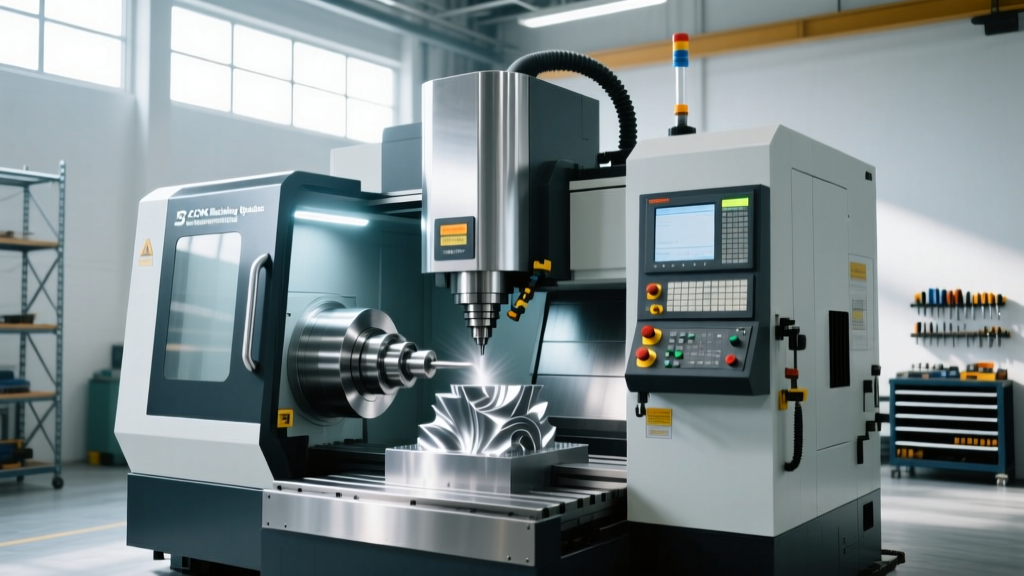
Selecting the right machine architecture is the most capital-intensive decision in scaling production. The industry has largely moved away from standalone VMCs for high-volume metal cutting, favoring Horizontal Machining Centers (HMCs) with integrated pallet pools, high-speed compact verticals for small electronics/medical parts, and Swiss-type lathes for complex rotational components.
Horizontal Machining Centers (HMCs) with Pallet Pools
For mid-to-large prismatic parts (e.g., automotive transmission housings, aerospace brackets), HMCs are the undisputed standard. The horizontal spindle orientation allows gravity to assist in chip evacuation—a critical factor when running unattended for 40+ hours a week. Machines like the Makino a61nx or DMG MORI NHX 5000 feature integrated 2-pallet changers as standard, with options to expand into 12-to-24-pallet Flexible Manufacturing Systems (FMS).
High-Speed Compact Verticals
For small, high-volume components (e.g., titanium bone screws, aluminum consumer electronics enclosures), standard HMCs are overkill. Compact, high-acceleration VMCs like the Brother Speedio S700X2 dominate this space. With rapid traverse rates exceeding 50 m/min and tap speeds up to 6,000 RPM, these machines minimize non-cutting time, which constitutes the majority of cycle time in small-part machining.
| Machine Architecture | Ideal Part Profile | Top 2026 Model Examples | Approx. Base Pricing | Expected Spindle Uptime |
|---|---|---|---|---|
| 500mm HMC w/ Pallet Pool | Mid-size prismatic, heavy cutting | Makino a61nx, Okuma MA-500HIII | $280,000 - $380,000 | 85% - 92% |
| High-Speed Compact VMC | Small aluminum/titanium components | Brother S700X2, Haas DT-1 | $110,000 - $160,000 | 75% - 85% |
| Swiss-Type CNC Lathe | Complex, long, small-diameter shafts | Star SR-32J, Citizen L32XII | $220,000 - $310,000 | 80% - 90% |
| Multi-Axis Turn-Mill Center | Complex rotational with off-axis features | DMG MORI NTX 1000, Mazak INTEGREX | $450,000 - $650,000 | 70% - 82% |
Automation: The Non-Negotiable Multiplier
High-volume CNC machining is inextricably linked to automation. In 2026, relying on manual operators to load and unload parts for runs exceeding 5,000 units is financially unsustainable. The National Institute of Standards and Technology (NIST) continuously highlights advanced manufacturing automation as the key driver for reshoring production capabilities, emphasizing that unattended machining is a requirement for domestic competitiveness.
Flexible Manufacturing Systems (FMS) vs. Standalone Cobots
When scaling, shops must choose between integrated FMS and standalone collaborative robots (cobots). An FMS, such as the Fastems MSL or Makino MMC2, connects multiple HMCs to a central rail-guided vehicle and a massive matrix of pallet storage. This allows for lights-out manufacturing over entire weekends. Conversely, for standalone VMCs or turning centers, integrating a Universal Robots UR10e or a FANUC CRX-10iA/L cobot with custom end-of-arm tooling (EOAT) provides a lower barrier to entry, typically yielding an ROI within 14 to 18 months based on labor savings alone.
"The biggest mistake shops make when scaling to high volume is buying a $300,000 machine and feeding it with a $20/hour manual loader. The machine's cycle time is dictated by the speed of the automation, not just the spindle RPM." — Production Engineering Lead, Tier 1 Automotive Supplier
Advanced Tooling and High-Pressure Coolant Strategies
Equipment selection is only half the battle; the cutting tool interface dictates the actual cost-per-part. High-volume production requires tooling that maximizes mean time between failures (MTBF). According to the Sandvik Coromant knowledge base, optimizing chip evacuation and thermal management at the cutting edge can increase tool life by up to 40% in continuous production environments.
The 1,000 PSI Through-Spindle Coolant (TSC) Standard
For high-volume machining of difficult-to-machine alloys (Inconel 718, Ti-6Al-4V) or deep-cavity aluminum milling, standard flood coolant is obsolete. Equipping machines with 1,000 PSI (69 bar) TSC pumps is mandatory. High-pressure coolant breaks chips into manageable 'C-shapes' rather than long, stringy birds-nests that can halt an unattended machine. Furthermore, it eliminates the need for peck drilling cycles in deep-hole applications, reducing cycle times by 15% to 22%.
Quick-Change Tooling Systems
For turning centers and turn-mills, standard VDI or BMT turrets require manual tool setting and clamping, adding 5-10 minutes per tool change during setup. Transitioning to a quick-change system like the Kennametal KM4X or Sandvik Coromant Capto C6 reduces tool changeover time to under 30 seconds per station, drastically increasing machine availability for high-volume scheduling.
Financial Framework: Calculating True Cost-Per-Part
High-volume buyers must abandon the standard "machine hourly rate + material" pricing model. Instead, utilize a Total Cost of Ownership (TCO) framework that accounts for automation depreciation, tooling amortization, and scrap rates.
- Calculate Fully Burdened Machine Rate: Include the base machine hourly rate plus the amortized cost of the automation (e.g., cobot or FMS) spread over 5 years, divided by the expected annual operating hours (typically 4,000 - 6,000 hours for multi-shift operations).
- Factor in Tooling Cost Per Part (TCPP): Divide the total cost of a tool assembly by its verified lifespan in number of parts. For high volume, negotiate bulk insert pricing with vendors like Kennametal or Iscar to reduce this metric by 15-20%.
- Apply the Scrap Multiplier: In runs of 50,000 parts, a 2% scrap rate at the end of the process line means you have paid to machine 49,000 good parts and 1,000 scrap parts to near-completion. Implement in-machine probing (e.g., Renishaw OMP400) to catch out-of-tolerance parts at Op 10 rather than Op 50.
- Determine Final Margin: Subtract the sum of the burdened rate, TCPP, material cost, and scrap loss from the contracted part price to find true profitability.
FAQ: Scaling Your CNC Machine Shop
What is the minimum volume to justify an HMC with a pallet pool?
Generally, if you are running batches of 50+ parts repeatedly throughout the year, or if total annual volume exceeds 5,000 medium-sized parts, the setup time savings and 85%+ spindle utilization of an HMC will outproduce two standard VMCs, justifying the higher capital expenditure.
How does AI impact high-volume CNC machining in 2026?
AI-driven tool wear monitoring systems, such as those integrated into modern Fanuc and Siemens CNC controls, analyze spindle load and acoustic emission data in real-time. This allows the machine to automatically compensate for tool deflection or halt production before a catastrophic tool failure ruins a batch of high-value parts, which is critical for unattended lights-out manufacturing.
Should I buy a 5-axis machine for high-volume production?
Only if the part geometry strictly requires it. 5-axis machines have higher hourly rates, more complex programming requirements, and generally lower rigidity than 3-axis or 4-axis HMCs. For high-volume production, it is almost always more cost-effective to split the operation across multiple dedicated 3-axis or 4-axis machines rather than bottlenecking volume through a single 5-axis trunnion table.