CNC Machine ShopBot Tolerances for Electronics Enclosures
Evaluating CNC machine ShopBot capabilities for tight-tolerance electronics enclosures, IP67 sealing, and EMI compliance standards.
The Compliance Reality: IP and NEMA Standards for Enclosures
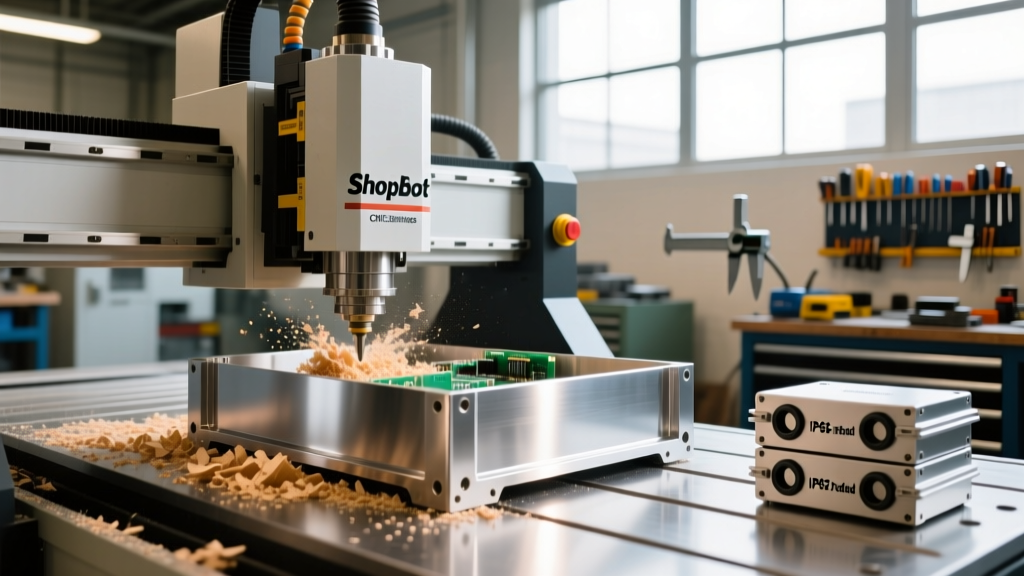
Designing electronics enclosures requires navigating strict compliance frameworks like IEC 60529 (IP ratings), NEMA 250, and MIL-STD-461 for electromagnetic interference. Many hardware startups and low-volume contract manufacturers attempt to reduce overhead by routing aluminum and polycarbonate housings on a CNC machine ShopBot rather than utilizing an industrial Vertical Machining Center (VMC). While gantry routers excel at sign-making, woodworking, and large-format plastic trimming, machining tight-tolerance features for environmental sealing and EMI shielding on these machines introduces severe mechanical risks.
According to the IEC IP Degrees of Protection standards, achieving an IP67 rating requires a continuous, uninterrupted seal against dust and temporary water immersion. This typically mandates the use of elastomeric O-rings or poured polyurethane gaskets seated in precision-machined grooves. The Parker O-Ring Handbook (ORD 5700) specifies that a standard AS568 O-ring groove (e.g., dash size -212) requires a groove width tolerance of ±0.002 inches and a depth tolerance of ±0.001 inches. Deviating from these dimensions compromises the O-ring squeeze percentage, leading directly to seal failure under pressure.
⚠️ WARNING: The Gantry Deflection TrapA standard CNC machine ShopBot relies on a moving gantry supported by linear bearings or V-wheels. When cutting 6061-T6 aluminum with a 1/2-inch endmill, lateral cutting forces can induce gantry deflection ranging from 0.003 to 0.015 inches depending on the machine model and feed rate. This mechanical reality makes holding the ±0.001-inch Z-depth tolerance required for IP67 O-ring grooves nearly impossible without secondary finishing operations.
Capability Matrix: ShopBot vs. Industrial VMC
To make informed production decisions in 2026, engineers must map machine capabilities directly to enclosure compliance requirements. The following matrix compares the mechanical realities of routing electronics enclosures across different equipment classes.
| Machine Class | Typical Model | Positional Accuracy (Aluminum) | Spindle Runout | Viable Enclosure Standards |
|---|---|---|---|---|
| Desktop Gantry Router | ShopBot Desktop MAX | ±0.010" to ±0.020" | 0.002" - 0.005" | NEMA 1, IP20 (Indoor/Non-sealed) |
| Industrial Gantry Router | ShopBot PRSalpha | ±0.005" to ±0.010" | 0.001" - 0.003" | NEMA 3R, IP44 (Splash resistant) |
| Standard VMC | Haas VF-2 / Robodrill | ±0.0005" to ±0.001" | < 0.0002" | IP67, IP68, NEMA 4X, 6P |
| High-Speed VMC | Brother S700X2 | ±0.0002" to ±0.0005" | < 0.0001" | MIL-STD-810, Aerospace EMI |
EMI/RFI Shielding and MIL-STD-461 Compliance
Beyond environmental sealing, military and medical electronics enclosures must comply with electromagnetic compatibility (EMC) standards to prevent radio frequency interference. This requires the enclosure halves to mate perfectly, compressing a conductive elastomer or wire mesh gasket to create a continuous Faraday cage.
Conductive gaskets typically require a compression deflection of 10% to 15% to achieve adequate shielding effectiveness (often measured at 60-100 dB attenuation from 100 MHz to 10 GHz). If the Z-axis of your CNC machine ShopBot drifts by just 0.005 inches across a 12-inch enclosure flange due to thermal expansion or ball screw backlash, the gasket compression drops below the critical threshold. High-frequency microwave signals will leak through the resulting microscopic gaps, causing the assembly to fail MIL-STD-461 RE102 radiated emissions testing.
Engineering Insight: For EMI-critical enclosures, mating flanges must be fly-cut to ensure absolute coplanarity. Gantry routers struggle with fly-cutting large aluminum surfaces without leaving visible scallop marks or stepping errors at the center of the gantry span, which ruins the RF seal.
Optimizing the ShopBot for Non-Sealed Enclosures
If your project specifies NEMA 1 or IP20 compliance (indoor use, no water exposure, protection against solid objects >12.5mm), a CNC machine ShopBot is a highly cost-effective tool. To maximize precision and surface finish on 6061-T6 aluminum and polycarbonate (Lexan) enclosures, implement the following toolpath and fixturing protocols:
- Tool Selection: Use 3-flute solid carbide endmills with an AlTiN (Aluminum Titanium Nitride) coating. The 3-flute geometry provides a larger core for rigidity, reducing chatter on the less-dampened gantry frame.
- Adaptive Clearing: Never use traditional offset contouring for pocketing. Use adaptive/trochoidal toolpaths to maintain a constant radial engagement (typically 10-15% of tool diameter). This prevents the sudden spike in cutting forces that causes gantry deflection.
- Spring Passes for Walls: Program a finishing pass with 0.002 inches of radial stock allowance. Run this pass at a reduced feed rate (e.g., 40 IPM) with flood coolant or a high-pressure mist system to clear chips and eliminate tool deflection marks.
- Vacuum Fixturing: Mechanical clamps induce localized stress in thin-walled enclosure shells (typically 0.100" to 0.150" thick). When the clamps are removed, the aluminum springs back, warping the mating flange. Use a custom MDF spoilboard with a dedicated vacuum zone and double-sided machinist tape to hold the part stress-free.
Cost and Lead Time Decision Framework (2026 Data)
Choosing between a gantry router and a VMC is ultimately a financial calculation balanced against compliance risk. Below is a comparative framework based on current 2026 contract machining rates for a batch of 50 medium-sized (8" x 6" x 3") aluminum enclosures.
| Metric | CNC Machine ShopBot (Router) | 3-Axis VMC (Haas/Doosan) |
|---|---|---|
| Average Hourly Shop Rate | $45 - $75 / hr | $95 - $140 / hr |
| Cycle Time (Per Enclosure Half) | 45 - 60 minutes | 18 - 25 minutes |
| Secondary Deburring/Finishing | High (Router leaves larger burrs) | Low (Clean shearing cuts) |
| Scrap Rate (Tight Tolerance Features) | 15% - 25% | < 2% |
| Best Application | Prototyping, IP20, large plastic covers | Production, IP67, EMI shielding |
When to Avoid the Router Entirely
Do not attempt to machine deep, narrow O-ring grooves (e.g., using a 1/16-inch or 3/32-inch endmill with a 3-inch stickout) on a gantry router. The lack of spindle rigidity and the high RPMs (often 18,000 - 24,000 RPM on router spindles) will cause the tool to deflect, resulting in a tapered groove wall. A tapered groove prevents the O-ring from seating correctly, guaranteeing an IP ingress protection failure during hydrostatic testing.
Frequently Asked Questions
Can I machine polycarbonate (Lexan) enclosure windows on a ShopBot?
Yes. Polycarbonate is highly forgiving regarding machine rigidity. A CNC machine ShopBot equipped with a single-flute O-flute carbide bit designed for plastics, running at 18,000 RPM with compressed air cooling, will produce optical-quality edges suitable for NEMA-rated display windows. Ensure the vacuum table is perfectly flat to prevent bowing during the cut.
How do I seal a ShopBot-machined enclosure if the grooves are out of tolerance?
If your router cannot hold the ±0.001-inch tolerance for a precision O-ring gland, pivot your design to use a Form-In-Place (FIP) gasket or a poured polyurethane foam gasket. These materials are dispensed as liquids and cure in place, conforming to the routed groove's imperfections and providing an IP65/IP67 seal without requiring tight machining tolerances.
Is it worth buying a ShopBot for in-house enclosure prototyping?
For internal electronics housings, rack-mount panels, and non-sealed prototypes, a ShopBot PRSalpha is an excellent 2026 capital investment, offering a fast ROI compared to outsourcing. However, if your roadmap includes outdoor, marine, or aerospace deployments requiring IP68 or MIL-STD-810G compliance, you will eventually need to transition to a VMC or outsource to a precision machine shop.