Scaling a CNC Machining Business: In-House vs Outsourcing in 2026
Evaluate in-house vs outsourced production for your CNC machining business. Compare 2026 tech trends, CapEx costs, and cloud manufacturing ROI.
The make-versus-buy decision has historically been a simple calculation of spindle hours versus supplier quotes. In 2026, scaling a CNC machining business requires evaluating digital thread continuity, automated API quoting, and the hidden costs of fragmented data. As cloud manufacturing networks leverage AI-driven Design for Manufacturing (DFM) analysis and distributed capacity, the choice between bringing production in-house or outsourcing to contract machine shops is no longer just about capacity—it is about technological control.
2026 Market Snapshot
According to data aggregated by the NIST Manufacturing Extension Partnership, mid-sized machine shops that maintain a hybrid model (core IP in-house, secondary ops outsourced) report a 22% higher net margin than those relying exclusively on external capacity for complex 5-axis work.
The CapEx Reality: In-House Automation and Lights-Out Machining
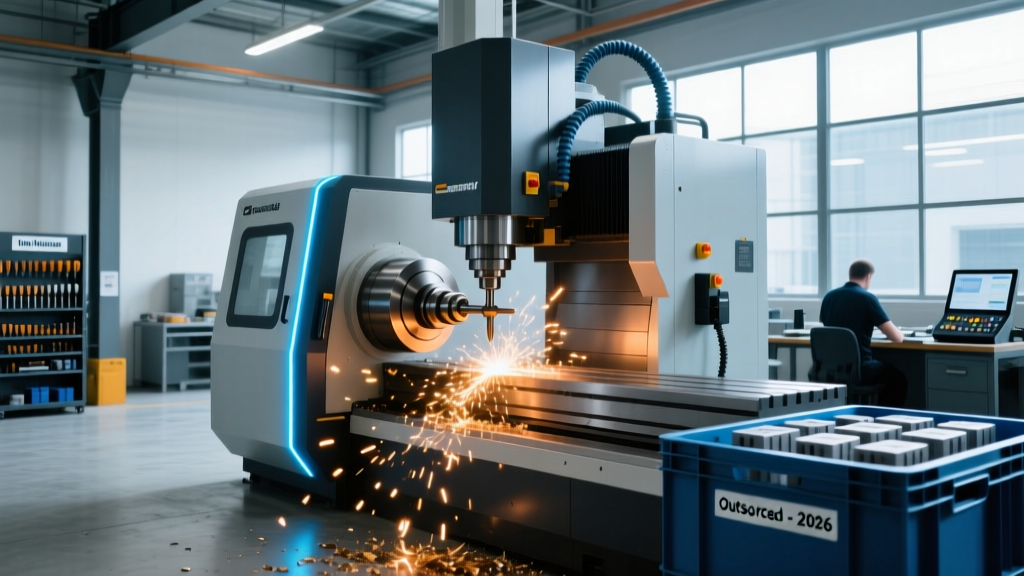
Bringing precision machining in-house demands significant capital expenditure, but the ROI timeline has compressed due to advanced automation. Consider the acquisition of a modern 5-axis vertical machining center, such as the DMG MORI DMU 50 3rd Generation. The base machine price hovers around $165,000. However, a production-ready configuration requires critical additions:
- High-Pressure Coolant System (100-bar): $12,500 (Essential for titanium and Inconel chip evacuation)
- Renishaw OMP600 Spindle Probe: $8,200 (For automated workpiece setup and in-cycle gauging)
- Automation Interface & Pallet Pool Prep: $18,000
- Installation, Rigging, and Calibration: $15,000
Total CapEx easily exceeds $218,000 per cell. Yet, when paired with a robotic part-loading system (like a Fastems or EROWA pallet pool), these machines achieve 85%+ spindle utilization during unattended 'lights-out' shifts. The Society of Manufacturing Engineers notes that shops utilizing automated pallet systems reduce cost-per-part on high-volume aerospace brackets by up to 34% over manual loading, effectively neutralizing the outsource rate advantage within 18 months.
Cloud Manufacturing Networks: The Outsourcing Evolution
Outsourcing in 2026 is dominated by cloud manufacturing platforms that aggregate distributed shop floors. These platforms use machine learning algorithms to instantly quote 3D CAD models, analyzing toolpath complexity, material removal rates (MRR), and setup geometries. If your CNC machining business experiences severe demand volatility, outsourcing via these networks converts fixed CapEx into variable OpEx.
However, relying on distributed networks introduces tolerance risks. While a cloud platform may quote a 5-axis impeller at $145/hour, the actual machine executing the job might lack the thermal stability or ISO 230-2 calibration required to hold +/- 0.0005-inch true position tolerances across a 100-part batch. You are trading process control for procurement speed.
Operational Comparison Matrix: In-House vs. Outsourced
| Metric | In-House Production | Cloud/Outsourced Network |
|---|---|---|
| CapEx Requirement | High ($150k - $500k+ per cell) | Zero (Pure OpEx) |
| DFM Feedback Loop | Immediate (Direct CAD/CAM to shop floor) | Delayed (Relies on platform AI or remote engineer review) |
| Material Traceability | Absolute (Internal ERP lot tracking) | Variable (Requires strict AS9100D supplier audits) |
| Lead Time Volatility | Low (Controlled scheduling) | High (Subject to network node availability) |
| IP & Data Security | Air-gapped or secure local servers | Cloud-dependent (Requires strict NDA/ITAR compliance checks) |
| Tolerance Holding | Guaranteed via in-cycle probing | Dependent on assigned vendor's machine condition |
The Hidden Cost of Digital Thread Fragmentation
The most critical technology trend impacting the make-versus-buy decision is the digital thread—the seamless flow of data from CAD design through CAM toolpaths, ERP scheduling, and CMM inspection. Modern machine shops utilize platforms like ProShop ERP or JobBOSS2, integrated with MTConnect for real-time machine telemetry.
When you outsource a complex sub-assembly, you sever this digital thread. If an outsourced vendor machines a batch of 304 stainless steel housings with incorrect surface finishes due to worn tooling, your internal quality management system (QMS) lacks the telemetry data to perform root-cause analysis. You receive the parts, but not the data. For a CNC machining business focused on continuous improvement and Six Sigma methodologies, this data blackout represents a massive hidden cost that rarely appears on a supplier's invoice.
Edge Case Warning: Exotic Alloys and Coolant Pressures
Outsourcing parts machined from Ti-6Al-4V (Titanium) or Inconel 718 is highly risky unless you can verify the supplier's equipment specifications. Machining these alloys requires minimum 1,000 PSI through-spindle coolant to prevent work hardening and tool welding. Many contract shops operate older VMCs with standard 300 PSI flood coolant, leading to premature carbide endmill failure, scrapped parts, and delayed deliveries. Always mandate high-pressure coolant certification in your RFQs for aerospace-grade superalloys.
Strategic Decision Framework for 2026
To determine whether a specific part family should be machined in-house or outsourced, apply this four-step technical framework:
- Assess Geometric Complexity vs. Setup Time: If a part requires 5-axis simultaneous machining but has a low annual volume (under 200 units), the in-house setup and CAM programming time will destroy margins. Outsource low-volume, high-complexity parts to shops specializing in first-article prototyping.
- Evaluate Tolerance Stack-Up Requirements: If the part features critical bearing bores requiring +/- 0.0002-inch tolerances and Ra 16 surface finishes, keep it in-house. Utilize your internal Renishaw probing and temperature-controlled metrology lab to guarantee compliance.
- Analyze Material Certification Needs: For medical (ISO 13485) or aerospace (AS9100D) components requiring full material heat-lot traceability and first-article inspection reports (FAIR), in-house production minimizes compliance audit risks.
- Calculate the Breakeven Spindle Hours: Use your shop's fully burdened hourly rate (typically $95-$135/hour in 2026, including overhead, floor space, and software licenses). If the outsource quote is less than 60% of your internal breakeven cost for a recurring high-volume part, investigate the vendor's automation capabilities before awarding the contract.
The Hybrid Model: The Optimal Path Forward
The most resilient CNC machining businesses in 2026 do not view in-house and outsourced production as mutually exclusive. Instead, they deploy a strategic hybrid model. Core intellectual property, high-tolerance mating surfaces, and exotic alloy components are kept strictly in-house, leveraging IoT-monitored machine cells and automated CMM inspection. Secondary operations—such as basic turning of non-critical spacers, anodizing, passivation, and high-volume basic 3-axis bracket milling—are routed through vetted contract partners via API-integrated procurement portals.
By aligning your manufacturing strategy with your technological infrastructure, you protect your profit margins, maintain absolute control over your digital thread, and ensure your shop remains agile in an increasingly automated industry. For further benchmarks on shop floor efficiency and supplier vetting, industry professionals can reference the latest procurement guidelines published by Thomasnet and regional manufacturing extension programs.