CNC Machining Bronze: Post-Processing Best Practices
Master post-processing for CNC machining bronze. Learn deburring, tumbling media, and ultrasonic cleaning best practices for C93200 and C95400 alloys.
The Hidden Scrap Trap in Bronze Post-Processing
When operators approach CNC machining bronze, the primary focus is typically on tool geometry, spindle speeds, and managing the gummy chip formation characteristic of high-lead alloys. However, the majority of hidden scrap costs and tolerance failures occur after the part leaves the CNC enclosure. Bronze alloys—specifically C93200 (SAE 660 Bearing Bronze) and C95400 (Aluminum Bronze)—possess unique metallurgical properties that make standard post-processing and secondary operations highly problematic if treated with a 'one-size-fits-all' steel or aluminum methodology.
The softness, high lead content, and thermal conductivity of bronze mean that aggressive deburring, improper tumbling media, and incorrect ultrasonic frequencies will smear critical sealing surfaces, embed abrasive particles into bearing bores, and ruin tight geometric tolerances. According to metallurgical guidelines published by the Copper Development Association, post-machining handling of copper-based alloys requires strict thermal and mechanical control to prevent work-hardening and surface degradation.
Operator Warning: The Smearing ThresholdC93200 contains 6.3% to 7.5% lead. Lead does not alloy with copper; it exists as microscopic dispersed particles. If your deburring tool generates excessive friction heat (above 300°F / 150°C at the cutting edge), the lead will melt and smear across the surface, creating a false 'smooth' finish that will fail under dynamic load and ruin the part's tribological properties.
Deburring Strategies for Gummy Bronze Alloys
Manual and automated deburring of bronze require a fundamental shift in tool selection and thermal management. High-speed steel (HSS) burrs and standard carbon steel brushes will gall and smear bronze surfaces. Operators must utilize specialized tooling and, where volume justifies it, advanced thermal or cryogenic secondary operations.
Manual and Semi-Automated Tooling
- Carbide Scrapers: Use solid carbide hand scrapers with a negative rake angle for edge breaking. Carbide dissipates heat away from the cutting edge faster than HSS, preventing lead smearing.
- Brush Selection: Avoid carbon steel wire brushes. Use brass or bronze wire brushes, or non-woven nylon abrasive pads (e.g., Scotch-Brite) rated for soft metals. If using nylon cups, keep RPMs below 1,500 to prevent melting the nylon matrix into the bronze pores.
- Coolant Application: Even in manual deburring, apply a mist of straight cutting oil (not water-soluble) to the edge to lubricate the scraper and carry away micro-chips.
Advanced Automated Deburring: Cryogenic vs. Thermal Energy
For high-volume production of bronze bushings, gears, and valve components, manual deburring is economically unviable and inconsistent. Modern machine shops are increasingly relying on Cryogenic Deflashing and Thermal Energy Machining (TEM). Industry data featured in Modern Machine Shop highlights that cryogenic processing is particularly effective for complex internal cross-holes in bronze hydraulic manifolds.
| Method | Best Suited Alloy | Cycle Time (Batch) | Approx. Cost/Part | Risk Factor & Limitations |
|---|---|---|---|---|
| Cryogenic Deflashing | C93200, C95400 | 15-25 mins | $0.12 - $0.25 | Low risk. Requires liquid nitrogen (-130°C). Excellent for internal intersecting holes. |
| Thermal Energy (TEM) | C95400, C51000 | 30-45 seconds | $0.30 - $0.55 | High thermal shock. Can alter surface hardness of high-aluminum bronzes if not calibrated. |
| Centrifugal Barrel | C95400 (Hard) | 45-90 mins | $0.08 - $0.15 | High risk of edge rounding on tight-tolerance ODs. Avoid for C93200. |
| Manual Carbide Scraping | All Alloys | 3-8 mins/part | $1.50 - $4.00 | High operator fatigue. Inconsistent edge break on complex geometries. |
Vibratory Tumbling and Media Selection
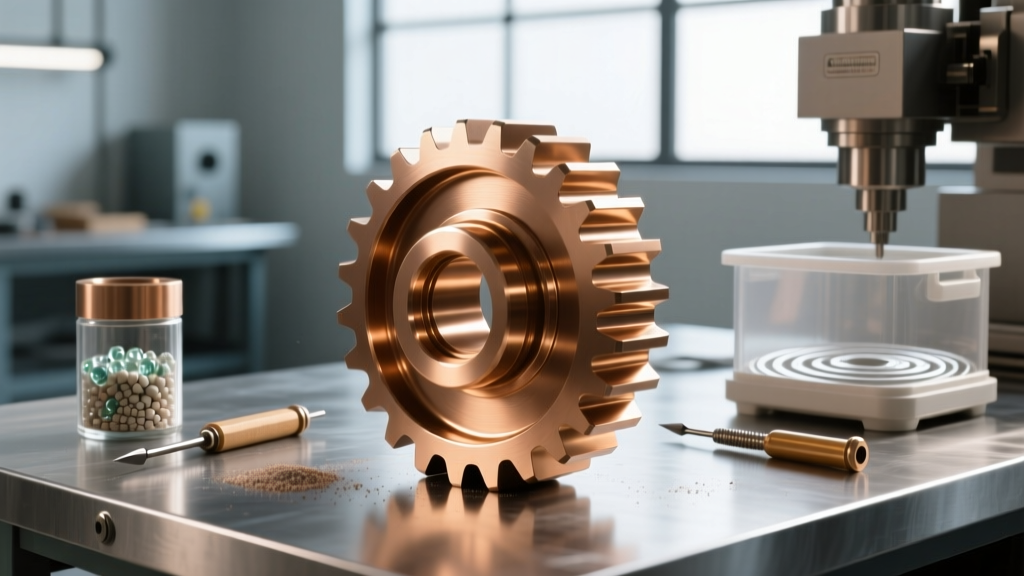
Surface finishing via vibratory tumbling is common for cosmetic improvement and edge radiusing. However, the most frequent mistake operators make when finishing CNC machined bronze is utilizing standard ceramic media. Ceramic media is too aggressive and porous; it will embed microscopic ceramic particles into the soft bronze matrix. When this part is later used as a bearing or bushing, those embedded ceramics act as lapping compound, destroying the mating steel shaft.
The Two-Stage Bronze Finishing Protocol
To achieve a smooth, 16-32 Ra µin finish without embedding media, operators must implement a strict two-stage process using high-density plastic media and organic polishing compounds.
Pro-Tip: Media-to-Part RatioFor intricate bronze parts with deep pockets or thin walls, maintain a media-to-part volume ratio of 4:1 or 5:1. This prevents part-on-part impingement, which causes severe denting and cosmetic scarring on soft C93200 surfaces.
- Stage 1: Edge Radiusing and Burnishing (120 Minutes)
Use 3/16-inch or 1/4-inch high-density urethane plastic cones or pyramids. Charge the bowl with a mild, non-foaming alkaline compound specifically formulated for copper alloys (pH 8.5 to 9.0). Do not use acidic compounds, as they will leach the zinc and tin from the bronze surface, leaving a porous, copper-rich 'dealloyed' surface layer that is highly susceptible to corrosion. - Stage 2: Final Polish and Tarnish Prevention (45 Minutes)
Drain the plastic media and compound. Introduce crushed walnut shell or corn cob media pre-charged with a fine jeweler's rouge or a specialized copper anti-tarnish paste. This stage absorbs residual moisture, polishes the surface to a semi-bright finish, and leaves a micro-thin protective wax layer that delays oxidation during inventory storage.
Ultrasonic Cleaning Parameters for Blind Holes
Bronze components, particularly hydraulic valve spools and aerospace bushings, frequently feature deep blind holes and cross-drilled lubrication channels. Removing trapped bronze swarf and tumbling compound from these features requires ultrasonic cleaning. However, improper frequency and temperature settings will damage the parts.
Frequency and Temperature Matrix
Standard 40 kHz ultrasonic cleaners generate cavitation bubbles that are highly energetic. While effective for steel, this energy level can cause micro-pitting on soft bronze surfaces and can erode delicate internal threads. The Society of Manufacturing Engineers recommends higher frequencies for softer, precision non-ferrous alloys.
- 40 kHz: Only use for heavy, rough C95400 structural castings with no tight internal tolerances.
- 80 kHz to 120 kHz: Mandatory for precision C93200 bearings, blind lubrication holes, and parts with internal UNJF threads. The smaller, less violent cavitation bubbles clean effectively without pitting the soft matrix.
- Temperature Control: Maintain the cleaning solution between 110°F and 130°F (43°C - 54°C). Exceeding 140°F accelerates the oxidation of the copper, resulting in a permanent dark brown or black staining that cannot be removed without aggressive chemical stripping.
Secondary Operations: Plating and Impregnation
Many CNC machined bronze parts require secondary operations to enhance wear resistance, provide corrosion protection, or achieve self-lubricating properties. These operations require specific metallurgical preparations.
Electroless Nickel Plating on High-Lead Bronze
Applying electroless nickel (EN) to C93200 is notoriously difficult. The 7% lead content prevents proper adhesion of the nickel deposit, leading to peeling and blistering in service. Standard zincate or stannate pre-treatments used for aluminum will fail on bronze.
The Solution: Operators must utilize a specialized anodic etch followed by a cyanide copper strike or a palladium activation bath to create a metallurgical bridge between the leaded bronze substrate and the electroless nickel layer. If your plating vendor does not explicitly ask about the lead content of your bronze alloy, find a new vendor.
Vacuum Impregnation for Porous Bronze (Oilite)
For sintered or highly porous cast bronze bearings designed to be self-lubricating, post-machining oil impregnation is critical. Simply soaking the parts in a bath is insufficient for modern high-performance applications.
'For critical aerospace and automotive applications, we mandate vacuum-thermal impregnation. We pull a vacuum of 28 inHg to evacuate all trapped air and machining coolant from the bronze pores, then introduce the synthetic PAO oil while maintaining the part at 180°F. As the part cools and the vacuum is released, the oil is forced deep into the micro-structure, yielding a 22% to 25% oil by volume saturation that you simply cannot achieve with atmospheric soaking.'
— Lead Metallurgist, Precision Sintered Components Division
Operator Inspection and Quality Control
Post-processing inspection for bronze requires different tools than steel. Standard steel profilometers with diamond stylus tips can scratch soft bronze, creating false roughness readings. Use optical profilometry or non-contact laser scanning for surface finish verification on finished C93200 bearing bores. Additionally, always inspect deburred edges under 10x magnification to ensure no lead smearing or embedded plastic media remains before the part is released to the assembly floor. Mastering these post-processing nuances is what separates a basic machine shop from a true precision manufacturing partner.