Advanced CNC Machining Coolant for Tighter Tolerance Standards
Discover how next-generation CNC machining coolant technologies, from nanofluids to high-pressure MQL, achieve sub-micron surface finishes and hold tight GD&T.
The Thermal-Tolerance Paradox in 5-Axis Milling
In precision contract machining, thermal expansion is the silent killer of tight Geometric Dimensioning and Tolerancing (GD&T). When machining aerospace superalloys like Inconel 718 or Ti-6Al-4V, the cutting zone can easily exceed 1,200°F (650°C). If this heat transfers into the workpiece, localized thermal growth will cause the part to machine oversized while hot, only to shrink below the ±0.0002-inch (5 µm) tolerance band once it cools to metrology lab temperatures. Managing this thermal-tolerance paradox requires moving beyond standard flood cooling and adopting advanced cnc machining coolant technologies designed specifically for thermal stability and boundary lubrication.
2026 Industry Benchmarks for Precision Machining:- Surface Finish Target: Ra 0.4 µm (16 µin) or better on hardened steels.
- Tolerance Capability: Holding ±0.0002" (5 µm) on critical bore diameters.
- Thermal Limit: Workpiece surface temperature must remain below 105°F (40°C) during finishing passes to prevent metrology drift.
According to metrology standards outlined by the National Institute of Standards and Technology (NIST), dimensional measurements are referenced at 20°C (68°F). If your cnc machining coolant strategy fails to extract heat efficiently, your CMM (Coordinate Measuring Machine) data will inevitably show out-of-tolerance conditions, leading to costly scrap rates in high-value production runs.
Next-Generation CNC Machining Coolant Formulations
The shift toward tighter surface finish and tolerance standards has driven significant innovation in fluid chemistry and delivery mechanics. Modern machine shops are upgrading to specialized formulations that alter the fundamental physics of the tool-workpiece interface.
Nanofluid-Enriched Emulsions
Nanofluids represent a major leap in thermal management. By suspending nanoparticles—typically Aluminum Oxide (Al2O3), Copper Oxide (CuO), or Diamond dust—at volume fractions of 0.5% to 1.5% in a semi-synthetic base, the thermal conductivity of the fluid increases by up to 20%. In finishing operations on 316L stainless steel, nanofluid-enriched cnc machining coolant prevents the built-up edge (BUE) formation that typically degrades surface finishes to Ra 1.6 µm or worse. The nanoparticles act as microscopic ball bearings, reducing the coefficient of friction and allowing the tool to shear the material cleanly rather than tearing it.
High-Pressure Through-Tool Delivery (1,000+ PSI)
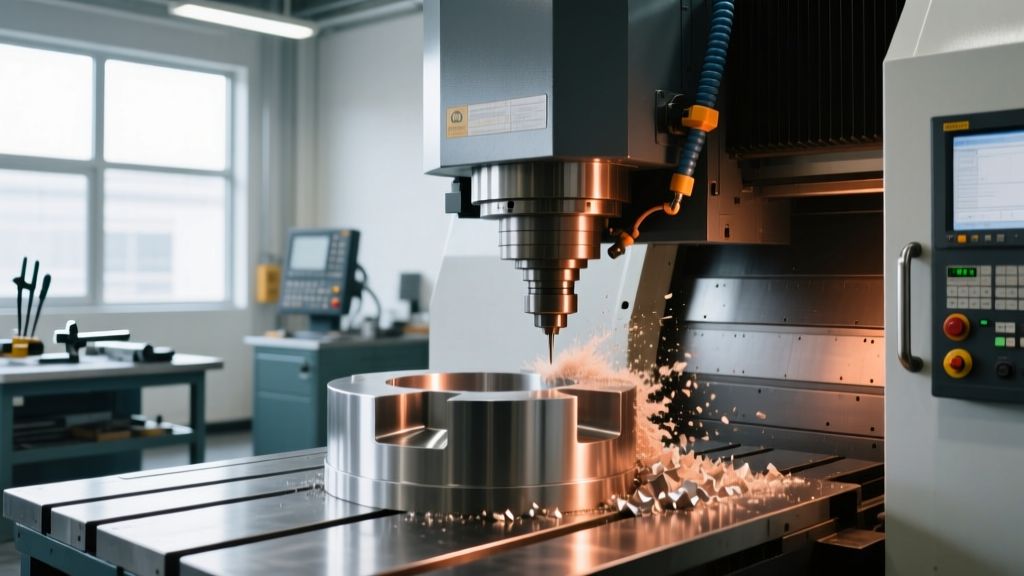
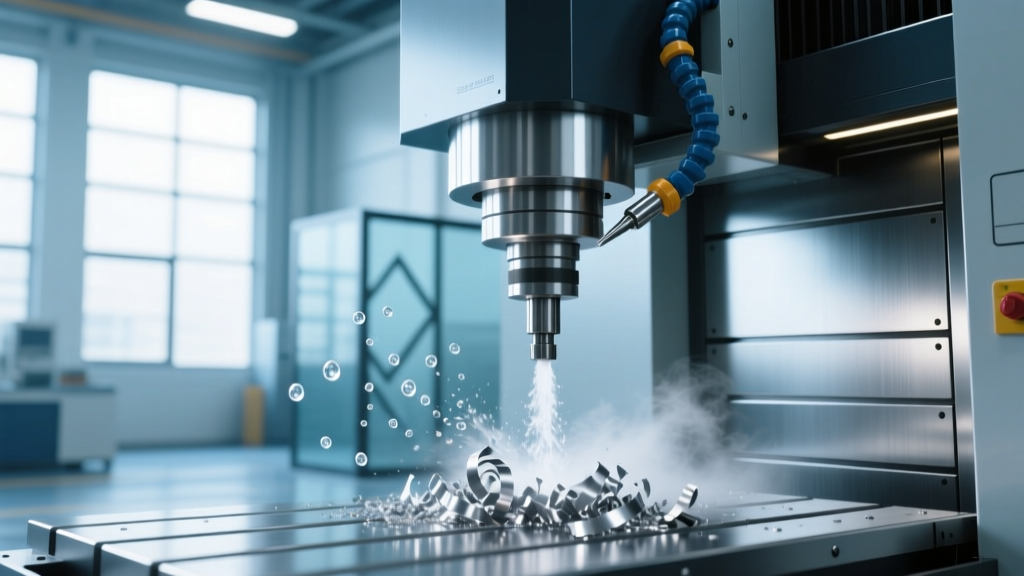
Fluid chemistry is only half the equation; delivery pressure dictates penetration. Standard flood coolant operates at 30 to 60 PSI, which is insufficient to penetrate the vapor barrier created during high-speed machining of titanium. Upgrading to high-pressure through-spindle coolant (TSC) systems operating between 1,000 and 1,500 PSI forces the fluid directly into the shear zone. As detailed in Sandvik Coromant's machining knowledge base, high-pressure coolant not only breaks chips into manageable 'C' shapes—preventing recutting and subsequent surface scratching—but also drastically reduces tool deflection, which is critical for maintaining true positional tolerances on deep-cavity milling.
System Comparison: Traditional vs. Advanced Coolant Delivery
Selecting the right infrastructure requires balancing capital expenditure against the cost of scrap and secondary finishing operations. Below is a comparison matrix of prevalent coolant delivery systems used in 2026 precision machine shops.
| System Type | Operating Pressure | Best Application | Surface Finish (Ra) | Est. Upgrade Cost |
|---|---|---|---|---|
| Standard Flood | 30 - 60 PSI | Roughing, Aluminum, Plastics | 1.6 - 3.2 µm | Base Machine |
| High-Pressure TSC | 1,000 - 1,500 PSI | Titanium, Inconel, Deep Cavities | 0.4 - 0.8 µm | $12,000 - $18,000 |
| Cryogenic MQL | 50 - 100 PSI (Liquid N2) | Hardened Steels, Composites | < 0.4 µm | $25,000 - $35,000 |
| Nanofluid Emulsion | 300 - 500 PSI | Stainless Steels, Precision Bores | 0.4 - 0.8 µm | $45 - $60 / Gallon |
Achieving Sub-Micron Finishes: The Concentration Factor
Even the most expensive cnc machining coolant will fail to hold tight tolerances if concentration levels fluctuate. In precision boring operations, a drop in coolant concentration leads to a loss of boundary lubrication, resulting in microscopic chatter marks that ruin the Ra value. Conversely, excessively high concentrations can cause foaming, which reduces the fluid's specific heat capacity and leads to thermal workpiece growth.
⚠️ Critical Maintenance Warning: Relying solely on visual checks or uncalibrated handheld refractometers is a primary cause of tolerance drift. Tramp oil contamination skews refractometer readings, leading operators to add water when the concentration is actually critically low. Implement daily digital refractometry and automated tramp oil skimming to maintain a strict 7.0% to 8.5% Brix concentration for heavy-duty semi-synthetics.For shops utilizing advanced metalworking fluid protocols, installing an automated centralized coolant distribution system with real-time concentration monitoring pays for itself by eliminating human error in fluid management. These systems typically cost between $8,000 and $14,000 but reduce coolant consumption by up to 30% while guaranteeing the chemical stability required for sub-micron surface finishes.
Troubleshooting Surface Finish Degradation
When a part suddenly fails to meet the Ra 0.8 µm specification or falls out of the ±0.0005-inch positional tolerance band, the coolant system is often the hidden culprit. Use this diagnostic framework to isolate fluid-related failures:
- Symptom: Built-Up Edge (BUE) on carbide inserts, resulting in torn surface finishes on aluminum or stainless steel.
Cause: Lack of extreme pressure (EP) additives or coolant concentration below 5%.
Fix: Increase concentration to 8% and verify the fluid contains adequate sulfurized EP additives for the specific alloy. - Symptom: Workpiece is consistently oversized after cooling to room temperature.
Cause: Inadequate volumetric flow rate (GPM) failing to extract bulk heat, despite adequate pressure.
Fix: Upgrade coolant pump capacity or add auxiliary programmable coolant nozzles aimed directly at the tool exit point. - Symptom: Micro-pitting or localized corrosion on finished steel surfaces within 24 hours of machining.
Cause: Chloride contamination in the water supply or depleted rust inhibitors in the cnc machining coolant.
Fix: Switch to a low-chloride, high-amine synthetic fluid and test the incoming water hardness; utilize reverse osmosis (RO) water for mixing if hardness exceeds 150 ppm.
Sourcing and Implementation Strategy for 2026
Transitioning to advanced coolant technologies requires a phased approach. Begin by auditing your current scrap rates related to thermal distortion and surface finish rejections. If your shop primarily machines aerospace titanium or medical-grade stainless steel, the immediate ROI lies in upgrading to a 1,000 PSI high-pressure pump system paired with a premium semi-synthetic fluid engineered for high-temperature shear stability. For high-volume automotive or hydraulic valve production, investing in nanofluid concentrates and automated concentration management will yield the tightest Cpk values on critical bore diameters. By treating your cnc machining coolant not as a consumable overhead, but as a precision tooling component, you can reliably hold the aggressive tolerance standards demanded by modern engineering.