Beyond Automotive Part CNC Machining: Oil & Gas Equipment Guide 2026
Transitioning from automotive part CNC machining to oil & gas? Discover 2026 equipment specs, turn-mill models, and tooling strategies for API components.
The Paradigm Shift: Automotive Part CNC Machining vs. Oil & Gas
Machine shops that have built their foundation on high-volume automotive part CNC machining often look toward the oil and gas (O&G) sector to diversify revenue and capture higher-margin contracts. However, the equipment requirements for manufacturing O&G components—such as wellhead valves, blowout preventer (BOP) housings, and mud pump fluid ends—are diametrically opposed to those used for automotive transmission cases or engine blocks. While automotive machining prioritizes high spindle speeds, rapid traverse rates, and pallet-changer automation for aluminum and cast iron, O&G machining demands extreme rigidity, massive low-end torque, and high-pressure coolant systems to conquer superalloys and hardened steels.
Upgrading your shop floor to handle API-standard components requires a fundamental rethinking of your capital equipment strategy. This 2026 buying guide outlines the exact machine specifications, turn-mill platforms, and tooling frameworks required to successfully transition into the lucrative oil and gas supply chain.
⚠️ WARNING: The Spindle Speed TrapDo not repurpose high-RPM automotive machining centers (15,000+ RPM) for O&G roughing. Attempting to rough out an Inconel 718 valve body on a machine optimized for 6061-T6 aluminum will result in catastrophic spindle bearing failure within weeks. O&G machining requires gear-driven or high-torque direct-drive spindles optimized for the 400–1,200 RPM range.
Critical Machine Specifications for O&G Components
Before evaluating specific machine brands, procurement managers must understand the baseline mechanical requirements dictated by O&G materials like Duplex 2205 stainless steel, Inconel 718, and 4140/4340 alloy steels. Below is a direct comparison of the machine architecture required for automotive versus O&G production.
| Specification | Automotive Part CNC Machining | Oil & Gas Component Machining |
|---|---|---|
| Spindle Torque | 150 - 300 Nm (High RPM focus) | 800 - 1,500+ Nm (Low RPM focus) |
| Coolant Pressure | 300 - 500 PSI (Through-spindle) | 1,000 - 1,500 PSI (Minimum for superalloys) |
| Machine Castings | Standard ribbed cast iron | Massive, heavily ribbed, polymer-concrete or heavy Meehanite |
| Work Envelope | Compact, optimized for tombstones | Large Z-axis travel, high table load capacity (5,000+ lbs) |
| Primary Materials | A356 Aluminum, Nodular Iron, Mild Steel | Inconel, Duplex SS, Titanium, Hardened 4140 |
2026 Turn-Mill & 5-Axis Equipment Shortlist
For complex O&G geometries like Christmas tree valves and hydraulic manifolds, 5-axis machining centers and multi-tasking turn-mill centers are mandatory. These platforms allow shops to complete a part in a single setup, which is critical for maintaining the strict geometric tolerances required by American Petroleum Institute (API) Standards.
1. Mazak INTEGREX i-800 ST
Estimated Base Price: $820,000 - $890,000 (2026 Market Average)
Best Application: Large-diameter wellhead valves and BOP stabs.
The INTEGREX i-800 ST features a second spindle and a lower turret, allowing simultaneous machining. Its 1,000 mm turning diameter and massive 1,200 Nm spindle torque make it ideal for heavy roughing of forged alloy steel blocks. The machine's thermal stability ensures that deep-cavity milling operations do not drift out of tolerance over 40-hour cycle times.
2. DMG MORI NTX 2500 2nd Generation
Estimated Base Price: $1,050,000 - $1,250,000
Best Application: Complex subsea manifold blocks and API 17D wellhead equipment.
DMG MORI's NTX series is renowned for its B-axis milling spindle rigidity. The NTX 2500 offers a 102 mm diameter turning spindle bar and integrated 5-axis milling. Its proprietary CELOS controller integrates seamlessly with shop-floor ERP systems, providing the material traceability documentation that O&G auditors demand.
3. Deep Hole Drilling Integration: IMSA MF1300/2C
Estimated Base Price: $650,000+
Best Application: BOP hydraulic manifolds and long-reach fluid end bores.
You cannot machine deep hydraulic intersecting bores on a standard VMC. Dedicated gun-drilling and BTA (Boring and Trepanning Association) equipment from manufacturers like IMSA or TBT Tiefbohrtechnik is required. The MF1300/2C features twin independent drilling units, allowing shops to drill intersecting holes in 4140 steel up to 1,300 mm deep with straightness tolerances of 1mm per 1,000mm.
Tooling, Coolant, and Scrap Prevention
The cost of raw material in O&G machining is staggering. A single API 6A wellhead housing forging can cost between $12,000 and $25,000 before a single chip is cut. Scrapping a part during the final finishing pass due to tool failure is financially devastating. Therefore, tooling and coolant delivery must be spec'd with zero compromise.
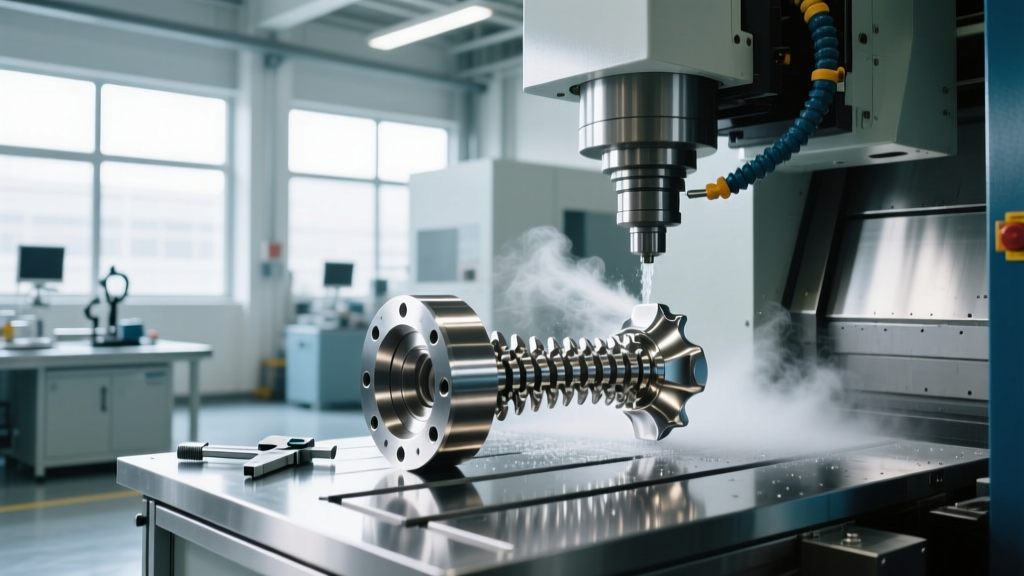
- High-Pressure Coolant Systems: When machining Duplex stainless steels or Inconel, standard flood coolant is useless. You must spec machines with 1,000+ PSI (70+ bar) through-spindle coolant. According to the Sandvik Coromant Inconel Milling Guide, high-pressure coolant is mandatory to break chips and prevent Built-Up Edge (BUE), which leads to catastrophic insert failure and workpiece surface tearing.
- Insert Substrates and Coatings: For roughing Inconel 718, utilize PVD-coated grades like Sandvik GC1125 or Kennametal KCSM15. For hardened 4140 (32-36 HRC), ceramic inserts (e.g., Sandvik Coromant CC6060) allow for cutting speeds 10x faster than carbide, drastically reducing cycle times on long-turning operations.
- Workholding: Abandon standard 3-jaw hydraulic chucks for heavy O&G turning. Invest in independent 4-jaw chucks with custom-machined soft jaws, or specialized pillar-type workholding systems from companies like Röhm or Schunk, which provide the clamping force necessary to resist the extreme cutting forces of heavy interrupted cuts on forged blocks.
'In oil and gas machining, you aren't just selling a metal part; you are selling the metallurgical integrity and the data packet that accompanies it. If your machine lacks the rigidity to hold a surface finish of 63 Ra on an Inconel seal ring, or your shop lacks the CMM equipment to certify it, you will not pass an API audit.'
— Manufacturing Engineering Lead, Tier 1 Subsea Supplier
Metrology and API Compliance Framework
Automotive part CNC machining relies heavily on automated, in-machine probing and rapid go/no-go gauging. The O&G sector requires exhaustive, documented metrology. When purchasing equipment for an O&G cell, you must allocate 15% to 20% of your total capital budget to inspection technology.
To meet AMPP (formerly NACE) Corrosion Standards and API specifications, shops must invest in:
- Large-Format CMMs: Zeiss CONTURA or Hexagon Global S series with rotary tables, capable of scanning complex 5-axis contoured sealing surfaces and verifying true position tolerances on bolt-hole patterns.
- API Thread Gauging Equipment: API 5B and API 6A threads (such as casing, tubing, and line pipe threads) require specialized lead, taper, and height inspection. Equipment from Brown & Sharpe or specialized optical thread scanners from Zoller are mandatory for certifying premium threaded connections.
- Surface Roughness Testers: Portable and benchtop profilometers (e.g., Mitutoyo Surftest SJ-410) are required to certify the exact Ra/Rz finishes on ring groove (RX/BX) sealing surfaces, where a deviation of mere microns can cause a high-pressure gas leak in the field.
Final Procurement Advice for 2026
Transitioning from automotive to oil and gas is not merely a matter of buying a larger machine. It requires a holistic investment in low-RPM torque, extreme high-pressure coolant, rigid workholding, and API-compliant metrology. Shop owners should prioritize turn-mill centers with massive thermal mass and partner with tooling engineers who specialize in superalloy machining. By aligning your equipment purchases with the unforgiving realities of O&G materials and API standards, your shop can secure long-term, high-margin contracts in the energy sector.