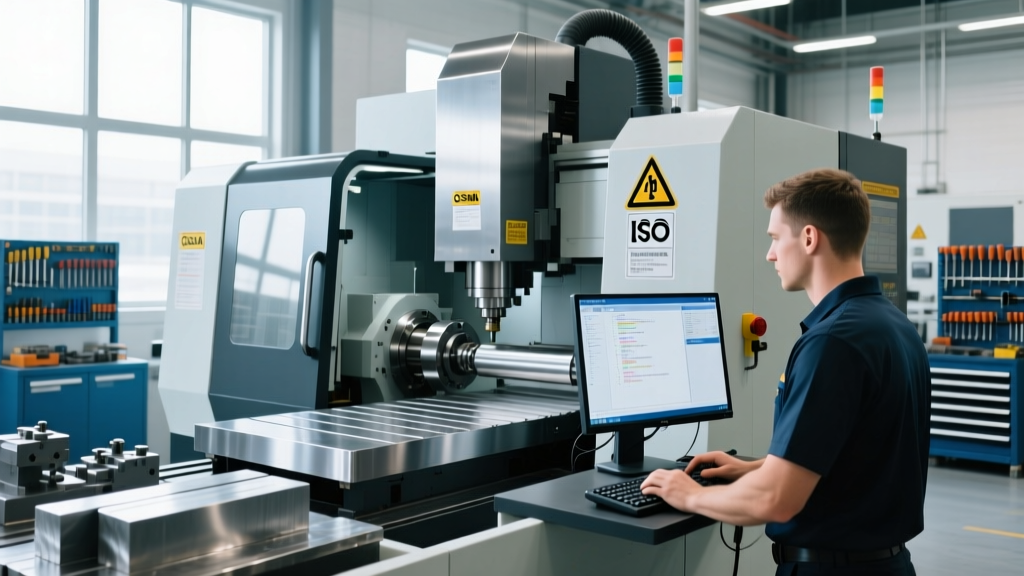
Writing a Safe CNC Machine Program: ISO & OSHA Compliance
Learn how to audit your CNC machine program for ISO and OSHA safety compliance, prevent G-code crashes, and verify toolpaths using simulation.
CNC machine programs are not merely instructions for cutting metal; they form the primary software boundary between safe operation and catastrophic mechanical failure. A single missing decimal in a G-code script, an unverified rapid traverse (G00) move, or a missing tool length offset can result in a $18,000 to $25,000 spindle crash on a standard VMC, or worse, cause severe operator injury from ejected tooling or workpieces.
While hardware interlocks and physical guarding are critical, safety standards like ANSI B11 and OSHA regulations increasingly recognize that the CNC machine program itself must be engineered with safety as a foundational parameter. This guide details how to audit, write, and verify G-code and CAM-generated toolpaths to meet rigorous industrial safety compliance standards.
⚠️ CRITICAL WARNING: The G00 Clearance TrapRapid traverse (G00) commands move the machine at maximum axis speed (often 1,000+ IPM). Programming a G00 move to a Z-coordinate without first retracting the X and Y axes to a safe clearance plane is the leading cause of tool shank collisions and workholding destruction. Always program X/Y retraction before Z-descents during non-cutting moves.
Core Safety Standards Governing CNC Programming
Compliance in CNC machining extends beyond physical machine guarding. The software logic must align with established safety frameworks to prevent foreseeable hazards.
OSHA 1910.212 and Machine Safeguarding
Under OSHA Standard 1910.212, employers must protect operators from hazards created by the point of operation and rotating parts. While this heavily dictates physical enclosure requirements, it also mandates that the machine's control logic (the CNC machine program) must not force the operator to bypass safety interlocks. For example, programming a tool change (M06) at a Z-height that requires the operator to open the enclosure doors and reach into the cutting envelope violates the spirit and letter of point-of-operation guarding.
ISO 23125 and ISO 16090 (Turning and Milling Safety)
International standards such as ISO 23125 (Turning Centers) and ISO 16090 (Milling Machines) specify requirements for the control systems. These standards dictate that the CNC machine program must respect software limit switches (soft limits) and that the control system must safely handle program interruptions, E-stops, and feed-hold states without losing positional accuracy or causing uncontrolled axis movement upon resumption.
The 5-Point CNC Machine Program Safety Audit
Before transferring any CAM-generated or hand-written G-code to the shop floor, run the program through this rigorous safety audit checklist.
1. Work Envelope and Soft Limit Verification
Every CNC machine program must be verified against the specific machine's kinematic limits. Programming in G53 (Machine Coordinates) requires exact knowledge of the machine's physical travel. If a CAM system uses a generic post-processor that outputs coordinates exceeding the machine's X, Y, or Z travel, the machine will trigger a hard over-travel alarm or crash into the way covers.
- Action: Verify the post-processor's defined work envelope matches the exact machine model (e.g., Haas VF-4SS vs. VF-2SS).
- Action: Ensure tool length offsets (H-codes) and fixture offsets (G54-G59) are mathematically validated to keep the tool tip within the Z-axis soft limits.
2. Safe Tool Change (M06) Z-Axis Clearance
Tool changes must occur in a designated, collision-free zone. On vertical machining centers, this is typically the highest Z-axis point or a specific G53 coordinate.
- Unsafe Code:
G91 G28 Z0(Returns to machine zero, which may cause the spindle nose to collide with tall fixtures on the table). - Safe Code:
G53 G0 Z-1.0(Moves to a specific, verified safe Z-height in machine coordinates, clearing all vise heights).
3. Spindle Speed Clamping (Turning Operations)
In CNC turning, Constant Surface Speed (G96) increases the spindle RPM as the tool moves closer to the centerline of the part. Without a speed clamp, the centrifugal force can exceed the mechanical limits of the chuck jaws, causing them to eject through the machine enclosure—a fatal hazard.
- Mandatory Safety Code: Always precede a G96 command with a G50 (or G92 on some controls) spindle speed limit. Example:
G50 S3000caps the spindle at 3,000 RPM, regardless of the CSS calculation.
4. Probing Cycle (G65/G31) Collision Prevention
Renishaw or Blum probing cycles are highly susceptible to crashes if the approach move is programmed incorrectly. The probe stylus is fragile and expensive ($500+).
- Action: Always program a rapid positioning move (G00) to a 'safe clearance plane' 0.500 inches away from the expected part surface before initiating the slow feed probe move (G31).
5. Coolant and Chip Evacuation Interlocks
High-pressure coolant (M08/M51) must be programmed to activate only when the spindle is at speed and the enclosure doors are confirmed closed by the machine's physical interlocks. Programming high-pressure coolant to turn on during a spindle stop or tool change can result in high-pressure fluid injection hazards for the operator.
Common G-Code Safety Violations vs. Corrective Actions
The following matrix highlights frequent programming errors that compromise safety and their required G-code corrections.
| Safety Violation | Hazard / Failure Mode | Corrective G-Code Action |
|---|---|---|
| G96 without G50 limit | Chuck jaw ejection due to extreme centrifugal force at centerline. | Insert G50 S[Max_RPM] before G96. |
| G00 Z-descend without X/Y clearance | Tool shank collision with workholding or raw stock. | Retract X/Y to clearance plane before Z-axis rapid move. |
| Missing H/D tool offsets | Z-axis crash into table; spindle bearing destruction. | Verify H-code calls match physical tool table; use G43 H_. |
| M06 at unsafe Z-height | Operator struck by swinging tool arm; fixture collision. | Force G53 G0 Z-[Safe_Height] before M06. |
| G84 Tapping without rigid tap sync | Tap breakage, thread stripping, tool ejection. | Use G84.2 (Rigid Tap) or ensure M29 S-sync is active. |
Simulation Software as a Compliance Shield
Relying solely on manual G-code review is insufficient for 5-axis simultaneous machining or complex mill-turn operations. Kinematic simulation software acts as a digital twin, verifying that the CNC machine program complies with the physical realities of the machine tool before a single chip is cut.
Industry-leading platforms like CGTech VERICUT and NCSIMUL read the actual post-processed G-code (not just the CAM toolpath data) and simulate the exact kinematics of the specific CNC controller (e.g., Fanuc 31i, Siemens 840D, Heidenhain TNC7).
💡 Financial Context for 2026:A comprehensive VERICUT license with Multi-Axis and Auto-Diff modules typically costs between $12,000 and $18,000 per seat. While this represents a significant capital expenditure, it is easily justified when compared to the $25,000+ cost of replacing a 12,000 RPM direct-drive spindle and the associated weeks of machine downtime following a severe crash. Furthermore, insurance underwriters for high-value manufacturing facilities increasingly require documented simulation logs as a condition for equipment coverage.
Simulation software automatically detects:
- Axis Over-travel: Movements that exceed the machine's physical limit switches.
- Component Collisions: Intersections between the tool holder, spindle nose, workholding, and machine table.
- Unprogrammed Stock Removal: Identifying 'air cuts' that waste cycle time and 'gouges' that scrap the part.
"In modern CNC manufacturing, the CNC machine program is a legally discoverable document. If an accident occurs and an investigation reveals that the G-code contained unverified rapid moves or lacked basic speed clamping, the liability shifts directly to the programming and engineering team. Simulation logs are your proof of due diligence."
— Manufacturing Safety Compliance Board, referencing OSHA Machine Safeguarding Guidelines.
FAQ: CNC Machine Program Safety
Can a CNC machine program override physical safety interlocks?
No. Modern CNC controls (Fanuc, Siemens, Mazak Mazatrol) are hardwired so that G-code or M-code commands cannot override physical safety interlocks, such as enclosure door switches or emergency stop circuits. However, poorly written programs can induce conditions that force operators to manually bypass these interlocks (e.g., programming a tool change outside the enclosure to save 4 seconds of cycle time), which is a severe OSHA violation.
How do I safely prove out a new CNC machine program on the shop floor?
Use the 'Single Block' and 'Optional Stop' (M01) modes in conjunction with the 'Rapid Override' switch dialed down to 5% or 10%. Keep your hand on the Feed Hold button. Verify the Z-axis distance-to-go on the control screen before allowing the tool to approach the part. Never run a new program with the enclosure doors open or interlocks defeated.
What is the safest way to program a dry run for a multi-pallet system?
When programming for tombstones or multi-pallet horizontal machining centers (HMCs), always include a B-axis rotation check. Program a safe Z-retraction (G53 Z0) before any B-axis indexing (e.g., B90. or B180.). Failing to retract the Z-axis before rotating the pallet will result in the workpiece or fixture swinging directly into the spindle column.