How AI is Reshaping CNC Machine Programming Software in 2026
Discover how AI, cloud computing, and digital twins are transforming CNC machine programming software in 2026. Compare costs, cycle times, and tech stacks.
The era of manually tweaking G-code and relying on static CAM post-processors is ending. In 2026, modern CNC machine programming software leverages cloud computing, AI-driven toolpath generation, and digital twins to eliminate spindle crashes and slash cycle times by up to 40%. For machine shop owners and manufacturing engineers, understanding these technological shifts is no longer optional—it is the primary differentiator between profitable job shops and those losing bids to faster, more agile competitors.
The Shift to Cloud-Native Ecosystems
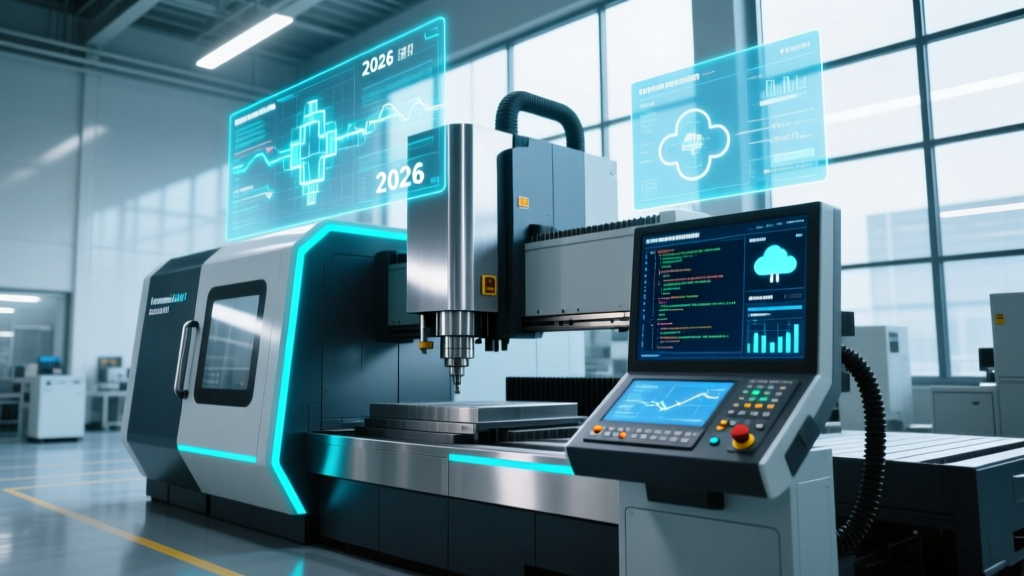
Historically, CAM software required heavy on-premise workstations and perpetual licensing. Today, the industry is split between legacy on-premise powerhouses and cloud-native disruptors. Cloud-based platforms offload complex toolpath calculations to remote server farms, allowing engineers to generate 5-axis simultaneous toolpaths on lightweight laptops or even tablets on the shop floor.
| Feature | Cloud-Native (e.g., Autodesk Fusion 360) | On-Premise Legacy (e.g., Mastercam, Siemens NX) |
|---|---|---|
| Pricing Model | ~$545/year (Base) + $1,000/year (Machining Extension) | $8,000 - $15,000 perpetual + $1,500/year maintenance |
| Compute Power | Cloud server farms (infinite scaling for complex 3D roughing) | Local workstation (requires $5,000+ GPU/CPU investments) |
| Offline Capability | Limited (requires sync for complex toolpath generation) | Full (100% independent of internet connection) |
| IT Overhead | Minimal (SaaS managed) | High (requires local server licensing and manual updates) |
According to Autodesk's official platform documentation, cloud-native CAM environments now support offline caching for basic toolpath editing, mitigating the historical risk of shop floor internet outages. However, for defense contractors handling ITAR-regulated aerospace components, on-premise solutions remain mandatory due to strict data sovereignty requirements.
AI-Driven Toolpaths and Generative Machining
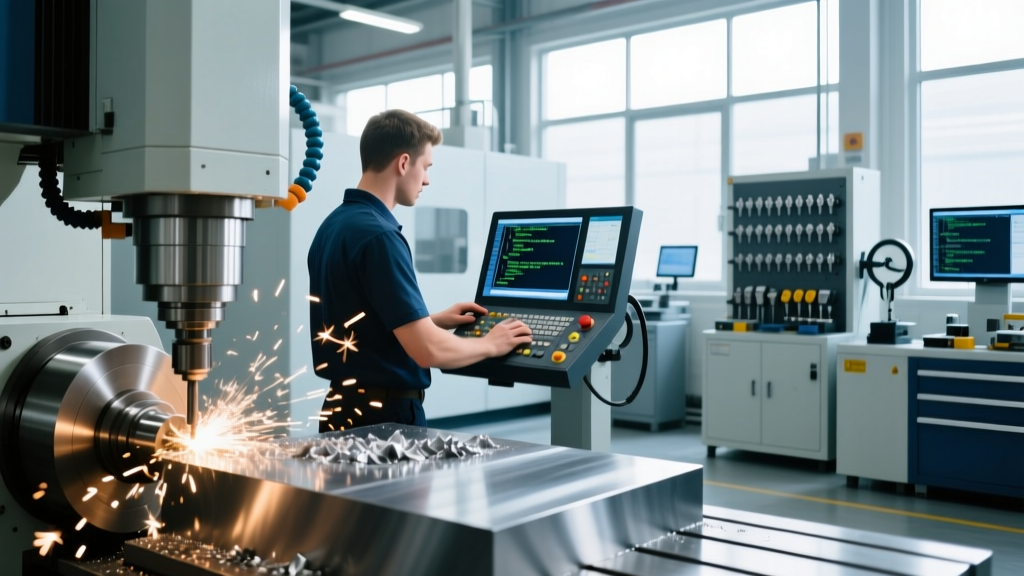
The most significant innovation in 2026 CNC machine programming software is the integration of Artificial Intelligence into toolpath algorithms. Traditional CAM relies on the programmer to manually define stepovers, feed rates, and engagement angles. AI-driven CAM analyzes the cutter's engagement with the material in real-time, dynamically adjusting the toolpath to maintain a constant chip load.
📊 Data Highlight: AI Toolpath EfficiencyShops utilizing AI-optimized dynamic milling report a 30% to 45% reduction in roughing cycle times and a 200% increase in carbide endmill lifespan due to the elimination of sudden engagement spikes that cause micro-fractures in cutting edges.
Material-Specific Cycle Time Reductions
To understand the real-world impact of AI toolpaths, consider a 3D adaptive clearing operation on a 10" x 10" x 2" aerospace structural pocket using a 1/2" (12mm) 5-flute carbide endmill.
| Material | Traditional Z-Level Roughing | AI-Optimized Trochoidal/Dynamic | Time Saved |
|---|---|---|---|
| 6061-T6 Aluminum | 14 mins (Constant Feed: 150 IPM) | 6.5 mins (Variable Feed: up to 350 IPM in low engagement) | 53% |
| Ti-6Al-4V (Titanium) | 48 mins (Conservative stepdown) | 31 mins (Optimized radial engagement, full axial depth) | 35% |
| Inconel 718 | 85 mins (High tool wear, frequent pauses) | 58 mins (Constant chip load prevents work hardening) | 31% |
By maintaining a constant radial engagement (e.g., keeping the cutter engaged at exactly 10% of its diameter), the software allows the machine to max out its axial depth of cut and feed rate without overloading the spindle. This is particularly critical when machining work-hardening superalloys like Inconel, where traditional cornering moves often snap the tool.
Digital Twins: Closing the Gap Between CAM and the Spindle
Simulating a toolpath on a generic 3-axis kinematic model is no longer sufficient for modern 5-axis machining. The 2026 standard requires a "Digital Twin"—a mathematically exact virtual replica of the specific CNC machine, including its rotary table geometry, limit switches, and exact controller behavior (e.g., FANUC 31i-B5 or Heidenhain TNC7).
"A digital twin is not just a 3D animation; it is the execution of the actual NC code on a virtualized CNC controller. This catches RTCP (Rotary Tool Center Point) singularities and nonlinear interpolation errors that standard CAM simulation completely misses." — Advanced Manufacturing Research Synthesis
Platforms like Siemens SINUMERIK ONE have pioneered the native digital twin, allowing programmers to run the exact PLC and CNC logic in a virtual environment before the physical machine is even powered on. According to frameworks established by the National Institute of Standards and Technology (NIST), implementing digital twins in complex manufacturing reduces physical commissioning time by up to 30% and virtually eliminates crashes caused by post-processor errors.
⚠️ Warning: The Hidden Cost of Digital TwinsWhile digital twins prevent $50,000+ spindle crashes, creating the initial virtual machine model requires precise kinematic data from the OEM. If your machine shop buys a used 5-axis mill without the OEM's 3D kinematic STEP files and exact axis limit parameters, building an accurate digital twin can take 40+ hours of specialized engineering time.
2026 Decision Framework: Upgrading Your CAM Stack
Choosing the right CNC machine programming software depends entirely on your shop's specific workflow, material mix, and tolerance requirements. Use this framework to evaluate your next software investment:
- Scenario A: High-Mix, Low-Volume Job Shop (3-Axis & 4-Axis)
Recommendation: Cloud-native software (e.g., Fusion 360, Onshape). The low barrier to entry, automatic post-processor library updates, and cloud compute for 3D adaptive clearing provide the highest ROI. Avoid tying up $15,000 in perpetual licenses for machines that sit idle half the week. - Scenario B: Aerospace & Medical (5-Axis, Tight Tolerances, Exotic Alloys)
Recommendation: Premium on-premise software (e.g., Mastercam, Siemens NX, hyperMILL) paired with a dedicated digital twin verifier like VERICUT. You need absolute control over post-processor variables, RTCP tuning, and localized data security. The $20,000+ initial investment is offset by preventing a single crash on a $100,000 titanium billet. - Scenario C: High-Volume Production (Automotive, Swiss-Type)
Recommendation: CAM software with native macro-programming integration and automated feature recognition (AFR). Look for platforms that can automatically identify hole patterns, chamfers, and pockets directly from the CAD model and apply standardized, shop-proven toolpaths without manual intervention.
The technology driving CNC machine programming software has fundamentally shifted from simple geometry translation to intelligent, physics-aware manufacturing ecosystems. Shops that leverage AI toolpaths and digital twins in 2026 will consistently outbid competitors who are still manually calculating stepovers and hoping their G-code doesn't crash the spindle.