Essential CNC Machine G Code M Code List for Controller Buyers
Compare controller dialects using our essential CNC machine G code M code list. Learn how code compatibility impacts post-processors and retrofit costs.
The Hidden Cost of Controller Dialect Fragmentation
Selecting a CNC mill, lathe, or multi-axis turn-mill requires scrutinizing the control unit's programming dialect. While the EIA-274-D (RS-274) standard established a universal baseline for numerical control in the 1970s, modern OEMs have heavily fractured this standard to support proprietary features. When evaluating a potential purchase, requesting the manufacturer's complete cnc machine g code m code list is a non-negotiable step for manufacturing engineers and shop owners. A mismatch between your CAM software's post-processor and the machine's native dialect can result in $3,000 to $6,500 in custom post-processor development fees before the first chip is even cut.
⚠️ Buyer Warning: Never assume a machine labeled 'Fanuc Compatible' supports the full Fanuc G-code dictionary. Many import brands and retrofitted legacy machines use stripped-down controllers (like Mach4 or basic DSP pendants) that lack support for G68 (coordinate rotation), G10 (data setting), or Macro B logic, severely limiting 5-axis and automated probing capabilities.The Baseline RS-274 Standard: What Every Controller Must Support
Before analyzing proprietary extensions, buyers must verify that the baseline EIA standard codes are implemented correctly. Below is the foundational CNC machine G code M code list that serves as the minimum viable requirement for any 3-axis or 4-axis production equipment.
| Code | Function | Dialect Variance Risk | Buyer Verification Step |
|---|---|---|---|
| G00 / G01 | Rapid / Linear Feed | Low | Verify exact decimal point tolerance (e.g., X1.0 vs X10000). |
| G02 / G03 | Circular Interpolation | Medium | Check if R-value (radius) supports negative values for arcs >180°. |
| G40-G42 | Cutter Compensation | High | Confirm G41/G42 supports C-axis and Y-axis mill-turn compensation. |
| G43 | Tool Length Offset | High | Ensure G43 H_ supports dynamic tool setting via probing macros. |
| G54-G59 | Work Coordinate Systems | Medium | Verify G54.1 P_ support for extended WCS (up to 300+ origins). |
| M06 | Tool Change | High | Check if M06 executes pre-stage (T_) or requires a separate T_ line. |
| M08 / M09 | Coolant On / Off | Low | Confirm M-code mapping for through-spindle coolant (usually M88/M89). |
Controller Dialect Matrix: Fanuc vs. Siemens vs. Heidenhain
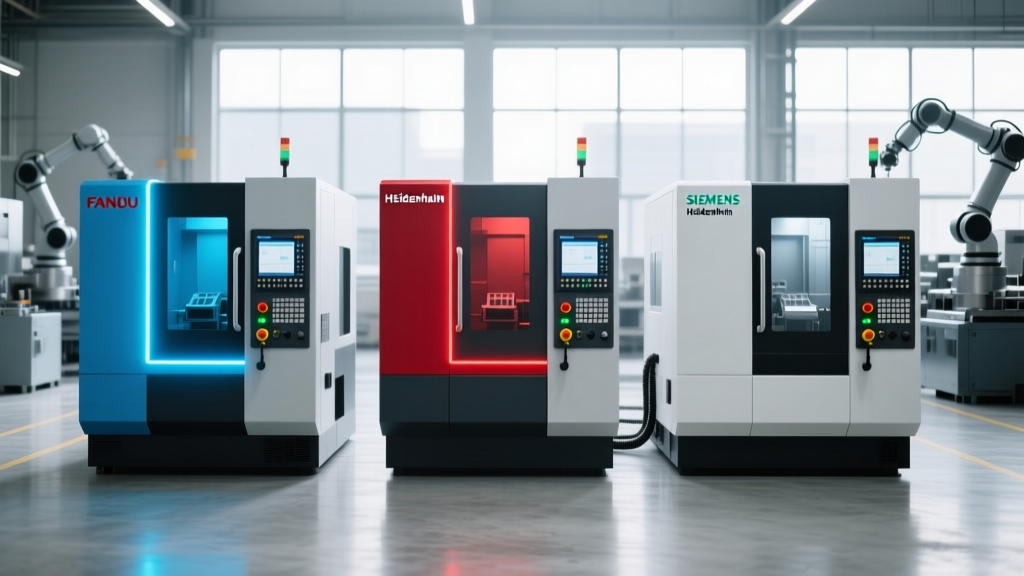
The true value of a CNC machine G code M code list emerges when comparing high-end controller ecosystems. According to industry analysis by Modern Machine Shop, the choice between Fanuc, Siemens, and Heidenhain dictates your shop's CAM strategy, operator training pipeline, and automation integration.
Fanuc (0i-F Plus / 31i-B)
Fanuc remains the global standard for job shops. Its G-code dialect relies heavily on G65 (macro calling) and G10 (programmable data entry). However, Fanuc's M-code real estate is strictly governed by the machine tool builder (MTB). When buying a Fanuc-controlled machine, you must request the MTB's specific M-code map, as M-codes like M10 (clamp) or M11 (unclamp) are entirely custom to the builder's PLC ladder logic.
Siemens (Sinumerik ONE / 840D sl)
Siemens diverges sharply from the RS-274 standard. While it accepts basic G-codes, it utilizes 'CYCLE' calls (e.g., CYCLE83 for peck drilling instead of G83) and ShopMill/ShopTurn conversational interfaces. If your shop relies on Mastercam or Fusion 360, you must ensure the machine's Sinumerik license includes the 'Advanced Programming' package, otherwise, standard G-code post-processed output will trigger syntax alarms.
Heidenhain (TNC7 / 640)
Heidenhain uses a proprietary conversational format (e.g., L, CC, C for linear and circular moves) rather than standard G-codes. While an ISO G-code option is available on the TNC7, it often runs 5-12% slower in complex 5-axis contouring than native Heidenhain blocks due to look-ahead processing differences. Buyers targeting aerospace contouring should prioritize native Heidenhain conversational training over standard G-code reliance.
M-Code Bandwidth and Automation Integration
For shops investing in pallet pools, robotic tending, or in-process gauging, the M-code list is more critical than the G-code list. M-codes act as the bridge between the CNC interpreter and the machine's Programmable Logic Controller (PLC).
- M00 - M09 (Standard): Program stop, tool change, coolant. Hardcoded and universally fixed.
- M10 - M99 (MTB Defined): Typically used for chuck clamping, tailstock advance, and spindle orientation (M19). Always verify the exact sequence timing in the OEM manual.
- M100 - M199 (User/Automation Defined): This is the critical zone for automation. If you are integrating a robot arm, you will need at least four dedicated M-codes (e.g., M110 for 'Robot Request Part', M111 for 'Part Ready', M112 for 'Chuck Open').
When spec'ing a new machine, ensure the controller includes at least 32 available M-finish codes. If the base controller lacks sufficient I/O mapping for your automation needs, adding an auxiliary I/O board from the OEM typically costs between $1,200 and $2,800 post-delivery.
💡 Pro-Tip for Retrofit Buyers: If you are purchasing a used machine with a legacy control (e.g., Fanuc 18i or older) and plan to retrofit it with a modern CNC control system like Haas NGC or a third-party system, the original M-code list becomes void. The retrofit integrator will write a new PLC ladder, meaning you must explicitly define and map every single M-code for your specific tooling and automation accessories during the commissioning phase.Parametric Programming: Macro B vs. R-Parameters
A comprehensive evaluation of a machine's programming capability must include parametric variables. Standard G-code lists only show motion; parametric programming enables in-process probing, tool breakage detection, and adaptive machining.
Fanuc and Haas utilize Macro B, employing local variables (#1-#33) and common variables (#100-#199). For example, a probing cycle might store the measured bore diameter in #101, allowing the program to execute an IF/THEN statement to scrap the part if it exceeds tolerance. Conversely, Siemens utilizes R-parameters (R0 to R999). When selecting CAM software, verify that your post-processor developer supports the specific parametric syntax of your target controller. Translating Fanuc Macro B logic to Siemens R-parameters manually is highly error-prone and can result in catastrophic machine crashes if variable scopes overlap.
Frequently Asked Questions
Can I run standard G-code on a conversational lathe?
Most modern conversational lathes (like Mazak's Mazatrol or DMG MORI's CELOS) include an EIA/ISO G-code mode. However, running standard G-code often disables the machine's proprietary collision avoidance and tool life management features. It is highly recommended to use the native conversational language or ensure your CAM post-processor outputs the OEM's specific conversational syntax.
Why does my G84 tapping cycle fail on a new mill?
G84 is the standard RS-274 code for right-hand tapping. However, many modern machining centers require G84.2 (synchronous tapping) or G84.3 (left-hand synchronous) to engage the spindle encoder synchronization. If your CAM software outputs standard G84 and the machine requires rigid tapping parameters, the spindle and Z-axis will desynchronize, breaking the tap. Always cross-reference the tapping section of the OEM's CNC machine G code M code list before running production.
How do I verify M-code execution times for robotics?
Request the PLC ladder logic documentation or the 'Signal Timing Diagram' from the machine tool builder. This document details the exact millisecond delay between the CNC outputting the M-code signal and the PLC confirming the physical action (e.g., hydraulic clamp pressure switch activation). This data is mandatory for programming robot wait-states and preventing the robot from pulling a part before the chuck has fully released.