Complete Maintenance Schedule for a Manual CNC Milling Machine
Master the dual-track maintenance schedule for hybrid manual CNC milling machines. Learn gib adjustment, ball screw care, and servo servicing.
The Unique Challenge of Hybrid Manual CNC Mills
A true manual CNC milling machine—often referred to in the industry as a hybrid mill—bridges the gap between traditional manual machining and automated production. Machines like the Southwestern Industries ProtoTRAK PMX series, Tormach 1100MX, and Kent CNC KVM bed mills feature both manual handwheels (MPGs) and full CNC servo-driven enclosures. This dual nature creates a complex maintenance paradigm. Standard CNC maintenance checklists ignore the mechanical wear of manual interfaces like gibs and bronze nuts, while manual mill guides completely overlook servo tuning, ball screw backlash mapping, and VFD thermal management.
Neglecting either side of this hybrid architecture leads to catastrophic accuracy loss. A manual handwheel might feel smooth, but if the underlying CNC ball screw coupling is degraded, your automated toolpaths will suffer from severe chatter and dimensional inaccuracy. This guide provides a comprehensive, dual-track maintenance protocol specifically engineered for hybrid manual CNC milling machines operating in 2026 production environments.
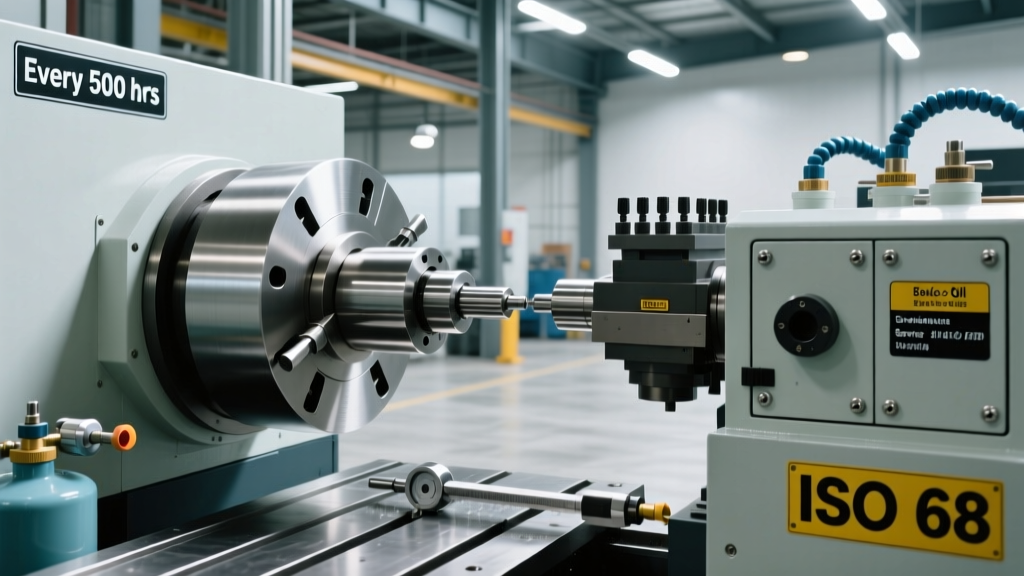
Critical Lubrication Warning: Never interchange way oil and spindle oil. Using ISO VG 68 way oil (like Mobil Vactra No. 2) in a high-speed spindle will cause immediate bearing seizure due to excessive viscosity. Conversely, using ISO VG 10 spindle oil on dovetail ways will result in metal-on-metal scoring within hours.The Dual-Track Maintenance Matrix
Hybrid mills require a bifurcated schedule that addresses both the manual mechanical linkages and the CNC electronic drivetrains. Below is the baseline service matrix for machines operating a standard 40-hour work week.
| Interval | Manual / Mechanical Tasks | CNC / Electronic Tasks |
|---|---|---|
| Daily | Clean manual handwheels and MPG pendants. Check way oil reservoir levels. Inspect way wipers for embedded chips. | Verify servo zero-return repeatability. Check enclosure door interlocks. Drain moisture from pneumatic air filters. |
| Weekly | Inspect manual gib lock screws for vibration loosening. Grease manual Z-axis counterbalance leadscrews. | Inspect servo motor coupling bellows. Clean electrical cabinet intake filters. Test E-stop circuit response times. |
| Monthly | Flush and refill way lube reservoir. Adjust X and Y axis gibs. Inspect manual quill feed gears for backlash. | Map ball screw backlash via controller. Check VFD cooling fan operation. Inspect limit switch and home sensor wiring. |
| Bi-Annual | Scrape or replace way wipers. Check manual spindle quill for taper runout. Re-tension manual drive belts. | Perform Renishaw ballbar circularity test. Re-grease ball screw support bearings. Update servo drive firmware. |
Manual Component Upkeep: Ways, Gibs, and Handwheels
The defining feature of a manual CNC milling machine is the retention of traditional cast-iron or steel dovetail ways and adjustable gibs. Unlike linear guide rails found on pure CNC VMCs, dovetail ways rely on a microscopic film of tacky lubricant to prevent stick-slip friction during low-speed manual handwheel operations and heavy CNC roughing cuts.
According to Mobil's industrial lubrication guidelines, way oils contain specific tackiness additives designed to cling to vertical surfaces and resist wash-off from flood coolant. For most hybrid bed mills, Mobil Vactra No. 2 (ISO VG 68) is the industry standard. You must verify that the one-shot manual or automated lube pump is delivering exactly 2-4cc of oil per cycle to each axis. If the manual handwheels feel 'notchy' or require high breakaway torque, the ways are starving, and the turcite or cast iron is galling.
Step-by-Step Gib Adjustment Protocol
Gib clearance directly dictates CNC contouring accuracy. If the X-axis gib is too loose, the CNC servo will oscillate (hunt) when changing direction, leaving visible dwell marks on machined surfaces. Follow this precise adjustment procedure:
- Prep the Axis: Clean the way surfaces thoroughly with a non-chlorinated brake cleaner. Ensure the way lube system has just cycled to provide a fresh oil film.
- Mount the Indicator: Secure a 0.0001" resolution dial test indicator on the machine table, with the stylus pressing against the ground edge of the saddle or table (perpendicular to axis travel).
- Apply Leverage: Insert a brass pry bar between the way and the gib. Apply exactly 15 lbs of lateral force.
- Measure Deflection: Note the indicator reading. Release the pry bar. The total deflection (play) must not exceed 0.0008" for high-precision CNC contouring, or 0.0015" for heavy manual roughing.
- Adjust and Lock: Loosen the gib lock nuts. Turn the adjustment screw clockwise in 1/8th turn increments until the deflection falls within the 0.0005" - 0.0008" target window. Tighten lock nuts and re-verify, as locking often shifts the gib by 0.0002".
CNC Drivetrain: Ball Screws, Servos, and Backlash
While the manual handwheels connect to the ball screws via timing belts or direct couplings, the CNC servos demand zero-backlash power transmission. The most common failure point on hybrid mills is the motor-to-ball-screw flexible coupling. Over time, the elastomer or bellows inside the coupling degrades, introducing 'wind-up' that the CNC controller interprets as following error.
To diagnose coupling wear without disassembly, command the machine to move 1.000" in the positive direction, then 1.000" in the negative direction, while monitoring a dial indicator on the table. If the indicator reads a discrepancy greater than 0.0003" between the commanded position and actual position—after accounting for mapped backlash—the coupling is slipping. Replacement of these precision bellows couplings (typically R+W or Schmidt brands) costs between $180 and $350 and should be done immediately to prevent servo drive faults.
Pro Tip for Backlash Mapping: Do not rely solely on the controller's software backlash compensation to fix mechanical wear. Software compensation only masks the issue and causes circular interpolation errors. Use a Renishaw QC20-W ballbar system to diagnose the exact mechanical root cause—whether it is ball screw end-play, thrust bearing wear, or nut preload loss—before adjusting software parameters.Electrical Cabinet and Thermal Management
Hybrid manual CNC machines often feature enclosed sheet-metal guards to contain coolant during CNC operations, which inadvertently traps heat around the manual handwheel bearings and the electrical cabinet. The servo drives and Variable Frequency Drives (VFDs) powering the spindle are highly sensitive to ambient temperature. For every 10°C (18°F) increase in cabinet temperature above 40°C, the lifespan of the drive's internal electrolytic capacitors is halved.
- Filter Replacement: Replace the NEMA 12 electrical cabinet intake filters every 90 days. In cast-iron machining environments, fine graphite dust can bypass torn filters and short-circuit servo drive logic boards.
- Thermostat Calibration: Verify the cabinet cooling fan thermostat engages at 35°C (95°F). If the machine is equipped with an active air conditioner (common on 2026 ProtoTRAK models), clean the condenser coils with compressed air monthly to maintain the 5,000 BTU/hr cooling capacity.
- Pendant Cable Routing: The manual MPG pendant cable is subjected to constant flexing. Inspect the strain relief at the cabinet entry point quarterly. Internal wire breakages cause erratic manual jog movements and can crash the machine.
'The biggest mistake operators make with retrofitted or hybrid manual CNCs is treating the enclosure like a pure CNC VMC. They blast coolant everywhere, ignoring that the manual quill feed and Z-axis handwheel seals are rarely rated for high-pressure flood coolant intrusion. Once coolant breaches the Z-axis manual gearbox, it emulsifies the grease and destroys the bronze worm gear within weeks.'
— Lead Service Technician, Southwestern Industries Retrofit Division
Coolant and Chip Management in Hybrid Enclosures
Because hybrid mills are often used for both quick manual one-offs and long CNC production runs, coolant management is frequently neglected. Manual operators tend to use manual air blow-offs, while CNC programs rely on flood coolant. This mixed usage accelerates tramp oil contamination.
Maintain the coolant pH strictly between 8.8 and 9.2. Below 8.5, bacterial growth accelerates, producing sulfur compounds that corrode the exposed cast-iron manual ways. Above 9.5, the alkalinity will degrade the polyurethane way wipers and the manual handwheel grips. Install an automated tramp oil skimmer in the coolant tank; the way oil that inevitably washes off the manual dovetails will float to the top and must be removed to prevent the coolant from turning rancid and losing its rust-inhibiting properties.
Cost of Neglect: Real-World Failure Pricing
Failing to adhere to the dual-track maintenance schedule results in compounding mechanical failures. The table below outlines the actual 2026 replacement costs and downtime penalties associated with ignoring specific maintenance intervals on standard hybrid bed mills (e.g., 3HP to 5HP class machines).
| Component Neglected | Resulting Failure Mode | 2026 Parts Cost | Labor / Downtime |
|---|---|---|---|
| Way Lube System / Wipers | Cast-iron way scoring and turcite delamination | $800 - $1,200 (Turcite/Scraping) | 40+ hours (Machine teardown) |
| Ball Screw Support Bearings | Thrust bearing collapse, severe Z-axis drop | $350 - $600 (Angular contact set) | 8 hours (Axis teardown) |
| Servo Motor Coupling | Following error faults, scrapped CNC parts | $180 - $350 (Bellows coupling) | 2 hours (Realignment required) |
| Electrical Cabinet Filters | VFD short circuit from conductive dust | $1,200 - $2,400 (Yaskawa/Delta VFD) | 4 hours (Programming/Install) |
| Manual Z-Axis Quill Seals | Coolant ingress, bronze worm gear seizure | $450 - $750 (Gearbox rebuild kit) | 6 hours (Head disassembly) |
Maintaining a manual CNC milling machine requires a disciplined respect for both its heritage as a manual tool and its reality as a precision robotic system. By strictly separating your way lubrication from your spindle lubrication, rigorously mapping your ball screw backlash, and protecting your electrical enclosures from the unique thermal and contaminant challenges of hybrid machining, you will secure sub-0.001" accuracy and decades of reliable service from your equipment.