CNC Turning Milling Machine Maintenance: Critical Service Schedules
Maximize uptime on multitasking centers. Explore exact service intervals, B-axis calibration steps, and fluid specs for CNC turning milling machines.
The Mechanical Complexity of Multitasking Maintenance
A standard 3-axis vertical machining center requires straightforward lubrication and way-cover maintenance. A CNC turning milling machine, however, represents a fundamental convergence of kinematics. Platforms like the Mazak Integrex i-200, DMG MORI NTX 1000, and Okuma Multus U3000 integrate 5-axis milling capabilities with twin-spindle turning, lower turrets, and complex B-axis contouring heads. This mechanical density creates unique maintenance liabilities. When the milling spindle intersects with the turning C-axis, micro-vibrations and thermal growth compound rapidly. Neglecting the specific service schedules of these hybrid machines does not just degrade surface finishes; it accelerates catastrophic failure in harmonic drives and rotary encoders.
The Economics of Mill-Turn Downtime
- Average Replacement Cost (B-Axis Encoder): $4,500 – $8,500
- Spindle Rebuild (12,000 RPM Mill-Turn Head): $18,000 – $35,000
- Unplanned Downtime Cost: $1,200 – $2,500 per hour (based on 2026 aerospace/medical job shop rates)
- Mean Time to Repair (MTTR) for C-Axis Brake Failure: 14 – 28 days (if parts are not stocked locally)
Daily and Shift-Level Operator Interventions
Preventive maintenance on a CNC turning milling machine begins at the operator console. Because these machines frequently alternate between heavy interrupted turning cuts and high-speed finishing passes, thermal shock and chip accumulation are constant threats.
- Spindle Warm-Up Protocol: Never initiate a 5-axis milling operation on a cold B-axis head. Run the OEM-specified thermal stabilization program (typically 15–20 minutes) to normalize the spindle bearing grease and expand the housing to its operating tolerance.
- Way Cover Wiping: The Z-axis way covers on the lower turret and main spindle are highly susceptible to stringy titanium or Inconel chips. Operators must manually clear chip dams with a brass scraper—never compressed air, which forces fines into the wiper seals.
- Coolant Concentration Check: Mill-turn machines require higher coolant lubricity due to the sliding friction of the turning tool combined with the high-heat milling passes. Maintain a 9% to 11% concentration of semi-synthetic fluid (e.g., Castrol Hysol MB50) using a digital refractometer, not a manual analog one.
- Hydraulic Pressure Verification: Check the main clamping pressure gauge. Standard operating pressure for the main spindle chuck and B-axis clamping brake should sit precisely between 35 and 40 bar. Drops below 32 bar indicate accumulator bladder failure or internal seal degradation.
B-Axis and C-Axis Servo Calibration: The Mill-Turn Differentiator
The defining feature of any CNC turning milling machine is the B-axis milling head and the C-axis spindle positioning. Unlike standard rotary tables, the B-axis on a multitasking center utilizes a zero-backlash clamping mechanism, often relying on a Hirth coupling or a high-pressure hydraulic brake disc.
Harmonic Drive and Backlash Compensation
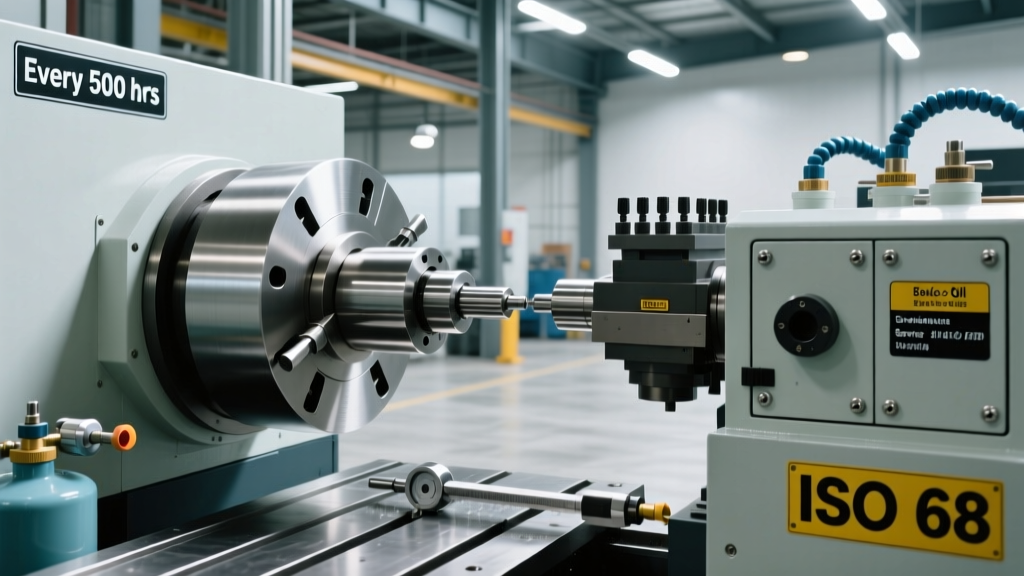
Every 500 operating hours, maintenance technicians must audit the B-axis backlash. Over time, the continuous interpolation of 5-axis simultaneous milling wears the harmonic drive gears. Using a Renishaw QC20-W wireless ballbar system, test the B-axis circular interpolation. If the backlash exceeds 4 arc-seconds, the servo parameters must be adjusted.
On machines equipped with Heidenhain controls, technicians must update the Electronic Rod Compensation (ERC) tables. This involves running a laser interferometer across the B-axis travel and inputting the new deviation map into the CNC control. Strict adherence to OSHA's Lockout/Tagout guidelines is non-negotiable when physically accessing the B-axis brake assembly to check the friction disc thickness, which must be replaced if it measures below 2.5mm.
Fluid, Filtration, and Lubrication Matrix
The fluid systems in a mill-turn center are highly segregated. Mixing way lube with spindle cooling oil is a common, fatal maintenance error. Below is the critical service matrix for a standard 20,000 RPM multitasking platform.
| Interval | System | Fluid Specification | Capacity / Action | Estimated Cost |
|---|---|---|---|---|
| Weekly | Way Lube (X, Y, Z, B) | ISO VG 68 (e.g., Mobil Vactra Oil No. 2) | Top off reservoir; check lube line pressure (12-15 bar) | $45 |
| 500 Hours | Spindle Chiller Unit | ISO VG 10 (e.g., Mobil Velocite Oil No. 6) | Replace 10-micron inline filter; check glycol mix ratio | $120 |
| 1,000 Hours | Hydraulic Power Unit | ISO VG 32 Anti-Wear Hydraulic Oil | Replace 25-micron return filter; sample fluid for particle count | $250 |
| 2,000 Hours | Gearbox (Lower Turret) | Synthetic Gear Oil (e.g., Mobilgear 600 XP 220) | Complete drain, flush, and refill (approx. 12 Liters) | $380 |
| Annual | Main Coolant Tank | Semi-Synthetic Metalworking Fluid | Full tank dump, bio-clean, and refill (approx. 800 Liters) | $2,800 |
Spindle Clamping and Drawbar Mechanics
In a CNC turning milling machine, the milling spindle must securely hold CAT40 or HSK-A63 tooling while enduring the lateral forces of heavy turning operations if the machine utilizes a turning tool mounted in the milling spindle. The drawbar mechanism relies on a stack of Belleville spring washers to generate up to 12,000 N of clamping force.
Warning: The HSK Taper Contamination Risk
If your mill-turn center utilizes an HSK-A63 interface, the dual-contact face-and-taper design is highly sensitive to micro-debris. A single 15-micron chip trapped between the toolholder flange and the spindle face will cause a 30-micron radial runout at the tool tip. Operators must use a dedicated HSK spindle cleaner tool with isopropyl alcohol before every automated tool change involving the B-axis magazine.
Every 1,000 hours, maintenance staff must use a drawbar force gauge to verify the clamping pressure. If the force drops below 10,500 N, the Belleville washers have fatigued and must be replaced. Continuing to run high-speed milling operations with degraded drawbar force will result in the toolholder pulling out of the taper, destroying the spindle nose and the workpiece.
Chip Conveyor and Way Cover Preservation
Standard VMCs produce small, brittle chips that easily fall into the conveyor. A CNC turning milling machine produces a hybrid chip profile: long, stringy, work-hardened ribbons from the turning operations, and fine, abrasive dust from the milling operations. This combination is notorious for binding hinge-belt chip conveyors.
To mitigate this, install a high-pressure coolant pump (minimum 70 bar) directed at the parting line during turning operations to break the chips. Furthermore, inspect the telescopic way covers every 500 hours. The polyurethane wiper lips on the way covers degrade rapidly when exposed to the extreme heat of dry or near-dry turning. Replace wiper lips showing any signs of curling or cracking to prevent abrasive fines from infiltrating the linear guideway blocks, which will prematurely destroy the recirculating ball bearings.
Annual OEM Calibration vs. Third-Party Servicing
When scheduling the annual 2,000-hour comprehensive service, shops must decide between OEM technicians and independent specialists. OEM networks, such as DMG MORI's global service division, provide proprietary servo-tuning software and access to original geometric compensation maps that third-party technicians often cannot legally or technically access. However, OEM rates in 2026 average $425 to $550 per hour, plus travel.
For catastrophic spindle failures or severe crash damage, facilities often turn to specialists like SKF Spindle Services or regional precision rebuilders. These experts can restore spindle runout to sub-2-micron tolerances for roughly 40% less than an OEM spindle replacement. The optimal strategy for high-utilization job shops is to contract OEM technicians for the annual geometric and volumetric error mapping (using laser trackers), while utilizing certified third-party integrators for routine fluid, filter, and mechanical wear-item replacements.
Implementing Predictive Vibration Monitoring
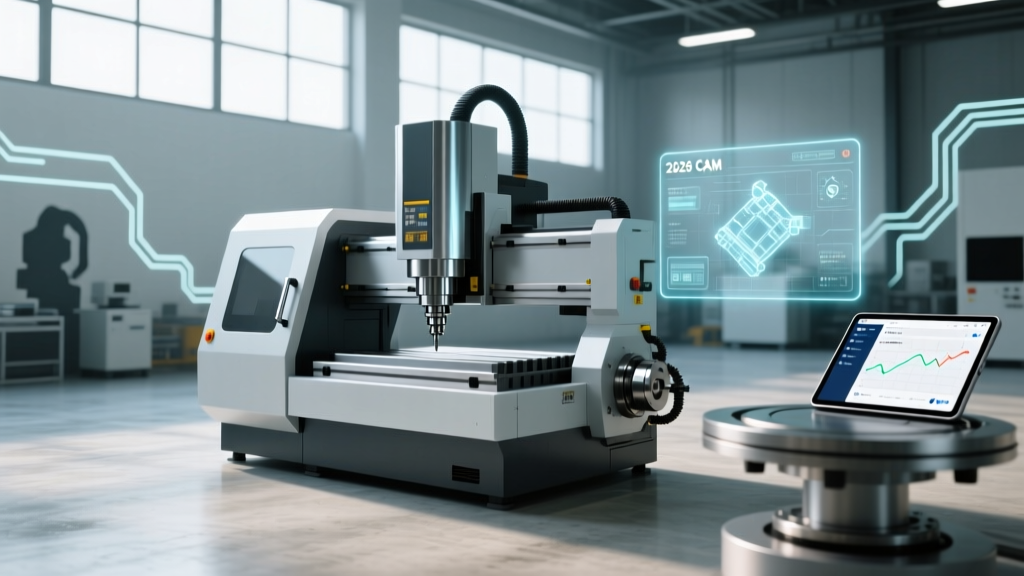
Relying strictly on time-based maintenance intervals leaves a CNC turning milling machine vulnerable to sudden bearing failures. The modern standard for 2026 and beyond is the integration of triaxial vibration sensors directly onto the B-axis head and main spindle housing. By establishing a baseline vibration signature during a balanced 5-axis finishing pass, the control system can detect the specific high-frequency harmonics that indicate early-stage spindle bearing spalling. Acting on these predictive alerts allows maintenance teams to schedule a spindle teardown during a planned holiday shutdown, entirely eliminating the $2,500-per-hour penalty of mid-production catastrophic failure.