Choosing the Right CNC Milling Machine Course for 2026 Automation Trends
Find the ideal CNC milling machine course for 2026. Compare AI CAM, digital twin, and 5-axis automation training with pricing and curriculum breakdowns.
The landscape of subtractive manufacturing has fundamentally shifted. As of 2026, the modern shop floor relies less on manual G-code memorization and more on AI-driven toolpath optimization, digital twin verification, and IoT machine monitoring. Consequently, selecting the right cnc milling machine course requires filtering out legacy curricula that ignore these automation trends. Machinists and manufacturing engineers who upskill in Industry 4.0 protocols command a documented wage premium, while shops that invest in advanced training reduce setup scrap by up to 90%.
📊 2026 Workforce Data Highlight:According to workforce analyses by the Society of Manufacturing Engineers (SME), CNC operators certified in digital twin simulation and MTConnect data parsing earn an average of 22% to 34% more than their peers limited to traditional 3-axis manual programming.
The Three Pillars of a Modern CNC Milling Curriculum
If a training syllabus does not address the following three technological pillars, it is already obsolete. When evaluating a program, ensure the coursework dedicates significant hours to these specific competencies:
1. AI-Assisted Toolpath Generation
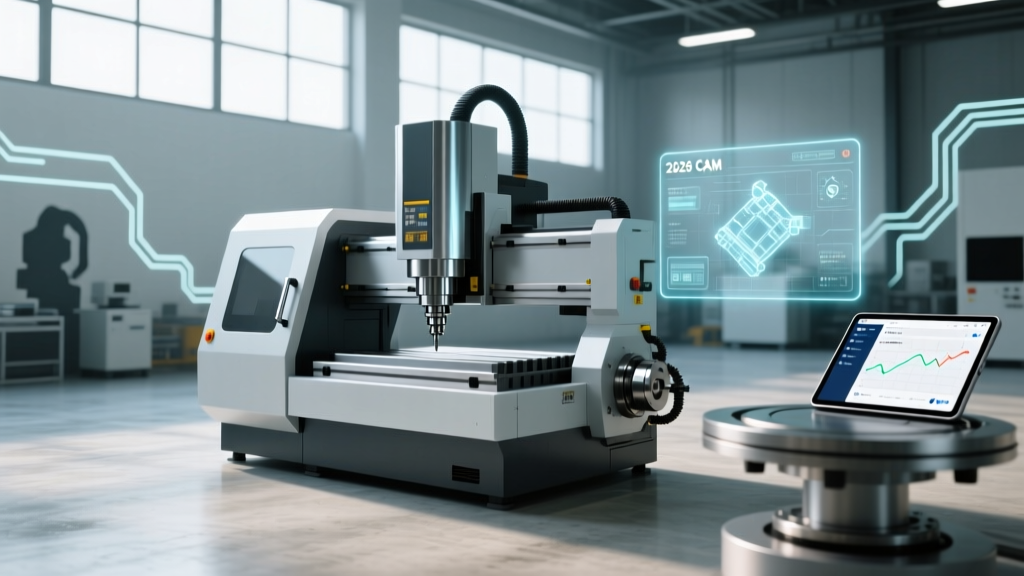
Modern CAM software no longer requires the programmer to manually calculate stepovers and lead-in angles for every pocket. Courses must cover AI-driven modules like Mastercam’s Dynamic Motion technology or Fusion 360’s cloud-based machining strategies. These algorithms analyze cutter engagement in real-time, adjusting feed rates to maintain constant chip thickness. A high-quality course will teach you how to manipulate the boundary conditions and stock models to allow the AI to generate toolpaths that extend carbide endmill life by 40% while reducing cycle times.
2. Digital Twin Verification
Crashing an $85,000 trunnion table on a 5-axis machining center is a catastrophic failure mode that modern shops mitigate via digital twins. Training must include hands-on time with verification software like Vericut or Siemens NX CAM. You will learn to map the exact kinematics of your specific machine—down to the limit switches and spindle nose dimensions—creating a virtual environment where 5-axis simultaneous moves are validated before a single line of NC code hits the shop floor.
3. IoT Telemetry and MTConnect Integration
The MTConnect Institute standard has become the universal language for CNC machine monitoring. Advanced courses now teach operators how to extract real-time spindle load data, axis servo lag, and thermal growth metrics directly from Fanuc 31i-B5 and Haas NGC controllers. Understanding how to read this telemetry allows machinists to predict bearing failures or thermal drift before they compromise tight-tolerance aerospace parts.
Course Selection Matrix: Match Your Shop's Tech Stack
Not every facility requires the same training. Use this decision matrix to align your educational investment with your shop’s actual equipment and software ecosystem.
| Provider Type | Core Tech Focus | Best Suited For | Avg. Cost (2026) |
|---|---|---|---|
| OEM-Specific (e.g., Haas Automation University, Mazak) | Controller-specific macros, conversational programming, proprietary 5-axis cycles. | Shops running a single brand of mills; operators needing deep macro-B or NGC skills. | $1,200 - $1,800 (3-5 days) |
| Agnostic / Industry Orgs (e.g., Tooling U-SME, NIST MEP partners) | Smart manufacturing, MTConnect, OPC UA, lean automation, robotic tending. | Manufacturing engineers, shop floor managers, mixed-fleet facilities. | $350 - $600 / seat (Subscription) |
| Advanced University Certs (e.g., Community College Industry 4.0 Grants) | Metallurgy, 5-axis kinematics, CAD/CAM integration, digital twin simulation. | Career transitioners, aerospace/medical job shops requiring AS9100 compliance. | $3,500 - $5,500 (12-16 weeks) |
Evaluating the Syllabus: Red Flags vs. Green Lights
Before authorizing a $4,000 training budget or committing your own time, scrutinize the course syllabus. The ratio of legacy instruction to modern application will dictate your return on investment.
⚠️ Warning: The G-Code TrapAvoid any cnc milling machine course that dedicates more than 20% of its curriculum to manual G-code and M-code memorization. While understanding G00, G01, G02, and G41/G42 cutter comp is foundational, modern 5-axis simultaneous toolpaths are mathematically impossible to program by hand. If a course spends three weeks on manual polar coordinate programming but ignores CAM post-processor editing, walk away.
Green Lights: What to Demand in 2026
- Post-Processor Customization: Learning how to edit and verify the post-processor that translates CAM data into machine-specific NC code. A generic post will crash a 5-axis machine; a custom post ensures safe rotary axis movements.
- Probe Cycle Integration: Hands-on training with Renishaw or Blum touch probes. The course should cover automated workpiece setup, in-cycle tool breakage detection, and closed-loop thermal compensation.
- High-Speed Machining (HSM) Physics: Moving beyond simple feed/speed charts to understand chip thinning, radial immersion angles, and harmonic vibration dampening when machining difficult alloys like Inconel 718 or Titanium Ti-6Al-4V.
Deep Dive: Top-Tier Training Pathways
The OEM Route: Haas Automation University (HUC)
For facilities heavily invested in Haas equipment, the HUC program remains the gold standard for controller mastery. Their advanced 5-axis and multi-axis courses focus heavily on the NGC (Next Generation Control) interface. Operators learn to utilize the built-in visual programming system, dynamic work offsets, and high-speed contouring parameters unique to Haas servo tuning. The physical access to $150,000 UMC-750 machines during training eliminates the "trial and error" risk on your production floor.
The Smart Factory Route: NIST MEP Network
If your goal is to integrate CNC milling into a fully automated, lights-out manufacturing cell, look to the NIST Manufacturing Extension Partnership (MEP) network. MEP centers frequently partner with local technical colleges to offer grant-subsidized training focused on the intersection of CNC milling and robotics. These courses teach you how to map machine tool APIs to robotic arm controllers, enabling automated part loading, blow-off, and deburring without human intervention.
"The machinist of 2026 is essentially a manufacturing data analyst. The machine does the cutting; the human optimizes the telemetry, verifies the digital twin, and manages the automation cell. Training must reflect this reality."
— Dr. Elena Rostova, Director of Advanced Manufacturing Research
Justifying the ROI to Management
Securing budget approval for advanced training requires speaking the language of shop floor economics. When pitching a specialized cnc milling machine course to ownership, frame the investment around these measurable KPIs:
- Scrap Reduction via Digital Twins: A single crashed spindle on a 5-axis mill can cost $35,000 in repairs and two weeks of downtime. Digital twin training pays for itself the first time it catches a rapid traverse collision in simulation.
- Spindle Uptime via IoT Monitoring: By training operators to read MTConnect spindle load data, shops can implement predictive maintenance. Replacing a spindle bearing during a planned weekend shutdown based on vibration telemetry prevents catastrophic mid-cycle failures on high-value aerospace forgings.
- Cycle Time Compression: Mastery of AI-driven CAM toolpaths routinely yields 15% to 25% reductions in roughing cycle times. On a $150/hour shop rate, recovering 10 hours a week across a fleet of VMCs generates over $75,000 in reclaimed capacity annually.
Ultimately, the right training program bridges the gap between owning advanced CNC hardware and actually extracting its full profitability. Prioritize curricula that treat the milling machine not as an isolated island of metal removal, but as a highly connected, data-generating node in a modern smart factory.