2026 CNC Gantry Milling Machine Innovations: AI & Linear Drives
Explore 2026 CNC gantry milling machine innovations. Discover how AI thermal compensation, linear motors, and IoT are transforming large-part machining.
The architectural foundation of the CNC gantry milling machine has undergone a radical transformation by 2026. For decades, large-format machining in aerospace, wind energy, and heavy die-mold sectors relied on pre-tensioned ball screws and worm-gear rotary axes. While sufficient for roughing, these mechanical linkages inherently limit rapid traverse rates, introduce backlash, and suffer from thermal stretching over travels exceeding 4 meters. Today, the integration of linear synchronous motors (LSM), edge-computing AI thermal models, and direct-drive torque motors has redefined what is physically possible in monolithic part manufacturing.
2026 Industry Shift: Over 65% of new 5-axis CNC gantry milling machine installations in the aerospace sector now specify linear motor drives for the X and Y axes, abandoning ball screws entirely to achieve the dynamic stiffness required for high-speed trochoidal milling of titanium and 7050-series aluminum.The Demise of the Ball Screw in Large-Format Machining
Traditional ball screw drives on a 6-meter X-axis gantry beam face severe physical limitations. The critical speed of the screw restricts rapid traverses, and the nut-to-screw interface generates friction-induced heat, causing the screw to elongate. Even with hollow-core, coolant-flushed ball screws, Z-axis positioning errors of 0.08mm to 0.12mm are common during heavy roughing cycles.
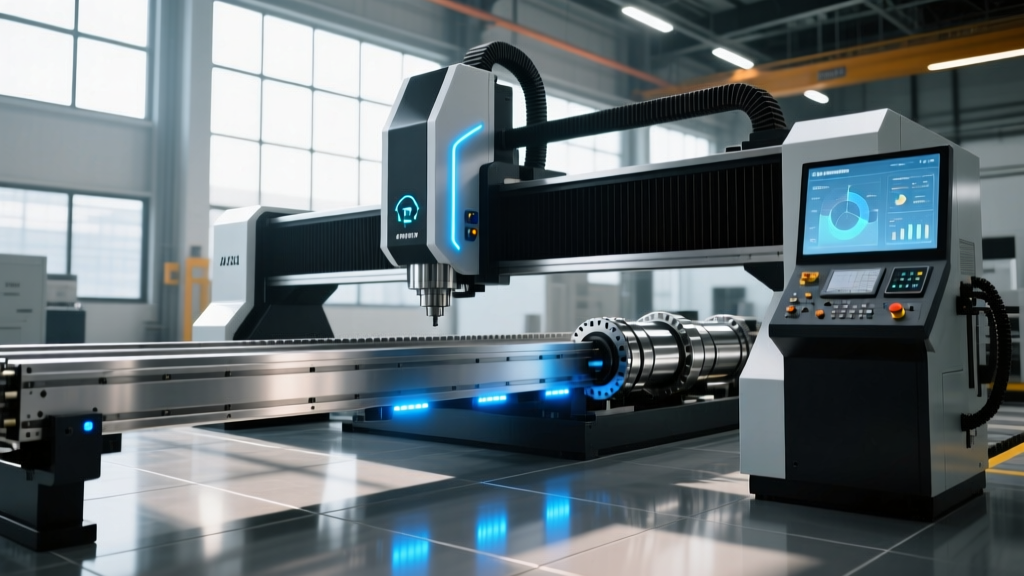
The 2026 standard for high-performance gantries utilizes Linear Synchronous Motors (LSM). By eliminating the mechanical transmission, LSMs provide direct electromagnetic force to the gantry carriage. This yields exponential improvements in both acceleration and contouring accuracy, particularly critical when machining complex aerodynamic surfaces on wing spars or wind turbine blade molds.
| Specification | Pre-Tensioned Ball Screw (Legacy) | Linear Synchronous Motor (2026 Standard) |
|---|---|---|
| Max Rapid Traverse (X/Y) | 25 - 35 m/min | 80 - 120 m/min |
| Max Acceleration | 0.3G - 0.5G | 1.0G - 1.5G |
| Backlash / Mechanical Play | 0.01mm - 0.03mm | Zero (Closed-loop glass scale) |
| Thermal Growth (6m travel) | Up to 0.15mm | Negligible (Non-contact) |
| Maintenance Interval | 2,000 hours (lubrication/nut replacement) | 20,000+ hours (bearing ways only) |
AI-Driven Volumetric and Thermal Compensation
A 4-meter tall steel gantry column will expand vertically by approximately 0.045mm for every 5°C rise in ambient shop temperature. In 2026, relying solely on air-conditioned facilities is no longer considered a viable or cost-effective tolerance strategy. Instead, modern CNC gantry milling machine controls utilize Edge-AI volumetric compensation.
Advanced platforms, such as the Siemens Sinumerik ONE, now integrate digital twin technology directly into the CNC kernel. Machine builders embed up to 24 PT100 thermal sensors throughout the cast iron and welded steel structures of the gantry. The AI model continuously maps the thermal gradient in real-time, predicting Z-axis droop and cross-rail (W-axis) sag before it manifests in the cut.
Real-World Compensation Metrics
- Spatial Error Reduction: AI thermal mapping reduces volumetric spatial errors from 0.12mm down to ≤0.02mm across a 5m x 3m x 1m working envelope.
- Warm-Up Cycle Elimination: Traditional gantries require 45-90 minute warm-up cycles to stabilize thermal growth. AI-compensated machines can begin tight-tolerance finishing passes immediately from a cold start, increasing spindle utilization by up to 14% annually.
Direct-Drive Torque Motors in 5-Axis Gantry Heads
The milling head is the most critical interface on a CNC gantry milling machine. Legacy 5-axis heads utilized worm-and-wheel gearboxes for the A (tilt) and C (rotation) axes. While capable of high clamping forces, gearboxes introduce torsional backlash and require frequent pre-load adjustments.
The 2026 innovation standard is the direct-drive torque motor head, championed by specialized manufacturers like Kessler and CyTec. These heads utilize large-diameter, permanent-magnet synchronous torque motors that eliminate all intermediate mechanical transmission.
"When roughing deep pockets in Ti-6Al-4V titanium forgings, the torsional stiffness of a direct-drive A-axis is non-negotiable. We are seeing continuous torque ratings exceeding 2,500 Nm on modern gantry heads, allowing aggressive 5-axis simultaneous milling without the axis 'chattering' or slipping that plagued older worm-gear designs." — Lead Manufacturing Engineer, Tier 1 Aerospace Structural Components.
Furthermore, modern controls like the Heidenhain TNC7 feature advanced dynamic collision monitoring that uses real-time torque feedback from these direct-drive motors to detect crashes within milliseconds, halting the machine before catastrophic damage occurs to the spindle or the multi-million-dollar gantry structure.
Aerospace MRR: Spindle Tech and IoT Predictive Maintenance
Material Removal Rates (MRR) in aerospace monolithic rib machining dictate profitability. To achieve MRRs exceeding 4,000 cm³/min in 7050-T7451 aluminum, 2026 gantry systems utilize HSK-100A or HSK-125 taper interfaces paired with high-frequency motor spindles capable of 24,000 to 30,000 RPM.
However, running at these speeds generates immense centrifugal forces and heat. A replacement HSK-125 high-speed spindle cartridge costs between $45,000 and $85,000, making unplanned downtime financially devastating. This has driven the mandatory integration of IoT Acoustic Emission (AE) and triaxial vibration sensors directly into the spindle housing.
The IoT Predictive Framework
- Baseline Mapping: During commissioning, the IoT suite records the specific vibration signature (frequency and amplitude) of the new spindle bearings across the entire RPM range.
- Edge Processing: Raw sensor data is processed locally at the machine cabinet to avoid network latency. The system filters out ambient shop noise and cutting harmonics.
- Degradation Alerting: By tracking the emergence of specific Ball Pass Frequencies (BPFO/BPFI), the system can detect microscopic spalling in the ceramic hybrid bearings up to 300 spindle-hours before catastrophic seizure, allowing maintenance to be scheduled during planned weekend shutdowns.
2026 CapEx Framework: Upgrading vs. Retrofitting
For shop managers evaluating capital expenditure, the decision to purchase a new CNC gantry milling machine versus retrofitting an existing mechanical gantry is heavily influenced by the part geometry and tolerance requirements.
Decision Matrix for Gantry Investment:- Choose Full OEM Replacement ($1.2M - $2.8M): If your parts require 5-axis simultaneous contouring, surface finishes below 1.6 Ra, and volumetric tolerances tighter than ±0.03mm over 4 meters. The cost of linear motors and AI controls cannot be retrofitted economically.
- Choose CNC/Drive Retrofit ($350k - $600k): If your gantry is primarily used for 3-axis roughing of steel dies or aluminum plate profiling where rapid traverse speeds above 30 m/min are unnecessary. Upgrading to a modern Sinumerik or Fanuc control with new servo drives and glass scales will restore baseline accuracy without the massive CapEx of a linear motor conversion.
The modern CNC gantry milling machine is no longer just a massive structural frame with a spindle attached; it is a highly networked, thermally aware, and electromagnetically driven manufacturing cell. Shops that align their capital investments with these linear and AI-driven technologies will secure a definitive advantage in cycle times and first-part correctness in the increasingly competitive large-part machining market.