CNC Vertical Milling Machine Costs: 2026 Buyer Budget Guide
Plan your 2026 shop budget with our complete cost analysis for a CNC vertical milling machine. Covers CapEx, OpEx, tooling, and ROI frameworks.
Purchasing a vertical milling machine CNC system involves a capital layout that extends far beyond the manufacturer’s base invoice. While the sticker price of the casting, spindle, and control dictates the initial financing, the true Total Cost of Ownership (TCO) encompasses facility preparation, workholding, cutting tooling, software, and ongoing maintenance. For job shops and production facilities planning capital expenditures in 2026, underestimating these peripheral costs is the primary cause of delayed ROI and cash flow bottlenecks.
The Sticker Price vs. Reality: Capital Expenditure (CapEx) Breakdown
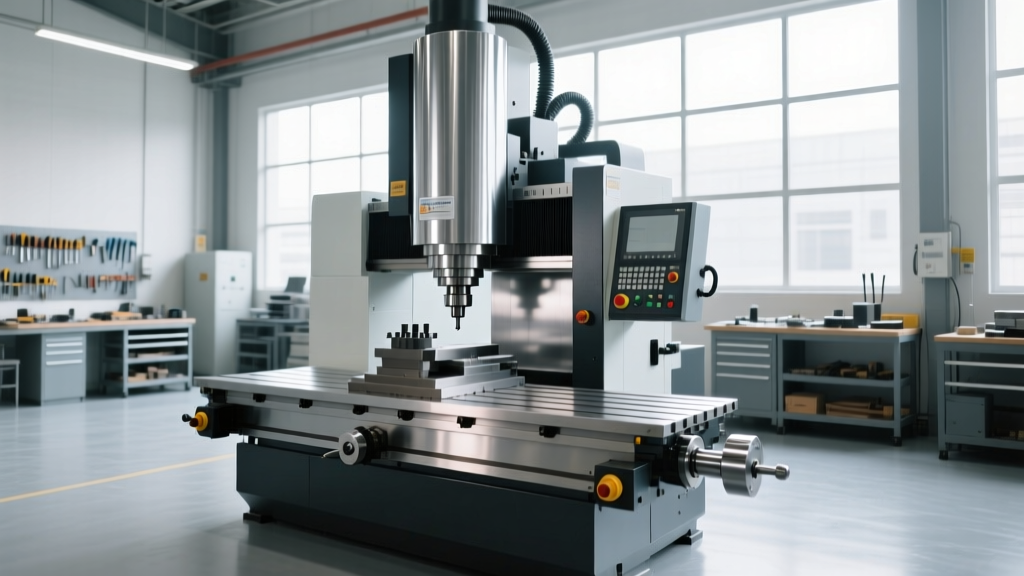
The base price of a VMC (Vertical Machining Center) varies wildly based on table size, spindle taper, rapid traverse rates, and control architecture. Below is a realistic 2026 CapEx matrix for standard 3-axis and 5-axis vertical mills, excluding freight and taxes.
| Machine Tier | Representative Models | Table Size | Spindle Taper | 2026 Base Price Range |
|---|---|---|---|---|
| Entry-Level / Prototype | Tormach 15L, Haas Mini Mill 2 | 16' x 10' to 20' x 16' | BT30 / CAT40 | $15,000 - $65,000 |
| Mid-Tier Production | Haas VF-2, Doosan DNM 5700 | 36' x 14' to 51' x 22' | CAT40 / BT40 | $75,000 - $135,000 |
| High-Speed / Aerospace | Fanuc RoboDrill, Brother Speedio | 25' x 15' to 30' x 17' | BT30 (High RPM) | $110,000 - $160,000 |
| 5-Axis Simultaneous | Mazak VARIAXIS i-600, DMG MORI | 24' x 20' to 40' x 30' | CAT40 / HSK-A63 | $240,000 - $450,000+ |
For the vast majority of general machining job shops, the Haas VF-2 or its direct equivalents remain the baseline workhorse. However, a $85,000 base price for a VF-2 quickly escalates to $105,000 once you add mandatory options like a high-pressure coolant pump ($4,500), a side-mount tool changer upgrade for 36+ tools ($3,200), and through-spindle coolant (TSC) preparation.
Hidden Operational Costs (OpEx) in the First 12 Months
Once the machine is on the floor, the secondary budget requirements begin. Failing to allocate funds for these categories will result in a machine that sits idle while you wait for components to ship.
1. Facility & Infrastructure Prep
- Electrical Drop Lines: Most production VMCs require 208V or 480V 3-phase power. Running a new drop line from your main panel, including a fused disconnect box, typically costs $2,500 to $5,500 depending on the distance. If your shop only has single-phase power, budget $1,800 to $3,000 for a 20HP rotary phase converter.
- Compressed Air & Dryers: CNC vertical mills rely on pneumatics for the tool changer arm and spindle air blast. You need a minimum of 100 PSI at 5 CFM. More critically, you must install a refrigerated or desiccant air dryer ($800 to $1,500). Pumping moist shop air into the machine's pneumatic valves will cause catastrophic tool-changer failures and internal corrosion.
- Rigging and Leveling: Moving a 9,000 lb machine requires a specialized machinery mover. Budget $1,500 to $3,500 for local rigging, fork-rentals, and precision leveling using a master machinist level.
2. Tooling and Workholding Starter Kits
A bare spindle cannot cut metal. Equipping a new CAT40 vertical mill requires a significant upfront tooling investment.
Standard VMC Tooling Budget (CAT40):• 20x Toolholders (End mill, collet, face mill): $1,400 - $2,200
• Retention Knobs (Pull Studs): $150 (Critical: must match exact OEM spec to prevent tool ejection)
• 2x 6-inch Precision Vises (e.g., Kurt DX6 or Glacern): $2,200 - $3,000
• Edge Finder, Dial Indicators, Parallels, 1-2-3 Blocks: $450
• Initial Cutting Tool Inventory (Carbide end mills, drills, taps): $2,500 - $5,000
Total Minimum Tooling CapEx: $6,700 - $10,800
When selecting cutting tools, prioritize indexable milling cutters for roughing to manage costs, reserving solid carbide end mills for finishing passes. Refer to the Sandvik Coromant milling cutter catalog for industry-standard insert geometries that maximize tool life in specific materials like 304 stainless or 6061-T6 aluminum.
Software and Post-Processor Licensing
The CNC control requires G-code, which must be generated by CAM (Computer-Aided Manufacturing) software. Your budget must account for both the seat license and the post-processor.
- Autodesk Fusion 360: Approximately $420/year per seat. Excellent for 3-axis work and 2.5D features, but requires a robust internet connection and can struggle with complex 5-axis simultaneous toolpaths.
- Mastercam Mill: Base license is roughly $4,500 to $7,500, plus an annual Software Maintenance Agreement (SMA) of $1,200 to $1,800. The industry standard for complex mold work and 5-axis machining.
- Custom Post-Processors: If your specific machine configuration (e.g., a Haas with a specific rotary table) requires a custom post-processor, budget $500 to $1,500 to have a reseller generate and verify the G-code translation file.
Calculating ROI: Spindle Hours vs. Breakeven
To justify the capital outlay, you must calculate your shop's specific machine hourly rate and breakeven point. The formula for the minimum billable machine rate is:
Machine Rate = (Total Annual Machine Cost + Allocated Overhead) / Available Billable Hours
Real-World Scenario:
Assume a $110,000 total investment (Machine + Tooling + Rigging). You finance it over 5 years at 8% interest, resulting in an annual payment of roughly $27,500. Add $12,000 for annual floor space, electricity, and insurance. Total annual machine cost = $39,500.
If the machine runs 6 billable hours a day, 250 days a year, you have 1,500 available hours.
$39,500 / 1,500 hours = $26.33 per hour.
This is your absolute floor. If your shop rate is $95/hour, the machine generates $68.67 in gross margin per hour. At 6 hours a day, the machine pays for its annual debt and overhead in just 96 working days.
Buying a 12-year-old VMC for $35,000 seems like a budget win until you inspect the way covers and ball screws. If the previous owner ran abrasive materials (like cast iron or fiberglass) without proper maintenance, budget immediately for:
- Way Cover Replacement: $1,200 - $2,500 per axis
- Ball Screw & Bearing Replacement: $4,000 - $7,000 per axis
- Spindle Rebuild (if bearing runout exceeds 0.0002'): $5,000 - $9,000
Financing and Tax Strategies for 2026
How you acquire the machine impacts your immediate cash flow. In the United States, the IRS Section 179 tax deduction allows businesses to deduct the full purchase price of qualifying equipment (including CNC machinery) from their gross income in the year it is placed into service. For 2026, the maximum deduction limit is projected to remain above $1.2 million, making it highly advantageous for small to mid-sized shops to purchase rather than lease, provided they have the tax liability to offset.
If preserving working capital is more critical than tax shielding, operating leases with a $1 buyout option are common. In 2026, expect lease factor rates to hover between 1.6% and 2.2% per month depending on your business credit profile. A $100,000 package might require $1,800 to $2,200 per month. Ensure your projected monthly spindle revenue exceeds the lease payment by at least a 3:1 ratio to account for material costs, operator wages, and tooling wear.
Final Budgeting Checklist
Before signing a purchase order, verify that your budget spreadsheet includes line items for: freight/rigging, 3-phase electrical drops, air drying systems, workholding vises, retention knobs, CAM software licensing, and a 10% contingency fund for immediate tooling replacements. Precision budgeting ensures your new vertical milling machine CNC asset begins generating positive cash flow from the moment the first chip is cut.