2026 Case Studies: ROI of Advanced CNC Milling Machine Tools
Explore 2026 case studies on CNC milling machine tools in aerospace and medical sectors. Analyze ROI, cycle times, and 5-axis integration strategies.
The 2026 Landscape for High-Performance CNC Milling Machine Tools
Capital expenditure justification for CNC milling machine tools has shifted dramatically. In 2026, shops are no longer evaluating 5-axis machining centers solely on spindle speed or rapid traverse rates. The true differentiator is thermal stability, automated tool-center-point control (TCP), and integration with closed-loop adaptive machining software. When machining unforgiving materials like Ti-6Al-4V or Cobalt-Chrome, the margin for error is measured in microns, and scrap costs can obliterate quarterly margins.
Market Insight: According to recent manufacturing technology shipments data, 5-axis CNC milling machine tools now account for over 38% of new aerospace tier-2 and tier-3 supplier installations, driven by the need to complete complex monolithic structural components in a single setup.This analysis breaks down two real-world applications where upgrading to advanced CNC milling machine tools yielded measurable, bottom-line results, moving beyond brochure specifications to actual shop-floor metrics.
Aerospace Application: 5-Axis Titanium Structural Milling
Titanium structural components, such as landing gear actuator housings and engine pylon fittings, require aggressive material removal rates (MRR) while maintaining strict metallurgical integrity. Traditional 3-axis VMCs require multiple fixtures, introducing cumulative stacking tolerances and excessive setup times.
Case Study: Actuator Housing Transition
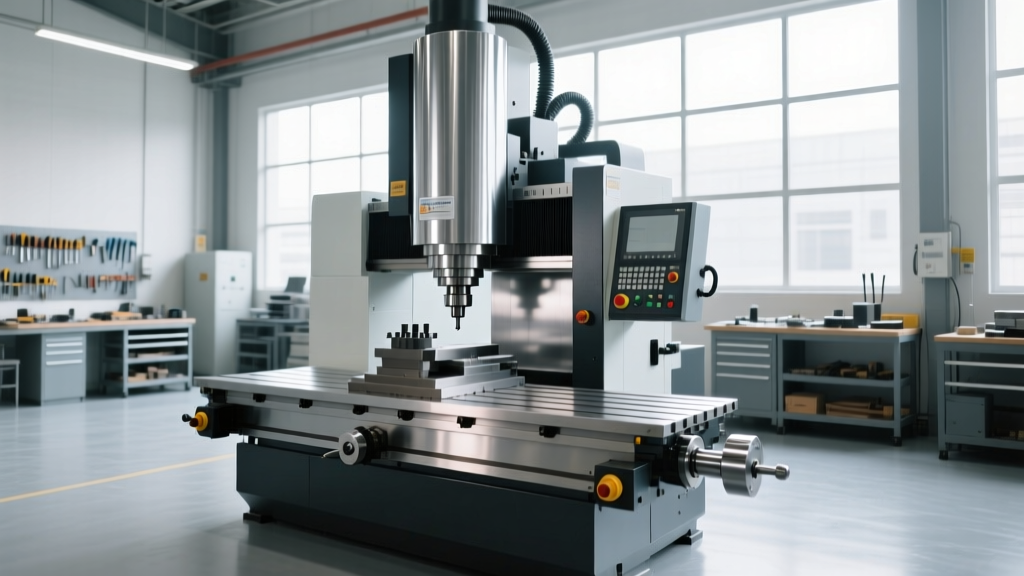
A Pacific Northwest tier-2 aerospace supplier transitioned from a fleet of aging 3-axis vertical machining centers to a pair of DMG MORI DMU 50 3rd Generation 5-axis CNC milling machine tools. The target part was a 14-inch Ti-6Al-4V actuator housing starting from a 180-lb forging, requiring 78% material removal.
| Metric | Legacy 3-Axis VMC | DMU 50 3rd Gen (5-Axis) | Delta |
|---|---|---|---|
| Total Cycle Time | 6.5 Hours (incl. 3 setups) | 2.1 Hours (Single setup) | - 67.6% |
| Spindle Load (Roughing) | 85% (Constant) | 65% (Adaptive Toolpaths) | - 20% |
| Tool Life (CoroMill 390) | 14 Parts per Insert Edge | 32 Parts per Insert Edge | + 128% |
| Cost Per Part | $1,140 | $615 | - $525 |
The integration of high-pressure through-spindle coolant (TSC) at 1,000 PSI was critical. By utilizing Sandvik Coromant milling strategies paired with the machine's rigid HSK-A63 taper, the shop achieved a radial depth of cut (RDOC) of 0.250 inches and a feed rate of 0.004 inches per tooth (IPT) during roughing, effectively clearing chips from the deep cavities without re-cutting.
"The thermal displacement compensation on the new 5-axis CNC milling machine tools is what actually saved our tolerances. On the old VMCs, the Z-axis would grow 0.003 inches after two hours of heavy titanium roughing. The DMU holds the TCP within 4 microns all day." — Director of Manufacturing, Tier-2 Aerospace Supplier
Medical Application: Micromachining PEEK and Cobalt-Chrome
Medical implant manufacturing demands extreme surface finishes and microscopic tolerances. Spinal interbody fusion devices and orthopedic bone screws often require machining medical-grade PEEK (polyetheretherketone) and Cobalt-Chrome (CoCr) alloys on the same production floor.
Case Study: Spinal Cage Micromachining
A Minnesota-based medical device contract manufacturer struggled with high scrap rates (14%) on complex CoCr spinal cages. The primary failure mode was chatter during the finishing passes of the 0.8mm internal lattice structures, caused by the slight bed deflection of their standard BT40 machining centers.
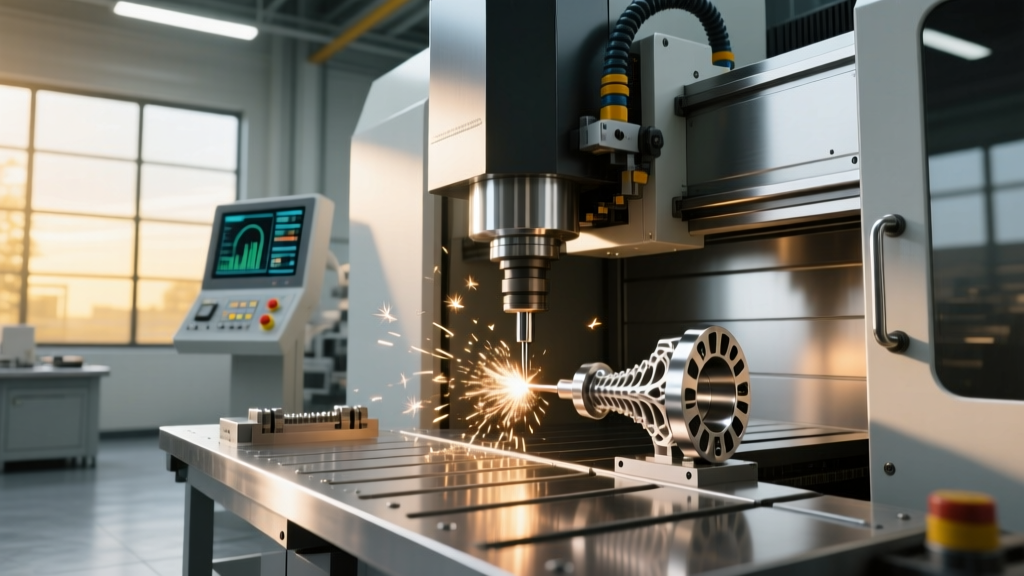
The facility invested in a Kern Micro HD, a specialized CNC milling machine tool featuring hydrostatic guideways and a 40,000 RPM spindle. Unlike traditional ball-screw drives, the hydrostatic system eliminates stick-slip friction, allowing for nanometer-level contouring accuracy required for the porous bone-ingrowth surfaces.
⚠️ Thermal Management Warning in Micro-Milling: When machining PEEK on high-speed CNC milling machine tools, spindle heat transfer can soften the polymer, causing the material to gum up micro-end mills. Shops must utilize chilled air blast systems (set to 38°F) rather than traditional flood coolant, which can cause PEEK to absorb moisture and swell post-machining, ruining the ±5µm tolerance.Tooling Integration Checklist for Medical Micromachining
- Toolholding: Upgrade to heat-shrink or high-precision collet chokers (runout < 3µm) to prevent micro-chatter.
- CAM Strategy: Implement trochoidal milling for slotting to maintain constant tool engagement and reduce radial cutting forces by up to 60%.
- Tool Coatings: Use AlTiN (Aluminum Titanium Nitride) coated carbide end mills for CoCr to withstand the 1,200°C+ localized cutting zone temperatures.
- In-Process Probing: Utilize spindle-mounted laser tool setters to check for micro-chipping on 0.5mm end mills between operations.
Following the integration of the hydrostatic CNC milling machine tools, the manufacturer's scrap rate plummeted from 14% to 1.8%, and cycle times for the finishing operations dropped by 42% due to the ability to take lighter, faster, chatter-free passes.
Framework: Calculating True ROI on CNC Milling Machine Tools
Many shops miscalculate ROI by only factoring in the machine's base price and cycle time reduction. A robust 2026 financial model for CNC milling machine tools must account for the total cost of ownership (TCO) and hidden integration expenses.
- Base Machine & Options: Include the cost of mandatory options like high-pressure coolant pumps ($18,000), chip conveyors ($8,500), and advanced probing packages ($6,200).
- Spindle Rebuild Intervals: A 20,000 RPM spindle typically requires a $22,000 rebuild at 10,000 to 12,000 hours. A 40,000 RPM spindle may cost $35,000+ to rebuild. Factor this into a 5-year depreciation model.
- CAM Programming Overhead: 5-axis simultaneous toolpaths require advanced CAM seats (e.g., Mastercam Multiaxis or hyperMILL) costing $12,000+ per license, plus 80-120 hours of programmer training.
- Floor Space & Power: Calculate the cost per square foot of your facility. A compact 5-axis machine might occupy 150 sq ft, while a 3-axis VMC with a rotary table and tombstone setup might require 220 sq ft, including operator clearance.
- Scrap Reduction Value: Multiply your annual part volume by the material cost and the historical scrap rate. A 10% reduction in scrap on $500 titanium forgings yields massive hidden ROI.
Strategic Sourcing for 2026 Production Floors
When evaluating CNC milling machine tools for the current production landscape, prioritize vendors that offer open-architecture CNC controls (like Siemens Sinumerik ONE or Heidenhain TNC7). These platforms allow direct integration with shop-floor IoT dashboards and adaptive machining sensors. As leading 5-axis manufacturers continue to push the boundaries of automation-ready architectures, ensuring your new machine tool can communicate seamlessly with robotic part loaders and CMM inspection feedback loops is no longer optional—it is the baseline for survival in high-mix, low-volume precision machining.