2026 Tech Trends Upgrading Your Small CNC Machine Wood Setup
Discover 2026 tech trends for your small CNC machine wood setup. Explore closed-loop motors, AI CAM software, and VFD spindle upgrades for desktop routers.
The Micro-Manufacturing Shift in Desktop Wood Routing
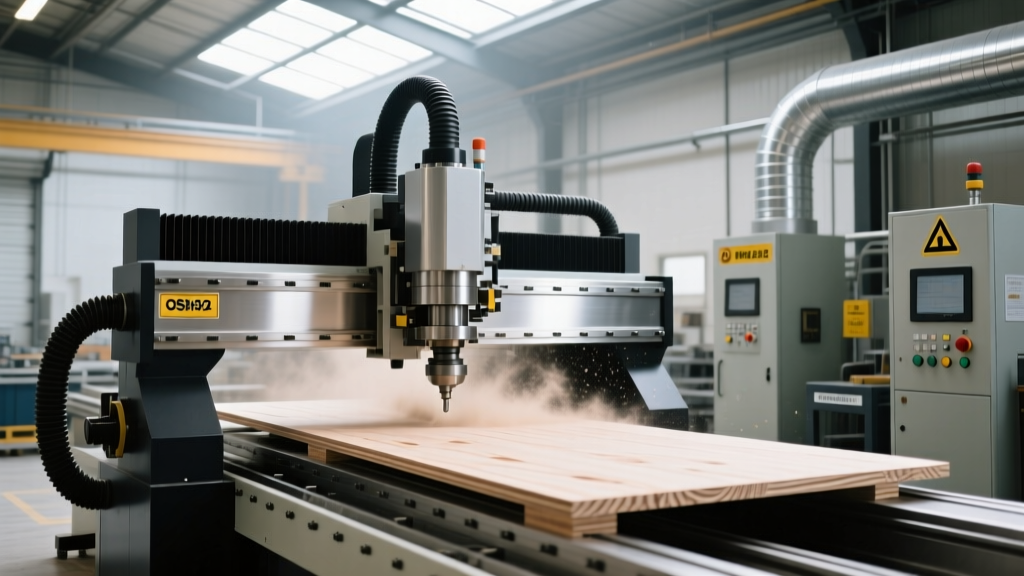
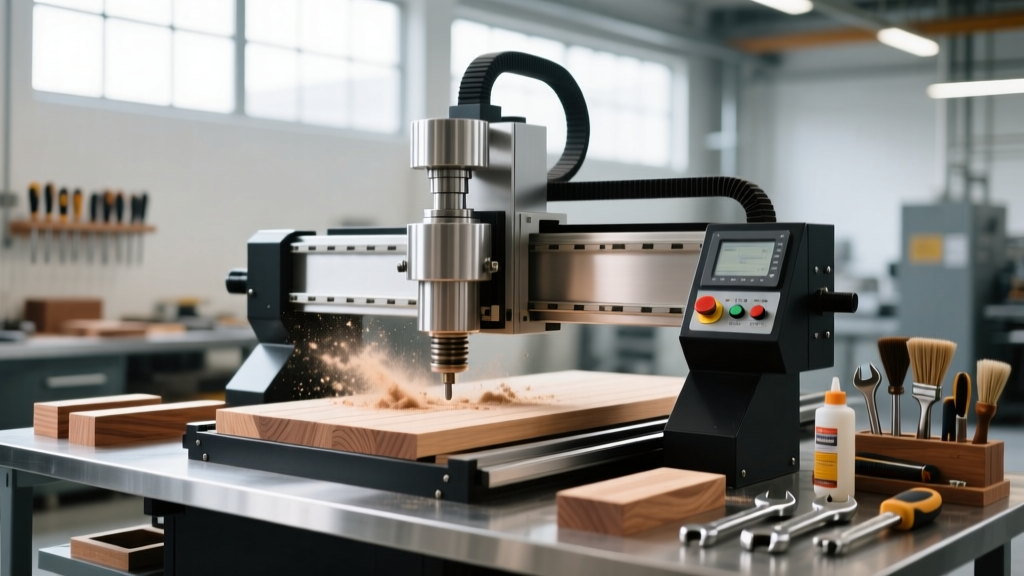
The landscape of desktop woodworking has fundamentally changed. Historically, a small CNC machine wood router was viewed as a hobbyist toy, limited to carving softwoods and plastics with trim routers. In 2026, machines with footprints under 4x4 feet are executing production-grade hardwood milling, driven by closed-loop motion control, AI-assisted toolpath generation, and micro-VFD spindle integration. The gap between a $3,000 benchtop router and a $40,000 industrial 5x10 table has narrowed significantly, provided operators leverage the latest hardware and software innovations.
2026 Innovation Snapshot:- Motion Control: Closed-loop NEMA 23 steppers eliminating lost steps in dense hardwoods.
- Software: AI-driven acoustic monitoring and adaptive feed-rate CAM.
- Spindles: 800W–1.5kW water-cooled VFDs replacing legacy trim routers.
- Workholding: Vacuum pod integration on small-format MDF spoilboards.
Closed-Loop Steppers: Conquering Hardwood Knots and Grain Reversals
The most critical failure point on legacy small-format CNCs is the open-loop stepper motor. When a 1/4-inch compression bit hits a dense knot in Hard Maple or encounters severe grain reversal in Walnut, the mechanical resistance spikes. Open-loop motors simply stall and lose steps, shifting the X or Y axis by fractions of a millimeter and ruining a four-hour carve.
In 2026, the integration of closed-loop stepper motors (such as the iSV57 series with integrated encoders) on small frames like the Sienci LongMill MK2 and custom retrofits has become standard for serious woodworkers. These motors constantly read the rotor position and adjust current on the fly. If the bit encounters a dense patch of Ipe or White Oak, the encoder detects the micro-stall and instantly ramps torque to compensate, preventing lost steps without the heat generation and resonance issues associated with traditional NEMA 23 drivers.
Real-World Milling Parameters with Closed-Loop Systems
With closed-loop assurance, operators can safely push chipload limits on small machines. For example, milling 3/4-inch Baltic Birch plywood with an Onsrud 57-910 compression bit at 18,000 RPM previously required a conservative feed rate of 90 IPM (inches per minute) on open-loop desktop routers to prevent stalling. With closed-loop steppers and a rigid linear rail Z-axis, feed rates can be safely increased to 160 IPM, reducing cycle times by nearly 40% while maintaining a flawless shear cut on both the top and bottom veneers.
AI-Driven Toolpaths and Acoustic Wear Monitoring
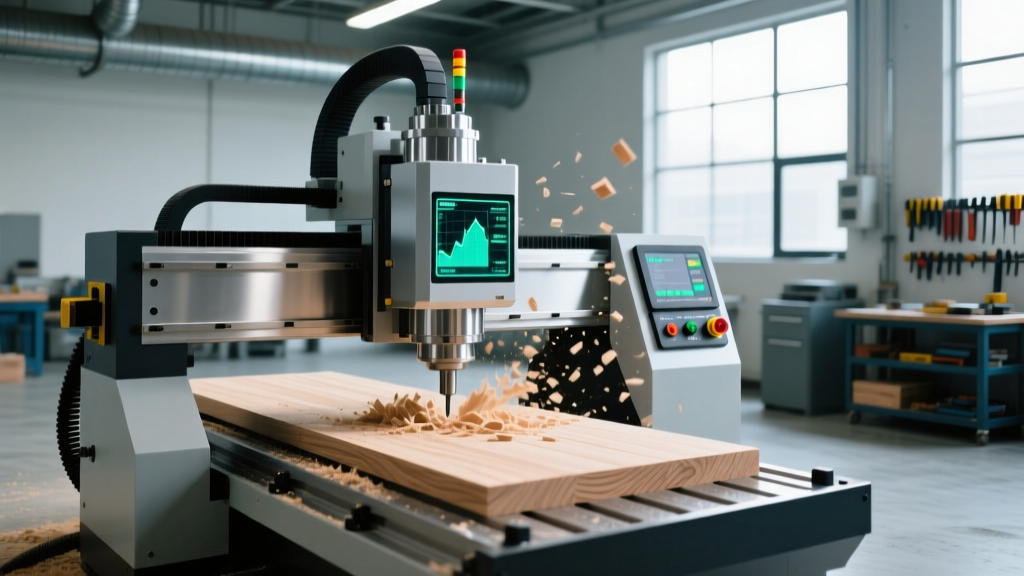
Software has evolved beyond static G-code generation. Modern CAM platforms now utilize AI to analyze tool engagement angles and adjust feed rates dynamically. When machining complex 3D topographical maps in cherry or mahogany, the software automatically slows the feed rate during high-engagement cornering and accelerates through straight, low-engagement passes. This prevents the tool from deflecting and leaving chatter marks on the wood surface.
| CAM Feature (2026) | Functionality | Woodworking Benefit |
|---|---|---|
| Adaptive Clearance | AI calculates optimal trochoidal toolpaths based on bit geometry. | Prevents burning in resinous woods like Pine by maintaining constant chipload. |
| Acoustic Wear Alerts | Monitors spindle motor current draw and vibration frequencies. | Alerts operator to dulling endmills before they scorch expensive hardwoods. |
| Grain-Direction Mapping | Allows user to input board grain angle; alters climb/conventional cuts. | Eliminates tear-out on highly figured woods like Birdseye Maple. |
Spindle Upgrades: The Death of the Trim Router
For years, the Makita RT0701C and DeWalt 611 trim routers were the default powerplants for small CNC machine wood setups. While adequate for occasional sign-making, their universal motors lack the low-end torque required for deep pocketing, and their collets exhibit up to 0.004 inches of runout, leading to premature bit wear and poor edge finishes.
The 2026 standard for production-grade desktop routing is the 800W to 1.5kW water-cooled VFD (Variable Frequency Drive) spindle. Machines like the Shapeoko 5 Pro and heavily modified X-Carves now frequently feature these spindles. A VFD spindle maintains consistent torque from 8,000 to 24,000 RPM, allowing operators to drop the RPM to 12,000 for large-diameter spoilboard surfacing fly cutters without stalling the motor. Furthermore, ER20 collets on these spindles reduce runout to less than 0.0005 inches, drastically extending the life of $40 carbide compression bits.
Warning: Static Discharge and Dust ExtractionUpgrading to a high-speed VFD spindle and routing MDF or dry oak generates immense static electricity. On small, non-grounded aluminum extrusion frames, this static can discharge through the spindle bearings, causing fluting damage that destroys the spindle in months. Always install a copper grounding brush dragging on the spoilboard, connected to a dedicated earth ground, and use anti-static PVC dust collection hose rather than standard corrugated plastic.
2026 Hardware Matrix: Top Small-Format Wood CNCs
Selecting the right machine requires matching the structural rigidity and motion control to your specific woodworking output. Below is a technical comparison of the leading small-format machines currently dominating the micro-manufacturing space.
| Machine Model | Max Footprint | Motion System | Z-Axis Rigidity | Approx. 2026 Price |
|---|---|---|---|---|
| Shapeoko 5 Pro (4x4) | 48' x 48' | Linear Rails (All Axes) | Heavy-duty Linear Rail | $2,999 |
| Onefinity Foreman | 48' x 48' | Ball Screws (X/Y) | 16mm Shaft + Lead Screw | $4,199 |
| Sienci LongMill MK2 (48x30) | 48' x 30' | Lead Screws + V-Wheels | Dual-Motor Z-Axis | $1,799 |
Note: Pricing reflects base router kits. Adding a 1.5kW VFD spindle and touch probe typically adds $600–$900 to the final investment.
Actionable Retrofit Guide for Legacy Small CNCs
If you are operating an older open-loop, belt-driven small CNC machine wood router built between 2018 and 2022, you do not need to purchase a new machine to achieve 2026 tolerances. Follow this targeted upgrade path to eliminate chatter and improve hardwood edge finishes:
- Upgrade the Z-Axis First: The Z-axis is the most prone to deflection during plunge cuts. Replace the standard lead screw and NEMA 23 motor with a 1610 ball screw and a closed-loop stepper motor. This single upgrade eliminates Z-axis backlash, ensuring your V-carving depth remains perfectly consistent across a 4-foot board.
- Install a Precision Collet Nut: If you are still using a trim router, discard the stock collet nut. Purchase a precision ER11 collet nut with a thrust bearing (often marketed as 'precision torque nuts'). This reduces bit runout by up to 50%, instantly improving the surface finish on end-grain cuts.
- Implement Software Probing: Wood is rarely perfectly flat. Invest in a touch probe (such as the Carbide 3D BitZero V2) and utilize surface mapping features in your CAM software. This allows the router to map the exact topography of your warped lumber and adjust the Z-height dynamically, ensuring consistent engraving depth without cutting through the veneer on high spots.
- Stiffen the Gantry with Tensioning: Add 1/4-inch steel or aluminum backing plates to the Y-axis gantry uprights. On extruded aluminum frames, torsional twist during aggressive X-axis direction changes causes 'ghosting' or echos in the cut. Stiffening the uprights reduces this harmonic vibration, allowing for 20% faster rapid traverse speeds.
'The limitation in small-format woodworking is rarely the machine's footprint; it is the operator's willingness to manage chipload, harmonic resonance, and tool deflection. A properly tuned 4x4 closed-loop machine will out-produce a poorly maintained industrial 5x10 table every single day.'
— Advanced Desktop Manufacturing Journal, 2026 Toolpath Analysis Report