CNC Engraving Machine for Wood: Complete Maintenance Schedule
Maximize uptime and precision with our detailed maintenance schedule for a CNC engraving machine for wood. Covers spindles, rails, and dust extraction.
The Hidden Cost of Neglecting Wood CNC Maintenance
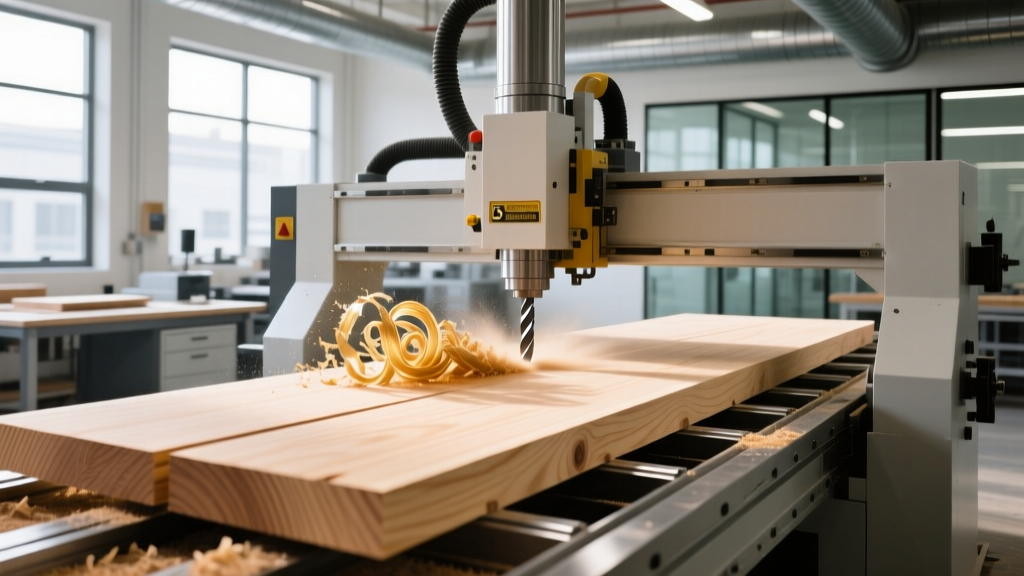
Operating a cnc engraving machine for wood subjects the equipment to a uniquely hostile environment. Unlike metalworking, where coolant washes away chips, wood machining generates massive volumes of fine, abrasive particulate. Medium-density fiberboard (MDF) dust acts like microscopic sandpaper, while hardwoods like oak and maple produce dense chips that can jam linear bearings. As of 2026, replacing a high-frequency HSD ES929 spindle costs between $2,800 and $3,500, whereas a comprehensive annual maintenance budget for a standard 4x8 router rarely exceeds $400. Implementing a rigid, interval-based service schedule is the only way to protect your capital investment and maintain the tight tolerances required for fine woodworking and cabinetry.
⚠️ Critical Warning: The MDF Moisture TrapMDF dust is highly hygroscopic, meaning it absorbs moisture from the ambient air. When this dust infiltrates unsealed linear bearings or ball screws, it forms a concrete-like paste that rapidly destroys recirculating ball bearings. If your shop processes MDF, daily dust extraction and weekly bearing purges are non-negotiable. Refer to the OSHA Woodworking Guidelines for mandatory dust collection and respiratory safety standards.
Daily Operator Protocols (Shift Start & End)
Daily maintenance on a wood CNC router is less about lubrication and more about particulate management and tooling inspection. These tasks should take no more than 10 minutes per shift but prevent 80% of catastrophic tooling failures.
Collet and Nut Decontamination
Wood resin and fine dust accumulate inside the ER32 or ER40 collet and the spindle nut. If left uncleaned, this buildup prevents the collet from closing concentrically, introducing severe runout.
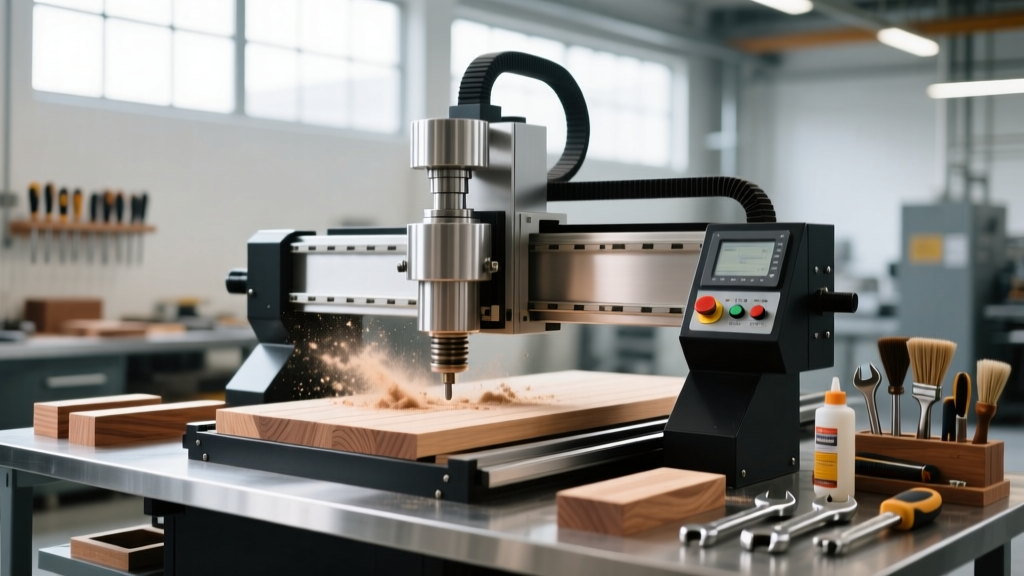
- Action: Remove the collet and nut. Use a brass-bristle brush and a specialized solvent like WD-40 Specialist Contact Cleaner or high-purity isopropyl alcohol to dissolve resin.
- Inspection: Check the collet for galling or scoring on the internal slits. A worn ER32 collet will slip during heavy 2D profiling, snapping end mills.
- Cost of Failure: A $45 precision collet prevents the destruction of $150 solid carbide compression bits and prevents spindle taper damage.
Dust Boot and Brush Inspection
The bristles on your spindle dust boot must maintain contact with the workpiece. If the bristles are worn down by more than 20%, the static pressure from your dust collector (measured in CFM) will bypass the cutting zone, allowing dust to migrate to the Z-axis lead screw.
Weekly & Bi-Weekly Lubrication and Drive Checks
Weekly servicing transitions from cleaning to active mechanical preservation. The linear motion systems on a cnc engraving machine for wood require specific lubricants; using the wrong product is a common and expensive mistake.
Linear Guide Rail Purging and Greasing
Most industrial wood routers utilize Hiwin HGR20 or THK SRG20 linear guide rails. These feature recirculating ball bearings that must be purged of wood dust and re-lubricated.
- Wipe Down: Use a lint-free microfiber cloth to wipe the exposed rail surfaces. Never use compressed air, as it forces fine dust past the bearing seals.
- Apply Grease: Use a NLGI Grade 2 lithium-based grease (such as Mobilux EP2 or Kluber Isoflex). Apply it directly to the grease nipple on the bearing carriage using a manual grease gun.
- Cycle the Axis: Jog the axis back and forth across its full travel to distribute the grease internally and push out contaminated grease from the wiper seals.
Never use aerosol WD-40 or lightweight machine oil on linear rails. These solvents strip the factory-applied heavy grease and leave the bearings dry, leading to failure within weeks.
Monthly & Quarterly Mechanical Inspections
Monthly and quarterly intervals focus on verifying geometric accuracy and checking for wear in high-load components like the Z-axis ball screw and drive belts.
Z-Axis Ball Screw Backlash Verification
The Z-axis on a wood CNC router carries the entire weight of the spindle assembly and experiences constant directional changes during 3D carving.
- Test: Mount a dial indicator with a magnetic base to the spoilboard. Jog the Z-axis down to touch the indicator, zero it, jog up 1.000 inch, and jog back down to the exact same coordinate.
- Tolerance: Acceptable backlash is under 0.001" (0.025mm). If the indicator reads a variance greater than this, the ball nut preload needs adjustment, or the thrust bearings at the top of the Z-axis column are failing.
Spindle Runout and Bearing Health
High-frequency spindles (typically 18,000 to 24,000 RPM) rely on precision angular contact bearings. According to bearing lifecycle data from SKF Rolling Bearings, the L10 life of these bearings is heavily dependent on load and contamination.
"The operational life of high-precision spindle bearings is inversely proportional to the cube of the load. Even a minor increase in radial load caused by excessive tool runout can reduce bearing life by over 50%."Measure runout at the tool tip using a high-precision dial indicator. Total Indicated Runout (TIR) should not exceed 0.0005" (0.012mm). If runout exceeds 0.001", the spindle bearings are pitted and require professional rebuilding.
Annual Overhaul: Electrical and Calibration
Once a year, the machine requires a deep dive into its electrical cabinets and structural geometry. Wood dust is an excellent insulator and can cause Variable Frequency Drives (VFDs) and stepper/servo drives to overheat and fail.
Control Cabinet Thermal Management
Vacuum the interior of the electrical enclosure using a soft brush attachment. Inspect the cooling fans on the VFD and servo amplifiers. Replace any fan that exhibits bearing noise or reduced airflow. Check all terminal block screws with a torque screwdriver; thermal cycling over 12 months causes wire connections to loosen, leading to voltage drops and erratic axis movements.
Geometric Squaring and Tramming
Wood expands and contracts with seasonal humidity changes, which can subtly shift the machine's gantry alignment. Use a precision machinist square and a tramming tool to verify that the spindle is perfectly perpendicular to the spoilboard in both the X and Y planes. A misalignment of just 0.002" over a 6-inch sweep will leave visible scallop marks on flat surfaced hardwood panels, ruining the finish quality.
Comprehensive Maintenance Matrix
Use the following matrix to build your shop's standard operating procedures (SOPs). Assign specific technicians to each task and log completion in a digital maintenance management system.
| Interval | Component | Action Required | Material / Tool | Cost of Neglect |
|---|---|---|---|---|
| Daily | Collet & Nut | Clean resin and dust | Brass brush, Contact Cleaner | $150+ broken end mills |
| Weekly | Linear Rails (X/Y) | Purge and re-grease carriages | NLGI Grade 2 Lithium Grease | $800 per rail carriage |
| Monthly | Z-Axis Ball Screw | Check backlash, clean bellows | Dial indicator, Lint-free cloth | Poor 3D carving accuracy |
| Quarterly | Spindle Taper | Measure TIR runout | 0.0005" Dial Indicator | $3,500 spindle replacement |
| Annual | Electrical Cabinet | Vacuum dust, torque terminals | Soft brush vacuum, Torque driver | $1,200 VFD failure / fire risk |
| Annual | Gantry Geometry | Tram spindle to spoilboard | Tramming tool, Feeler gauges | Visible scallop marks on panels |
Optimizing Dust Collection for Machine Longevity
Maintenance of the cnc engraving machine for wood extends beyond the machine itself to the dust collection infrastructure. A standard 4-inch dust port on a CNC spindle requires a minimum of 800 CFM at 4 inches of static pressure to effectively capture heavy hardwood chips and fine MDF particulate. If your ducting features corrugated flexible hose, replace it with smooth-walled PVC or spiral metal pipe. Corrugated hose creates turbulence that drops static pressure by up to 30%, allowing abrasive dust to settle on the machine's lead screws and linear guides. Investing $300 in rigid ducting pays for itself by extending the life of your linear motion components by years.